This piece transforms a mundane annual ritual into a life-or-death medical emergency, arguing that the arbitrary shift of daylight saving time is not merely an inconvenience but a physiological trigger for cardiac events. Rohin Francis constructs a compelling narrative linking the disruption of our internal clocks to the rupture of arterial plaque, offering a stark, evidence-based reason to question a policy long defended by outdated economic logic.
The Human Cost of an Hour
Francis begins by grounding the abstract concept of time change in the visceral reality of a patient named Casey, a 79-year-old man whose heart attack unfolds in real-time. "Casey is a 79 year old man presenting to the emergency room with chest pain radiating to his left jaw," Francis writes, immediately establishing the stakes. The author uses this case study not just to illustrate symptoms, but to map the biological cascade that turns a sleepless night into a blocked artery. He explains that while Casey had pre-existing conditions like diabetes, the sudden time shift acted as the catalyst. "The extra disruption in circadian rhythm significantly changes which genes are expressed in our body," Francis notes, highlighting the molecular scale of the impact. This framing is powerful because it moves the conversation from "feeling tired" to "cellular dysfunction," forcing the reader to confront the biological reality of the policy.
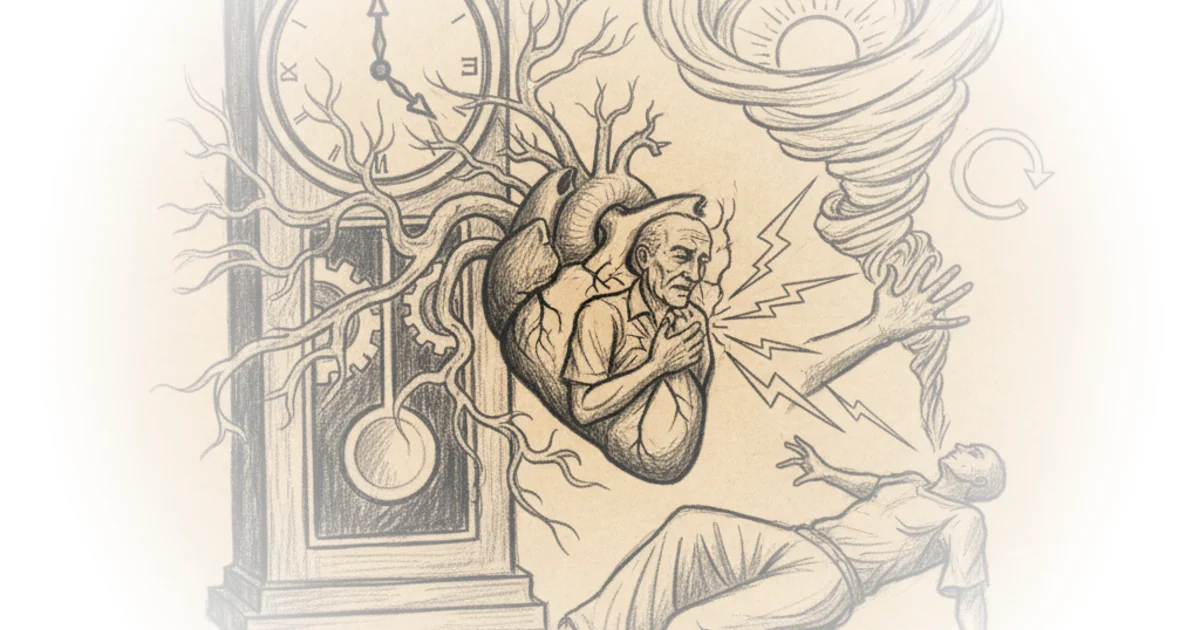
The narrative meticulously details how sleep deprivation and circadian misalignment create a perfect storm for heart disease. Francis paraphrases decades of research on night-shift workers to show that the body struggles to regulate blood sugar and inflammation when its internal clock is thrown off. "Sleep deprivation increases inflammation," he writes, connecting the dots between a lost hour of rest and the systemic stress that weakens arterial walls. This is a crucial distinction: the article doesn't claim the time change causes heart disease in healthy people, but rather that it is the "straw that breaks the camel's back" for those already vulnerable. Critics might note that the data on heart attacks post-time change is sometimes correlational rather than definitively causal, and that individual susceptibility varies wildly. However, Francis effectively argues that even a small statistical increase in a high-risk population represents a significant public health burden.
Every year there's a lot more people that are entering in that 65 and up demographic because of the baby boomer generation. These are the ones who are going to get hit the hardest by this.
The Mechanism of Rupture
Moving from the patient to the pathology, Francis dissects the medical mechanics of an ST-elevation myocardial infarction with remarkable clarity. He describes how diabetes and high cholesterol lead to the formation of plaque, a buildup of fat and dead white blood cells within the artery. The critical moment, he explains, is when inflammation causes this plaque to rupture. "The chemicals released by the immune cells during inflammation in and around the plaque break down that fibrous cap," Francis writes, vividly describing the moment the artery's defense system fails. He then connects this biological fragility directly to the stress of the time change, noting that the shift "inflicts signal changes disrupting sleep increasing inflammation decreasing insulin sensitivity causing a cascade of metabolic derangements."
The author's choice to explain the medical procedure—percutaneous coronary intervention—in plain language serves to underscore the severity of the event. He describes how doctors must physically pop the vessel open with a balloon and insert a stent to restore blood flow. This technical detail reinforces the argument that the damage is structural and immediate, not just a matter of feeling groggy. "As each minute passes by parts of Casey's heart keep dying," Francis writes, emphasizing the urgency that the time change inadvertently accelerates. The argument here is that the policy ignores the biological cost of forcing hundreds of millions of people to adapt their sleep schedules overnight.
The Evidence and the Verdict
Francis anchors his argument in specific epidemiological data, citing studies from Sweden and Michigan that show a spike in heart attacks following the spring time change. "Data shows an increase in heart attacks in the days right after the one hour forward," he writes, contrasting this with the autumn change where incidents actually decrease. This asymmetry is a key piece of evidence: losing an hour of sleep is physiologically different from gaining one. The author points out that the spring equinox is already a time of natural seasonal adjustment for the body, and the arbitrary one-hour shift forces an additional, unnatural adaptation. "Young people can tolerate these changes but elderly with pre-existing conditions likely cannot handle this," Francis observes, pinpointing the demographic most at risk.
The piece concludes with a clear policy recommendation rooted in health outcomes rather than energy savings. Francis argues that the minimal economic benefits of daylight saving time do not justify the health risks. "I would prefer that we stay on standard time all year from a health standpoint," he states, a direct challenge to the status quo. This is the article's strongest move: shifting the debate from "does it save energy?" to "does it kill people?" While some policymakers might argue that the health data is not yet robust enough to warrant legislative change, the sheer volume of mechanistic evidence Francis presents makes the status quo increasingly difficult to defend.
Bottom Line
Rohin Francis delivers a masterclass in medical storytelling, successfully translating complex pathophysiology into a compelling argument for policy reform. The piece's greatest strength is its ability to make the invisible visible, showing how a one-hour clock change triggers a chain reaction of inflammation and plaque rupture. Its only vulnerability lies in the political inertia required to change a law that has stood for nearly a century, but the medical evidence presented here provides a formidable case for the administration to reconsider the practice. The reader is left with a clear understanding that for millions of Americans, the spring time change is not a harmless tradition, but a preventable health hazard.