Brad DeLong uncovers a profound intellectual tragedy: the architect of modern economics spent his final decades dismantling his own life's work, only to be ignored by the very profession he built. This is not a standard history of ideas; it is a forensic examination of how a "cathedral" of neoclassical theory was constructed on foundations its creator later admitted were "not very helpful." For busy leaders navigating a world of volatile markets and political instability, DeLong's analysis of why our economic tools fail to capture reality offers a critical warning about the limits of technical solutions.
The Architect of a Flawed Cathedral
DeLong begins by establishing John Hicks not as a distant academic, but as the "most technically accomplished British economist of the twentieth century." He credits Hicks with forging the "coherent analytical framework that generations of economists would inhabit as though it were simply the way things must be." This framework includes the IS-LM model, which DeLong notes has become the "backbone of macroeconomics teaching for fifty years," and the Kaldor-Hicks welfare criterion, which shaped global policy from the 1940s onward.
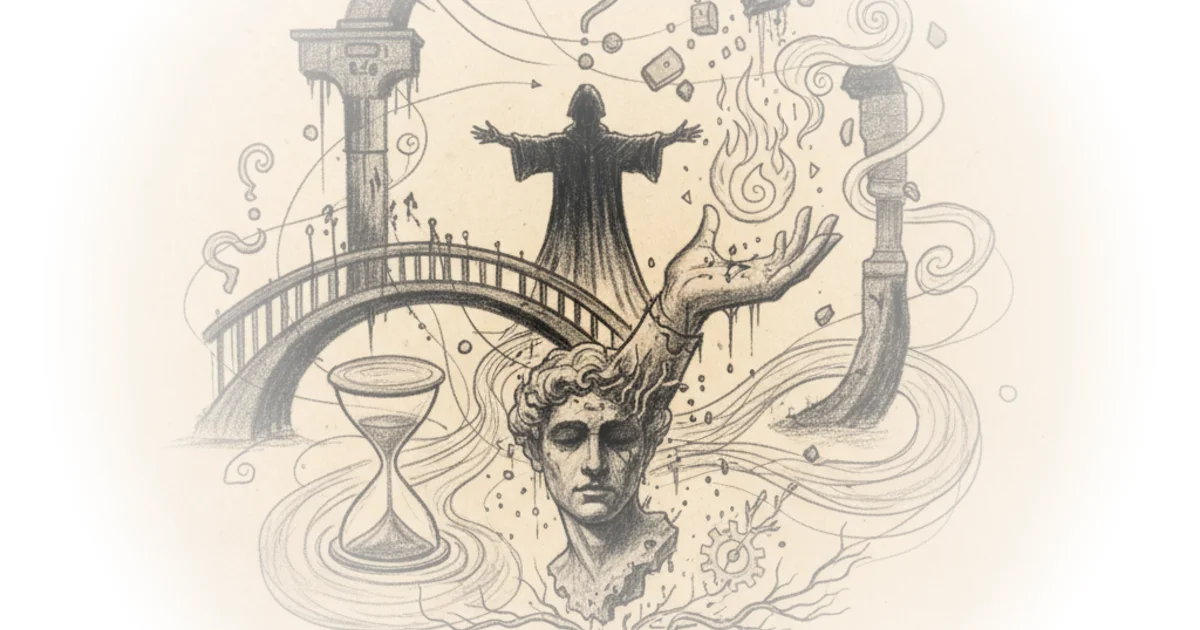
The striking claim here is that Hicks, in his later years, engaged in a quiet "apostasy." DeLong writes, "He spent the last quarter of his life trying to explain to people why the cathedral was, at its foundations, not very helpful." This reframing is powerful because it shifts the blame for current economic failures away from the original architects and toward the profession's refusal to listen to their creator's second thoughts. DeLong draws a parallel to Julian the Apostate, the last pagan emperor of Rome, noting that while Julian failed to reverse the Christianization of the empire, his vision of what was lost remains clear. Similarly, Hicks saw that his own models had suppressed the "tragic uncertainty" and "optionality-uncertainty of historical time" that define real-world economics.
"The IS-LM diagram... is not meant to be a synopsis of the General Theory... It was 'a classroom gadget' that had been 'read back' into Keynes's text in ways Keynes would not have recognized."
This admission is devastating because it reveals that the standard textbook model of the economy was never intended to be the whole story. DeLong argues that the model lost "time, sequence, optionality, revision," and crucially, the "essential Keynesian insight" that coordinating expectations in a world of genuine uncertainty may be "genuinely impossible." The framework turned a radical political argument about the instability of capitalism into a manageable technical problem of "aggregate demand management."
Critics might argue that simplifying complex theories for teaching purposes is a necessary evil, and that the IS-LM model remains a useful heuristic even if it is not a perfect representation of reality. However, DeLong suggests that when these simplifications are treated as the absolute truth, they blind policymakers to the very risks that cause crises.
The Cost of "Potential" Improvements
The commentary then pivots to the Kaldor-Hicks welfare criterion, the intellectual engine behind modern cost-benefit analysis. DeLong explains that this criterion declares a policy an improvement if the winners could compensate the losers, even if they never actually do. He describes this as a "monstrous parody of what welfare economics should be."
"The gap between 'could' and 'did' is the gap between theory and the world in which human beings actually live, and in that gap live the actual losers of every trade liberalization, every factory closure, every 'efficiency-enhancing' reform."
DeLong's analysis here is particularly sharp for anyone involved in public policy. He points out that the criterion became the "philosopher's stone of a particular kind of economic liberalism," providing an intellectual warrant for policies that upend lives as long as the aggregate numbers look positive. Hicks realized that by focusing on "potential" Pareto improvements, the profession had provided a formal apparatus to "look away" from the people whose lives were materially worsened by efficiency gains.
This section resonates with the historical concept of "temporary equilibrium," where markets clear in the present but actors hold divergent expectations about the future. DeLong notes that while Hicks glimpsed this in his early work, he later concluded that the irreversibility of time meant that "you cannot uninvest. You cannot un-hire. You cannot un-commit." Once a decision is made, the future it presupposes either arrives or does not, and the option value of keeping futures open is lost.
"The entire apparatus of neoclassical general equilibrium... was built for a world without real time — which is to say, a world that does not exist."
This is the core of DeLong's argument: the tools we use to govern the economy are designed for a static, reversible world that never existed. The "sequential analysis" Hicks advocated for in his later years—acknowledging that economic history is path-dependent and irreversible—was largely ignored.
The Silence of the Profession
Why did the profession ignore its own architect? DeLong suggests that the "cathedral" Hicks built was simply too large and too useful to be dismantled by the "second thoughts of one of its own architects." He notes that while it is common to blame "neoclassical economics" for the 2008 financial crisis and the subsequent stagnation, the specific doctrines that blocked regulation were not Hicks's. Instead, he points to the influence of Milton Friedman and various conservative think tanks.
"Hicks's apostasy... sprung not from the fact that the policy questions and options that grew out of his version of the neoclassical synthesis were destructive, but out of the fact that it offered little purchase against the obstacles that needed to be overcome to make further progress."
DeLong's verdict is sobering: Hicks was right, but he was "too late." The intellectual inertia of the profession was too strong. The "patient prose of a very old man" could not overcome the entrenched training and practice of a generation of economists who had learned to see the world through the very lens Hicks had come to reject.
"He was right. He was too late. The cathedral he had helped build was too large, too useful, too deeply embedded in the training and practice of too many economists to be dismantled by the second thoughts of one of its own architects."
This failure of institutional memory is the most dangerous legacy of the Hicksian synthesis. By treating uncertainty as manageable and time as reversible, the economic establishment lost the ability to see the structural fragility of the system until it was too late.
Bottom Line
DeLong's most compelling contribution is his defense of Hicks against the blanket condemnation of neoclassical economics, isolating the specific failure: the profession's refusal to update its models to account for historical time and genuine uncertainty. The argument's vulnerability lies in its reliance on the assumption that Hicks's late-career insights could have realistically altered the trajectory of a globalized, politically charged economic orthodoxy. The reader must watch for how current institutions are grappling with the "irreversibility" of climate change and supply chain shocks—problems that demand the very "sequential analysis" Hicks championed but which modern models still struggle to capture.