Claire Berlinski delivers a searing indictment of a specific strain of academic thought that treats Russian aggression as a rational reaction to Western provocation rather than imperial ambition. In a landscape often dominated by cautious geopolitical hedging, she argues that this "Russialism" is not just intellectually dishonest but morally bankrupt, effectively serving as a propaganda arm for the Kremlin. For listeners tracking the erosion of global security, this piece is a vital warning: the cost of appeasement is not peace, but the normalization of atrocities that will eventually engulf the entire continent.
The Anatomy of Intellectual Malpractice
Berlinski opens by dismantling the popular joke about three scholars watching a country invaded, noting that the punchline has become a grim reality. She identifies a chorus of experts who rush to explain away mass atrocities, arguing that "responsibility is diluted, tired tropes and equivocation recited, and restraint is demanded not of the attacker, but of the victim." This framing is crucial because it shifts the burden of proof onto the aggressor's apologists, forcing them to confront the human cost of their theories. The author contends that these scholars, often labeled as realists, have abandoned the discipline's core tenets of national interest and power balancing in favor of a perverted logic she calls "Russialism."
"Their version of 'realism' operates with a shameless double standard. It explains, if not outright justifies, Russian aggression as an understandable reaction to NATO 'expansion' or Western 'encirclement,' threats that exist only in the Kremlin's imagination and on these scholars' op-ed pages."
Berlinski's critique here is sharp and historically grounded. She points out that the narrative of NATO expansion ignores the agency of Eastern European nations that "stampeded toward the alliance the moment they could" to escape Russian domination. By stripping these nations of their choices, the "realists" engage in what she calls "callous moral evasion dressed up as sophistication." The argument holds weight because it highlights a fundamental asymmetry: the West hesitated to arm Ukraine for a decade, while the invaded nation begged for protection. To suggest the victim is the aggressor in this dynamic is not just wrong; it is a distortion of reality that enables further violence.
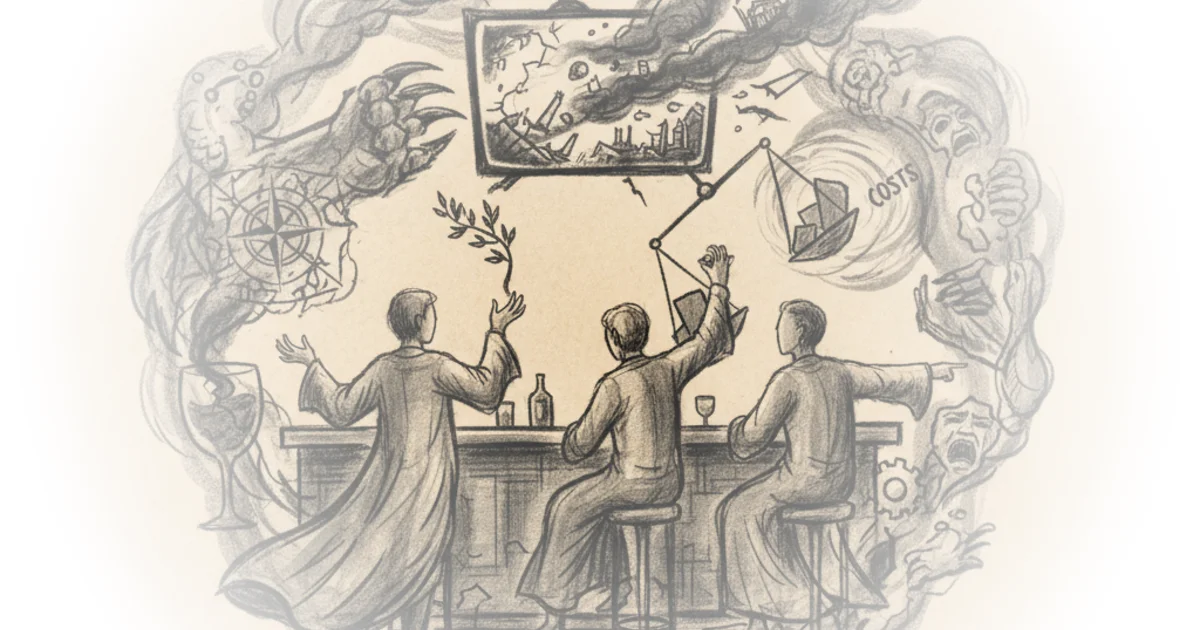
Critics might argue that understanding an adversary's perceived security concerns is essential for de-escalation, regardless of whether those concerns are valid. However, Berlinski counters that this approach has consistently failed, noting that "unpunished evil grows" and that the pattern of aggression has only accelerated.
The Cult of Stability and the Myth of Great Power
The piece then dissects the obsession with "stability" that drives these academic arguments. Berlinski argues that this version of stability is a euphemism for accepting conquest and freezing conflicts in a way that rewards violence. She writes, "'Peace at any cost' is the most dangerous oxymoron in circulation." This is a powerful rhetorical move that exposes the hollowness of a peace built on the subjugation of others. The author suggests that the realists' desire for a frozen conflict ignores the inevitable escalation that follows, as the aggressor simply regroups for a larger war.
"If aggression pays, the war expands."
Berlinski also tackles the "Great Power" mantra, a recurring theme in foreign policy circles that treats Russia as a peer competitor deserving of special deference. She dismantles this by pointing to Russia's economic and demographic collapse, noting that "Russia's GDP is smaller than that of Texas." The author argues that a true great power leads in culture, science, or technology, none of which Russia currently does. Instead, she describes a nation in decay, dependent on illicit operations and the import of weapons from Iran and North Korea. This evidence effectively challenges the notion that Russia is a rational actor capable of a "Reverse Kissinger" deal to peel it away from China.
"Russia is a quintessential empire in demographic decline, with an economy built on extraction and rent, and a political model that doesn't know how to manage a peaceful transfer of power and cannot legitimate itself without violence and conquest."
The author's assertion that Russia is an empire pretending to be a nation-state is particularly compelling. She argues that without an external enemy to mobilize against, the Russian state loses its coherence. This structural necessity for war explains why diplomatic off-ramps are unlikely to work; the regime's survival depends on the very aggression it claims to be managing. Critics might suggest that even a declining empire poses a nuclear threat that cannot be ignored, but Berlinski's point is that treating it as a rational partner only accelerates its descent into chaos and dependency on Beijing.
The Human Cost of Abstraction
Throughout the piece, Berlinski refuses to let the reader hide behind abstract geopolitical concepts. She brings the focus back to the human reality of the invasion, noting that the "Putinverstehers" imply that the world has no choice but to accept that Russia will "murder Ukrainian children in the middle of the night and steal them." This stark language is necessary to counter the sanitized, academic tone of the apologists. The author reminds us that the "sphere of influence" argument is a justification for the permanent denial of agency to entire societies.
"Fool me once, shame on you. Fool me twice, shame on me. But Russia has, apparently, earned the right to fool the same experts indefinitely."
This observation cuts to the heart of the intellectual failure Berlinski is describing. The repeated failure to learn from history—from Chechnya to Georgia to Crimea—suggests a willful blindness that is more dangerous than ignorance. The author warns that failing to confront this aggression now guarantees more of it later, with costs that will be "exponentially higher, and the options far worse."
"Only the willfully blind miss this."
Bottom Line
Berlinski's strongest contribution is her unflinching exposure of the moral bankruptcy behind the "realist" defense of Russian aggression, proving that what is often sold as sophisticated statecraft is actually a form of intellectual malpractice. The argument's vulnerability lies in its reliance on the assumption that the West will eventually wake up to the threat, a hope that may be fading as domestic political fractures grow. Readers should watch for how this critique of the "Putinverstehers" influences the next generation of foreign policy analysts, or if the cycle of appeasement continues until the security order collapses entirely.