In an era where digital content is often treated as a commodity to be hoarded, Jeannine Ouellette makes a radical claim: that the most effective strategy for a writer's survival is not protectionism, but radical, unguarded generosity. This piece moves beyond standard advice on networking to argue that the ethics of how we treat other writers are inextricably linked to the quality of our own creative output, framing literary citizenship not as a polite obligation but as a spiritual necessity.
The Architecture of Abundance
Ouellette begins by dismantling the scarcity mindset that plagues the creative industries. She argues that the tension between protecting one's intellectual property and sharing it freely is a false dichotomy. "It's not so much an effort to be virtuous as it is an effort to be happy, because I've simply found, over and over, that my life is simply better—much better—when I operate this way," she writes. This reframing is potent because it shifts the motivation from moral superiority to personal well-being. The author posits that her own prolific output at Writing in the Dark is fueled by a willingness to share hundreds of posts for free, a strategy that defies the conventional wisdom of gatekeeping knowledge.
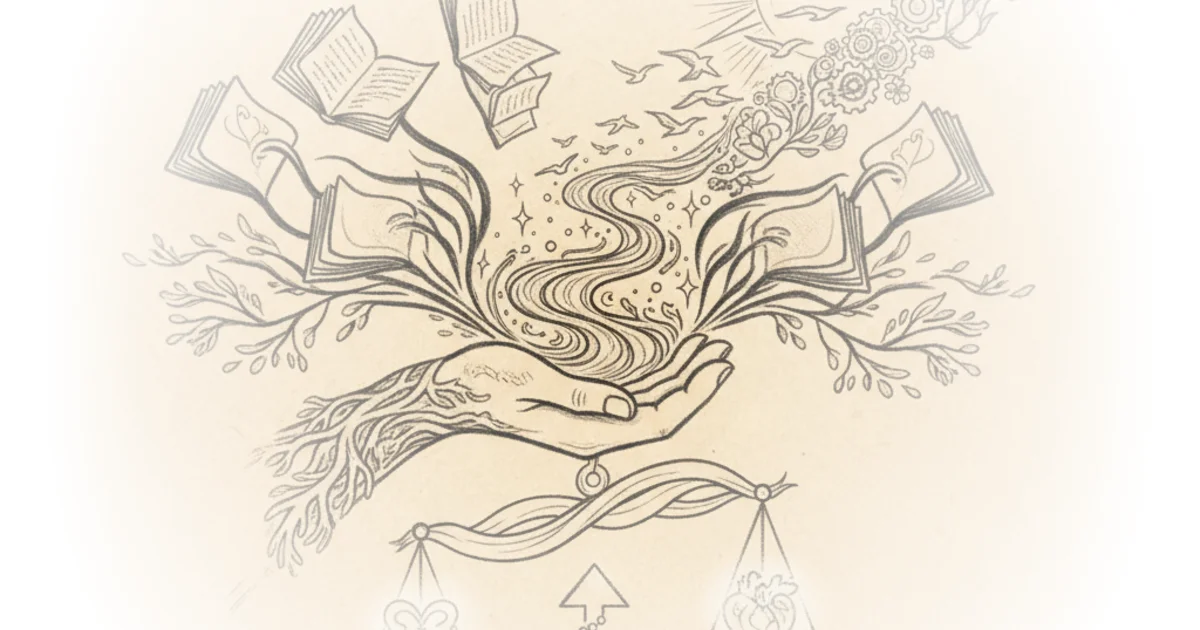
The core of her argument rests on the idea that creativity is a cumulative, communal act rather than a solitary genius moment. She details her own development of a process called "shimmers and shards," a method for paying attention that she openly credits to predecessors like Pam Houston and Marie Howe. "I have never studied with Pam or Marie, nor do either of them have a craft book published. But I know about their practices from reading online interviews and craft essays about their teaching, which has inevitably influenced mine," Ouellette notes. This admission serves as a practical demonstration of her thesis: ideas travel through the ecosystem, and acknowledging that flow strengthens the community. It is a stance that resonates with the spirit of the Oulipo movement, where writers in the 1960s famously embraced constraints and borrowed structures to generate new forms, proving that limitation and borrowing can be engines of innovation rather than theft.
To have, give all to all. This tenet appears in the teachings of virtually every spiritual tradition around the world since the dawn of time.
Critics might argue that in a hyper-competitive market, giving away one's "keys to the kingdom" risks diluting a writer's unique value proposition. However, Ouellette counters this by suggesting that the fear of being copied is a symptom of a deeper insecurity about one's own originality. She writes, "Writing is not a competition. It is a holy creative act through which we remake ourselves and the world and it should be treated as such." This distinction is crucial; it separates the act of creation from the act of accumulation, suggesting that the latter is a distraction from the former.
The Ethics of Attribution
The piece transitions into a practical FAQ format, addressing the anxieties writers feel about credit and competition. Ouellette is unequivocal: if an idea was influenced by another, it must be credited, regardless of the other writer's fame or status. "You should ALWAYS be transparent and vocal when another writer's work has influenced your own! Always," she insists. This is not merely about politeness; it is about the integrity of the creative lineage. She draws a parallel to the work of Simone Weil, whose philosophy of attention and self-emptying suggests that true understanding requires a surrender of the ego. By refusing to hoard credit, a writer practices a form of intellectual humility that keeps the mind open to new inputs.
She challenges the notion that sharing helps a "competitor." "What if the other writer is a competitor of mine? I need to get ahead. Crediting or sharing their work would disadvantage my own," she poses, only to dismiss the premise entirely. "Writing is not a competition. It is a holy creative act through which we remake ourselves and the world and it should be treated as such." This perspective is a direct rebuke to the capitalist logic that often infiltrates the arts, where writers are pitted against one another for limited resources. Instead, she proposes a model of "clean fuel," where lifting others up creates a rising tide that benefits everyone. She cites Chimamanda Ngozi Adichie's motto, "never admire quietly," as a guiding principle, urging writers to give people their flowers while they are still alive to receive them.
There is enough everything for everyone, if only we stop hoarding and start sharing.
The argument holds up under scrutiny because it addresses the emotional reality of the writer's life. The fear of being overshadowed is real, but Ouellette suggests that the act of generosity actually generates more creative energy for the giver. She notes, "I've found that teaching generously makes me a better writer." This is a self-reinforcing loop: the more one gives, the more one receives, not necessarily in the form of direct reciprocity, but in the expansion of one's own practice.
Bottom Line
Ouellette's argument is a compelling antidote to the isolation and anxiety that often define the modern writing life, successfully reframing generosity as a strategic and spiritual asset rather than a liability. Its greatest strength lies in its refusal to separate the ethics of living from the ethics of writing, creating a holistic vision of the artist's role. The only vulnerability in the piece is its reliance on the reader's willingness to abandon the deeply ingrained belief that success is a zero-sum game, a hurdle that may prove difficult for those entrenched in high-stakes commercial publishing. Nevertheless, the call to treat writing as a "holy creative act" offers a necessary corrective to the transactional nature of contemporary literary culture.