The oil crisis that changed everything happened on October 1973, when Arab producers cut off exports to the United States. Crude oil prices more than doubled in a single day. Gas stations ran out. The national speed limit dropped to 55 miles per hour to conserve fuel. And deep inside Exxon’s New Jersey research lab, a British chemist named Stanley Whittingham suddenly became very important.
The year before, Whittingham had been studying how different materials store energy—a side project that nobody outside the lab particularly cared about. But now oil supplies were running out, and Exxon needed something better than the lead-acid batteries powering early electric cars: bulky devices that weighed 360 kilograms but could only take you 60 kilometers.
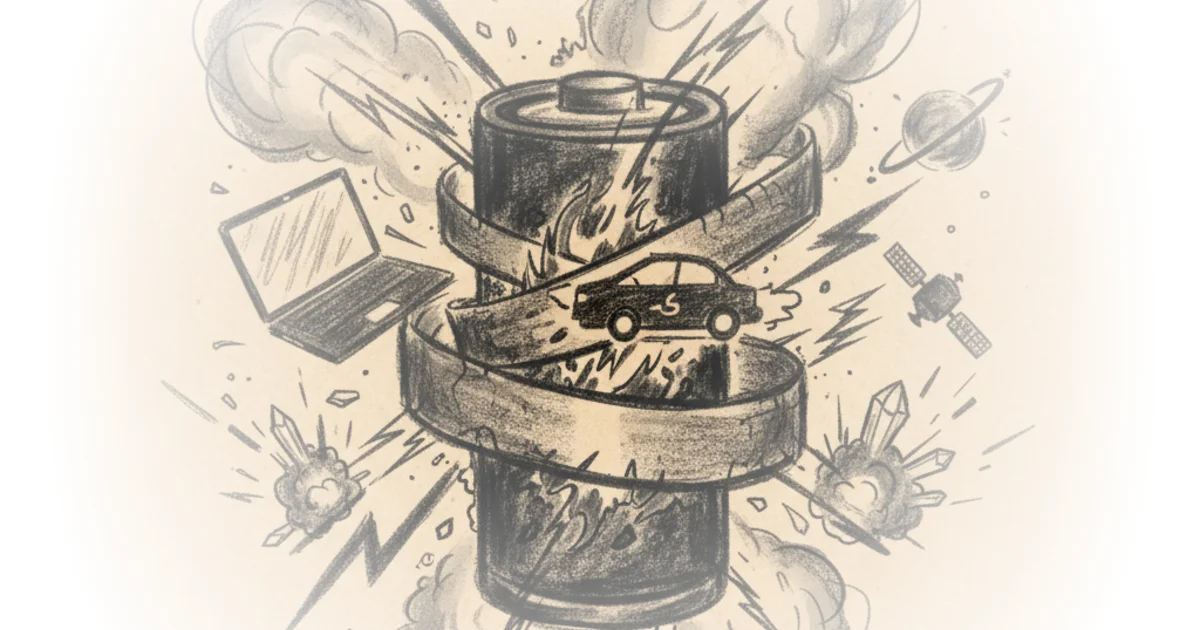
The company poured resources into Whittingham's research. And what he found would eventually power every laptop, phone, and electric vehicle on Earth—but not without serious danger.
The Quest for Energy Density
By the early 1970s, most rechargeable batteries were stuck at just 40 to 60 watt-hours per kilogram. That meant a full kilogram of battery could power a 40-watt light bulb for one hour. When the first commercial mobile phone launched in 1983, it took ten hours to charge for just thirty minutes of talk time.
Everyone from electronics giants to oil companies knew that doubling energy density could unlock an entirely new era of portable electronics. But nobody had found the right material.
Whittingham zeroed in on a class of compounds called transition metal dicalcenides—specifically, titanium disulfide. This material has stacked layers held together by weak forces, creating natural gaps between sheets of atoms just wide enough for ions to slip through. The structure could expand and contract repeatedly without breaking down.
But there was a problem: the voltage limit.
The 1.23-Volt Ceiling
Every commercial battery used a water-based electrolyte, which limited how much voltage could push through—about 1.23 volts. This ceiling existed because hydrogen ions in the liquid wanted electrons so badly that they turned into hydrogen gas when pushed too hard. To increase energy density, you needed to break through this barrier.
Whittingham had a solution: replace water with a lithium salt dissolved in organic solvent. The new electrolyte worked, but it came with serious risks. The mixture was volatile, chemically unstable, and could explode or release toxic fumes if mishandled. A stray spark or trace of moisture could destroy everything.
Still, the change unlocked something remarkable. Whittingham's chemistry delivered nearly double the voltage—2.4 volts per cell—and created a rechargeable battery that worked reliably cycle after cycle with incredible consistency.
Why Lithium Changed Everything
Lithium is unique among metals for batteries. When it loses its outer electron, it forms a tiny, incredibly stable positive ion. That reaction releases more energy per electron than any other metal. It produces the highest voltage of any metal used in batteries. And because lithium has just three protons, it's also the least dense metal—0.53 grams per cubic centimeter.
The combination of low density and the tendency to give away its electron made lithium perfect for Whittingham's vision: a high-energy battery in a compact, lightweight package.
But there was a catch—a dangerous one.
The Dendrite Problem
Whittingham's design used pure lithium as an anode. It worked brilliantly until it didn't. When charging too fast, lithium doesn't deposit evenly across the electrode. Instead, it forms in one location—growing like a spike, reaching toward the cathode.
These dendrites could easily short-circuit the battery. They keep growing until they reach the other side, creating a shortcut for electrons. That sudden surge causes intense heating and can trigger what scientists call "thermal runaway"—the battery catching fire or exploding.
The early prototypes required extreme caution. Firefighters were called so often that they threatened to start charging Exxon lab for the special chemicals needed to extinguish burning lithium.
The Precision Required
What makes batteries so remarkable is how perfectly every single ion must travel. In a chemical reaction, if you could get a 60% yield, that would be considered good. But in a battery—especially one you want to recharge a thousand times—you need that reaction to be 99.9% efficient.
If it's not, the battery's capacity rapidly deteriorates. After fifty cycles, you'd only have 8% of your original range left.
So every lithium ion must leave one electrode, pass through the electrolyte, slot neatly into the layered crystal structure of the cathode, and then when you recharge, they must leave again cleanly without getting stuck. They must travel all the way back to the anode.
It's a process that sounds like science fiction. And yet Whittingham's early prototype came close to that 99% efficiency target—almost impossibly close for such a new technology.
In the winter of 1973, Exxon executives summoned Whittingham to New York. He explained his work for five or ten minutes. Within a week, they said yes—they wanted to invest in it.
"If it's not 99.9% efficient, your battery rapidly deteriorates."
Critics might note that while Whittingham's discovery was revolutionary, the safety challenges with lithium dendrites took decades to solve. Some argue that the real revolution came not from his initial work but from later advances—like graphite anodes—that made lithium-ion batteries safe enough for consumer products.
Bottom Line
The strongest part of this argument is the story: how a side project during an oil crisis created the foundation for our entire digital world. The biggest vulnerability is that Whittingham's original design was dangerous—literally explosive—and required years of further refinement before becoming safe enough for everyday use. What listeners should watch for is how battery safety continues to evolve, especially as electric vehicles demand ever-higher energy densities. The tension between power and danger hasn't disappeared—it just gets better managed.