John Pistelli transforms a routine newsletter update into a profound meditation on how we construct our own humanity through literature, technology, and the physical spaces we inhabit. Rather than simply listing new releases, he challenges the reader to consider whether the "human" is a fixed biological reality or a fragile invention constantly being rewritten by the very stories we tell ourselves.
The Architecture of Consciousness
Pistelli opens by reframing the act of reading not as passive consumption but as an active participation in the invention of the self. He tackles the classic question of whether figures like Shakespeare or Jesus "invented the human" by suggesting that these figures did not discover a pre-existing truth but rather "helped to inspire or devise the very reflexivity of consciousness that makes us regard the question as unanswerable." This is a bold move; it shifts the focus from historical discovery to the psychological mechanism of self-awareness. As Pistelli puts it, "what is most our own is also somewhat opaque to ourselves; we have that within which passeth show."
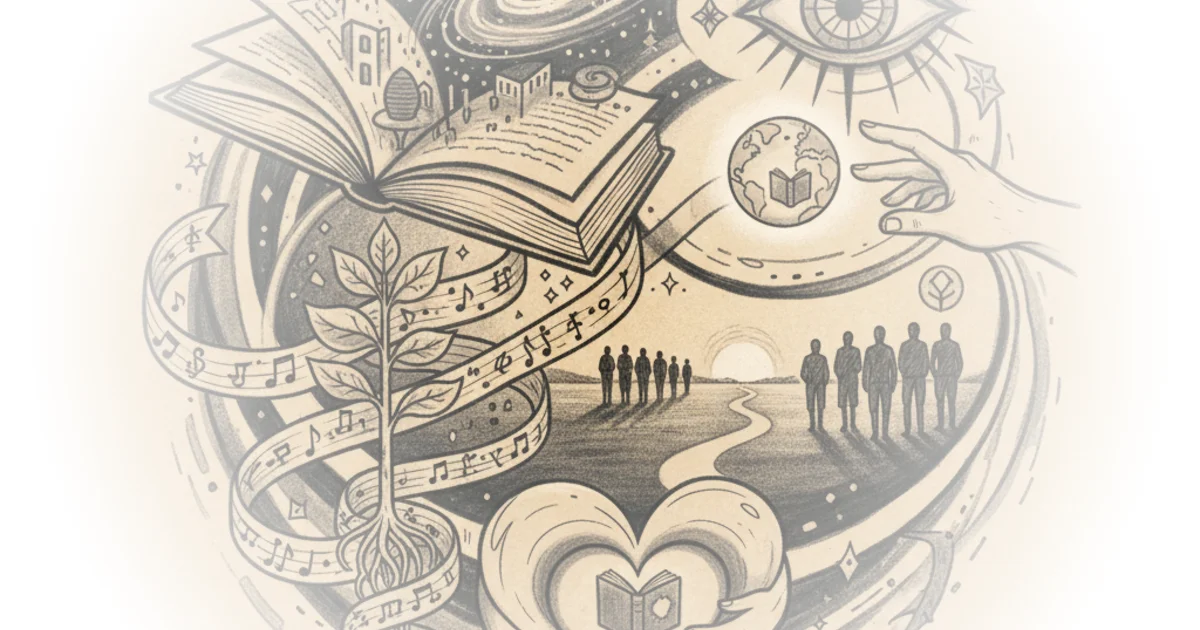
The argument gains depth when he connects this internal struggle to the external world of cultural exchange. He references Edward Said's lament that "we Arabs have no unconscious" and his desire to import psychoanalysis to the Arab world. Pistelli uses this to highlight a deep irony: that resisting global imperial hegemony might ironically require people to become more like one another—reflexively aware and critical. He writes, "the only effective resistance to assimilation into a global imperial hegemony will require people to become more and more the same, i.e., reflexively aware enough to reflect critically on both self and other." This perspective suggests that the path to preserving cultural distinctiveness runs through a shared, universal self-scrutiny, a notion that complicates the usual binaries of local versus global.
Critics might argue that this universalizing impulse risks erasing the very particularities it claims to protect, turning diverse cultures into a single, homogenized "Planet Hamlet." Yet, Pistelli's framing remains compelling because it acknowledges the tension rather than resolving it too neatly.
The human, defined as that within which passeth show, transmitted now through the undersea fiberoptic cables that weave the globe more and more into a single cultural text in the air around us.
The Ideology of the Bookshelf
Shifting from the abstract to the tangible, Pistelli turns his gaze to the modern bookstore, dissecting the ideological performance of urban independent shops versus corporate chains. He offers a scathing critique of the "boastful and drubbing overidentification with the most bad-taste and dubious versions of the ideology" found in many progressive bookstores. He argues that the problem is not the ideology itself, but the performative nature of it, noting that "the very bookstore owners, if they're like every other urban progressive I've ever spoken with privately, will even concede are stupid."
In a surprising twist, he finds a surprising openness in the corporate giant Barnes and Noble, which he visited in a gentrifying Pittsburgh neighborhood. He observes that the chain stocked Ernst Jünger and Yukio Mishima alongside Charlie Kirk and MAGA kitsch, creating a chaotic but inclusive ecosystem of thought. "They had Jünger (Storm of Steel) and Mishima (more than half a shelf's worth)," he notes, contrasting this with the curated, often narrow selections of indie stores. He suggests that the academic used and rare bookstore remains the superior model because its stock "encompassing every worldview in the repertoire of human thought, works against aesthetic or epistemic closure."
This observation challenges the common narrative that corporate retail is inherently hostile to complex or controversial ideas. While one might counter that corporate chains prioritize profit over curation, leading to a superficial diversity that lacks depth, Pistelli's point stands: the sheer volume of conflicting ideas on a corporate shelf can sometimes be more intellectually honest than a curated indie selection that silences dissent in the name of political purity.
The Digital Otherworld
Finally, Pistelli bridges the gap between the physical and the digital, drawing on the work of his colleague, Default Friend, to describe the internet not as a tool but as a destination. He writes, "Adapting begins with seeing the internet for what it actually is — not a drug, nor a set of behaviors, but a place we travel to, with its own geography and customs." This reframing is crucial for understanding how we navigate modern life; it suggests that our online interactions are not less real than our offline ones, but simply different in their rules and consequences.
He warns that surviving this "enchanted world" requires the right stories to help us "cross thresholds without losing ourselves." The reference to Alan Moore's Big Numbers and the idea of mapping "all maps we have mistaken for the world" underscores the danger of confusing our digital representations with reality itself. As he concludes, the challenge is to keep the "astral and physical planes... in a tight cybernetic or Hegelian braid as we continuously transform the one into the other and vice versa."
Bottom Line
Pistelli's strongest asset is his refusal to separate literary theory from the material conditions of reading, whether that means the shelves of a Barnes and Noble or the fiber-optic cables of the internet. His argument is vulnerable only in its reliance on a specific, high-brow cultural literacy that may alienate readers unfamiliar with the references to Nabokov or Said, yet this erudition is precisely what gives the piece its unique texture. The reader should watch for how this tension between the curated and the chaotic plays out in the future of physical book retail and digital identity.
The human, defined as that within which passeth show, transmitted now through the undersea fiberoptic cables that weave the globe more and more into a single cultural text in the air around us.