Cory Doctorow does more than announce a book; he exposes the fragile architecture of the digital commons by proving that the most effective resistance to corporate enclosure is often a beautifully bound, physical object. In a landscape dominated by algorithmic feeds and digital rights management, his argument that "making a set of documents that allows creativity to spread freely across 45+ (often very different) legal systems is arguably the most ambitious piece of applied IP legal research ever undertaken" reframes the Creative Commons not as a charity, but as a critical infrastructure project.
The Architecture of Sharing
Doctorow anchors his narrative in the practical necessity of the Creative Commons, tracing its origins to the "copyright wars of the early 2000s." He argues that without these standardized licenses, the internet would be paralyzed by legal friction, noting that bringing user-generated content into compliance would "cost hundreds of billions of dollars in billable lawyer hours." This is a powerful economic framing that moves the conversation beyond abstract ideals of freedom to the hard math of scalability. The system works because it allows a "Japanese animator [to] create a short based on a French story, using Australian 3D assets and a Croatian soundtrack," a global interoperability that traditional copyright law actively forbids.
Critics might argue that relying on voluntary licensing leaves creators vulnerable to bad-faith actors who ignore the terms, but Doctorow's evidence of "tens of billions of works" licensed suggests the model has achieved a critical mass that makes enforcement less about litigation and more about cultural norm-setting.
The Uncanny Valley of Digital Art
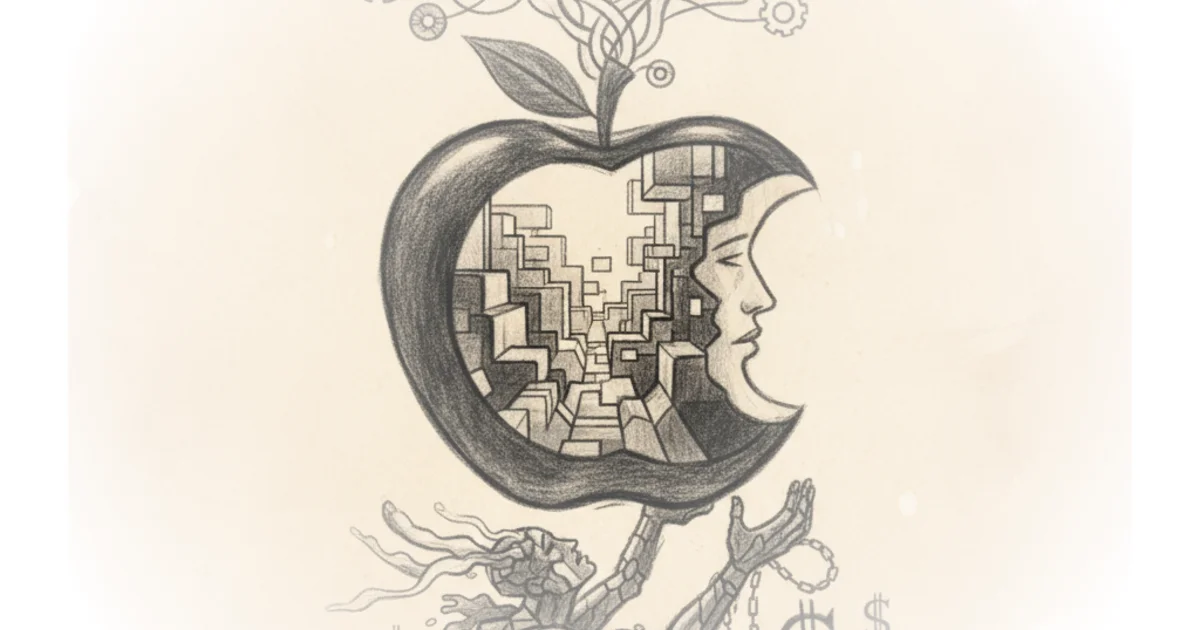
The piece takes a sharp turn into aesthetics, using the concept of the "canny valley" to explain why Doctorow's collage work feels so distinct. He leans heavily on an introduction by Bruce Sterling, a cyberpunk pioneer who draws a parallel to the 1970s robotics theory of Masahiro Mori. Sterling observes that while traditional art forms are comfortable to humans, digital collages that "slice up and weld highly disparate elements" often land in a zone that feels "severely not-okay."
Doctorow embraces this discomfort. He explains that his work is not about polished illustration but about "conceptually gooey congelations, stuck in the valley mire of that which is and must be neither this-nor-that." This is a deliberate choice. As Sterling notes, Doctorow "can't draw" in the traditional sense, yet his inability to produce clean, commercial art forces him to create something more analytical. The result is a visual language that mirrors the chaotic reality of the internet itself.
"These images look dank and horrible because they're analytical, revelatory and make sense."
This comparison to the Dadaist collages of Hannah Höch is particularly striking. Where Dada was a reaction to the absurdity of war, Doctorow's collages are a reaction to the "tangled penthouse/slash/underground machinations of billionaire web moguls." The "craphound aesthetic"—a term Doctorow uses to describe his love for the discarded and the messy—is not a bug, but the feature that allows him to visualize the "shameful disasters" of the tech industry without resorting to "torrents of unwieldy tech jargon."
The Physical as Political
Perhaps the most surprising element of Doctorow's commentary is his insistence on the materiality of the digital. He details the production of his limited edition book, Canny Valley, noting it was printed on "100lb Mohawk paper" by a "family-owned print shop that's been in business for more than 100 years." In an era where digital goods are ephemeral and easily deleted, the decision to create a "leather bound, extremely limited edition" serves as a tangible counter-narrative to the "enshittification" of online platforms.
Doctorow writes, "I rely heavily on CC licensed works to make the images that run over my posts... which you can download in high-rez (and freely re-use, thanks to the CC licenses I apply to each of them)." By selling the physical book to fund the digital nonprofit, he creates a closed loop where the physical object subsidizes the digital infrastructure. This is a strategic move that bypasses the traditional gatekeepers of publishing and advertising. He admits that while he could hire a professional artist, "that effort would be three times the labor for a dogged crusader who is already working like sixty." The DIY approach is not just a budget constraint; it is an ideological stance against the specialization that often dilutes political messaging.
Bottom Line
Doctorow's strongest argument is that the survival of a free internet requires both robust legal frameworks like Creative Commons and a cultural willingness to embrace the "uncanny" messiness of digital remix culture. The piece's vulnerability lies in its reliance on a niche, high-effort model of patronage that may not scale to the millions of creators who lack Doctorow's specific platform and literary success. However, as a proof of concept for how to monetize public goods without selling out to surveillance capitalism, it remains a compelling blueprint for the future of independent media.
"A modern digital artist has billions of jpegs in files, folders, clouds and buckets. He's never gonna run out of weightless grist from that mill."
The verdict is clear: in a world of infinite digital noise, the most radical act is to curate, print, and bind the truth into something you can hold in your hands.