Luke Savage resurrects a 1983 parliamentary speech by Ed Broadbent to expose a disturbing continuity in how the United States justifies military intervention in the Western Hemisphere. While the Reagan administration framed the invasion of Grenada as a rescue mission, Savage highlights how Broadbent dismantled those claims with a moral clarity that feels unnervingly prescient for today's geopolitical landscape.
The Architecture of Aggression
Savage introduces Broadbent's address not merely as a historical artifact, but as a direct rebuttal to the official narratives that still dominate foreign policy debates. The author notes that the invasion was "officially justified on the absurd grounds that the tiny island nation represented a security threat to the USA," a claim Savage underscores by pointing out the overwhelming international condemnation that followed. The piece is most effective when it strips away the diplomatic fog to reveal the human reality of the conflict.
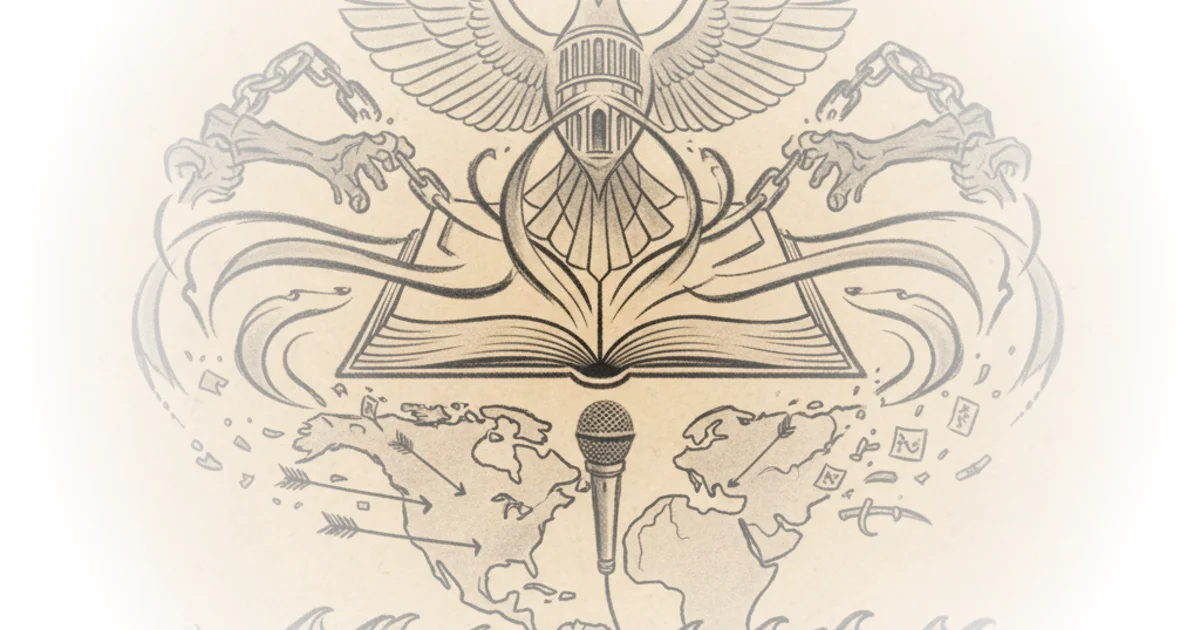
Broadbent, speaking in the House of Commons, refused to let the debate devolve into a discussion of Grenada's internal politics or the murder of Prime Minister Maurice Bishop. Instead, he focused on the act of invasion itself. "The debate is not about whether one liked or disliked the Government of the former Prime Minister of Grenada, Mr. Bishop," Broadbent states, "nor is this about the brutal act of murder." By isolating the aggression from the internal chaos, Broadbent forces the listener to confront the fundamental violation of sovereignty. Savage argues this distinction is crucial; it prevents the justification of violence through the chaos of the target nation.
War is not some abstract entity that is a collection of mere statistics. War means that men and women, particularly young men and women, are going to disappear from the planet in a violent and cruel way.
This focus on the individual cost of war is the emotional core of the commentary. Broadbent describes the loss of life not as a strategic outcome but as the extinguishing of future potential: "They will not have the pleasures and the friendships we will have, and they will not experience the joys of parenthood." Savage uses this to critique the modern tendency to view military operations through the lens of cost-benefit analysis rather than human tragedy. The argument holds up because it refuses to let the reader hide behind the abstraction of "collateral damage."
Deconstructing the Justifications
Savage meticulously follows Broadbent's dissection of the three primary excuses offered by the executive branch: the protection of citizens, the restoration of democracy, and the request from regional allies. The author points out that Broadbent identified the "protection of citizens" claim as a "bogus argument," citing reports that American students in Grenada had explicitly asked the United States not to intervene violently. This historical detail, often glossed over in mainstream summaries, is vital for understanding the manufactured nature of the crisis.
The critique of the "democracy" argument is even starker. Broadbent lists Haiti, Guatemala, and Nicaragua, noting that in each case, American military intervention led not to freedom but to "vicious, inhumane dictatorships" that lasted for decades. Savage highlights Broadbent's citation of Senator Daniel Patrick Moynihan, who famously asked, "I don't know how you restore democracy on the point of a bayonet." This rhetorical question, preserved by Savage, serves as a timeless check on the hubris of interventionist powers.
Critics might argue that the Cold War context made non-intervention a luxury the West could not afford, given the perceived Soviet threat in the Caribbean. However, Broadbent's speech anticipates this by framing the issue not as a strategic necessity but as a moral perversion. He argues that the administration was engaging in a "crusade against any kind of political regime which can be seen in any sense... to be philosophically left of centre." Savage draws a parallel to the Crusades themselves, noting how religious principles were perverted to justify violence, just as democratic principles were being twisted in the 1980s.
Just as during the Crusades, when the so-called Christian heads of state perverted the very principles of morality, of Christianity, in the name of Christianity, so do we now find people in the Reagan administration completely perverting the most fundamental principles of democracy in the name of democracy.
The Enduring Relevance
Savage's framing of the piece as a warning against "renewed aggression" in the hemisphere connects the 1983 invasion to contemporary tensions involving Venezuela and Cuba. The author suggests that the mechanisms of justification have not changed, only the specific targets. Broadbent's observation that "a democracy can abuse its authority, its power" remains a potent reminder that the nature of the regime does not guarantee moral conduct in foreign affairs.
The speech also touches on the legal void created by the intervention. Broadbent notes that the collective action by the Organization of Eastern Caribbean states violated its own charter, which required unanimity and was intended only for defense against an outside aggressor. Savage emphasizes that this was not a legal gray area but a clear violation of international law, including the United Nations Charter. The irony that the invasion occurred the day after the UN's anniversary, a body founded to prevent such aggression, adds a layer of tragic weight to the narrative.
Bottom Line
Savage's commentary succeeds by using Broadbent's 1983 speech as a mirror for current foreign policy, revealing that the rhetoric of "humanitarian intervention" often masks a crusade against political dissent. The strongest part of the argument is its unflinching focus on the human cost of war, refusing to let geopolitical strategy overshadow the reality of young lives lost. Its greatest vulnerability lies in its idealism; while morally sound, it offers little guidance on how to manage the complex security threats that drive such interventions, leaving the reader with a powerful critique but no clear path forward.
The Reagan administration is turning the whole of Central America into a crusade against any kind of political regime which can be seen in any sense to be philosophically left of centre.