In a landscape where the mere mention of genetics often triggers an immediate, reflexive shutdown, Freddie deBoer makes a startlingly clear distinction that has been obscured by decades of political polarization: the difference between individual biological variation and group-based essentialism. While the discourse around intelligence and heredity is usually a minefield of bad faith arguments, deBoer cuts through the noise to argue that acknowledging individual genetic luck is not only scientifically accurate but morally necessary for a compassionate society. This is not a defense of hierarchy, but a plea for nuance that challenges both the right's obsession with racial destiny and the left's fear of any biological reality.
The Individual Versus The Group
The core of deBoer's argument rests on a fundamental biological fact that has been lost in the cultural fog: genes operate at the level of the individual, not the category. He writes, "When we say that someone has 'good genes,' the phrase is a shorthand acknowledgment that an individual's genetic inheritance... has given them some advantage." This framing is crucial because it reclaims the language of heredity from the clutches of scientific racism, which has historically weaponized group averages to justify oppression. By focusing on the individual, deBoer argues we can discuss talent and aptitude without falling into the trap of believing that entire populations are biologically destined for success or failure.
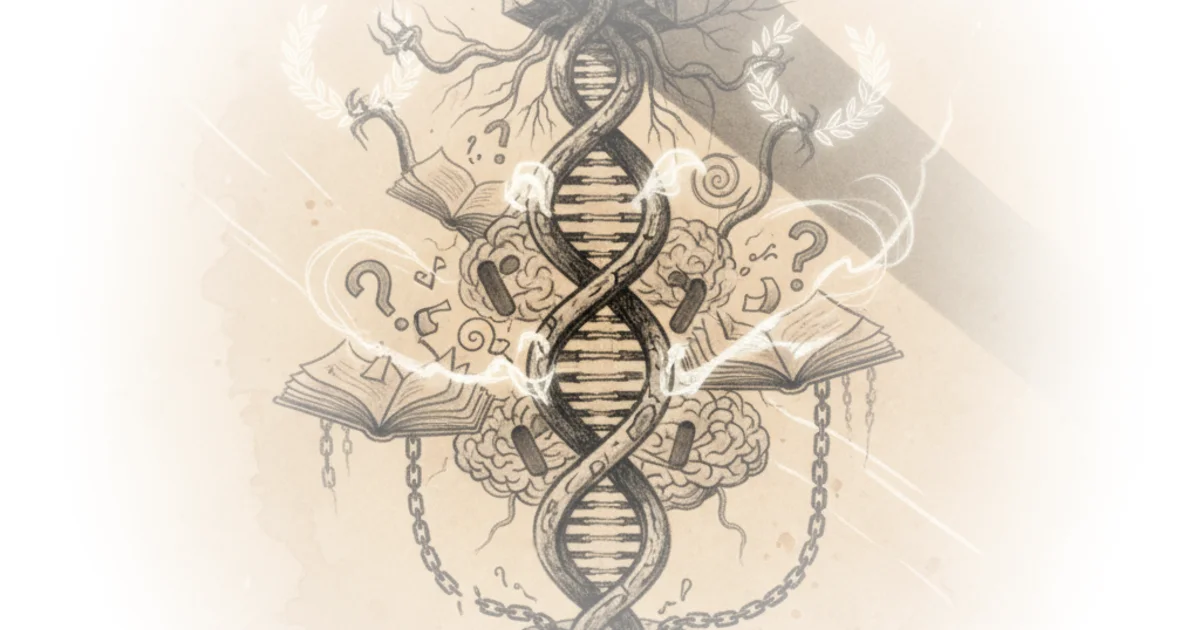
He illustrates this by pointing out that the phrase "good genes" is often used to describe traits like facial symmetry or physical prowess, noting that "the idea of 'good genes' corresponds roughly to something real: each person's unique genetic makeup affects how their bodies grow, look, and function." This observation is effective because it grounds the discussion in tangible, observable reality rather than abstract ideology. However, the argument requires a leap of faith from readers who have been conditioned to view any discussion of genetic advantage as a dog whistle for white supremacy. Critics might note that in a society with such a fraught history of eugenics, even the individual claim can be co-opted to support elitist narratives about who deserves success.
To say that an individual has 'good genes' is to comment, however loosely, on a personal quirk of inheritance; to say that a race has 'good genes' is to collapse that individuality into stereotype, to erase personhood in favor of typology.
The Moral Imperative of Biological Reality
DeBoer's most provocative claim is that refusing to acknowledge individual genetic differences actually fuels a conservative "bootstraps" mentality. He argues that if we pretend everyone starts with the same genetic deck, we inevitably conclude that those who fail simply didn't try hard enough. "A refusal to grapple with the influence of individual genetic endowments leads to political conservatism," he asserts, because it "contribute[s] to the false notion that individuals have total control over their outcomes." This is a bold inversion of the typical progressive stance, which often emphasizes environmental determinism to the exclusion of biological factors. By suggesting that acknowledging biological luck is a progressive act, deBoer forces a re-evaluation of what true empathy looks like.
He connects this to his previous work, The Cult of Smart, where he argued that the education system fails because it refuses to accept that genetic influences on intellectual ability exist. He writes, "My experience in the education system demonstrating to me how individuals suffered from a lack of intrinsic academic talent that was not acknowledged by the system, leaving them to be categorized as losers for conditions out of their control." This personal anecdote adds weight to the theoretical argument, grounding it in the lived experience of students who are crushed by a system that demands uniformity. The historical context of the eugenics movement, which sought to eliminate those deemed "unfit" based on group characteristics, makes this distinction even more vital; as deBoer notes, "The moral danger of group-level genetic claims is not only that they are inaccurate but that they are inevitably hierarchical."
The Danger of Essentialism
The piece shines when it dissects why the leap from individual to group is so dangerous. DeBoer explains that while individual variation is random and contingent, group claims create a fixed hierarchy. "To say that one group has 'good genes' is to imply that others do not," he writes, "It invites a ranking of human value according to biology, which is the essence of racist ideology." This is the article's strongest point: it identifies the mechanism by which benign observations about individuals can metastasize into toxic ideologies about populations. He draws on the history of population genetics to show that while allele frequencies do vary by geography, these differences are "probabilistic and usually modest," and certainly do not support the grand narratives of racial superiority or inferiority.
He challenges the reader to see the absurdity of conflating the two, asking, "What seems nutty to me is how many people profess not to understand... the difference between saying 'this person's good genes made them beautiful' and 'this person's genes were called good, that must be a statement of their racial superiority.'" This rhetorical question cuts to the heart of the current intellectual paralysis. It suggests that the fear of being labeled racist has made many people unable to speak plainly about human biology, creating a vacuum where bad actors can thrive. The argument is compelling because it appeals to scientific literacy as a tool for liberation rather than oppression.
Bottom Line
Freddie deBoer's argument is a necessary corrective to a discourse that has become paralyzed by the fear of saying the wrong thing about genetics. The strongest part of this piece is its insistence that acknowledging individual biological luck is a prerequisite for true social justice, as it dismantles the myth of total individual control. Its biggest vulnerability lies in the practical difficulty of separating these concepts in a public sphere where nuance is often the first casualty of political warfare. Readers should watch for how this distinction plays out in future debates on education and inequality, where the tension between individual merit and systemic bias will only grow more complex.
Understanding the science of genes should make us humble, not haughty. It reveals how random and contingent our own traits are, how much of what we call 'talent' comes down to luck of birth and circumstance.