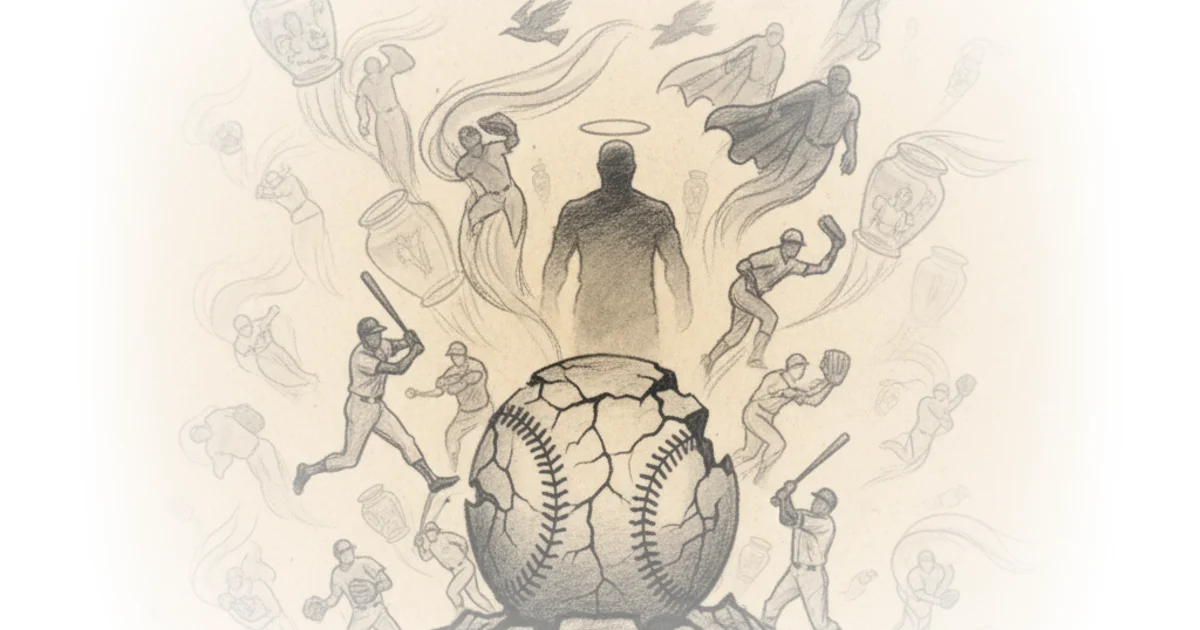
In a year where sports headlines are often dominated by trade deadlines and championship parades, Tom Stone offers a somber, data-rich reckoning with the inevitable passing of baseball's giants. This piece is not merely an obituary list; it is a statistical eulogy that uses advanced metrics to reframe how we remember the game's history, proving that even in death, the numbers tell a story of enduring legacy.
The Weight of the Roster
Stone opens by grounding the reader in the sheer scale of loss, noting that "2024 was no different, as three Hall of Fame players... and the controversial all-time hits leader... all passed away." Rather than relying on vague sentiment, the author immediately pivots to hard data, having conducted "searches at Stathead to review the full lists" to compile a definitive roster. This methodological choice is crucial; it transforms a list of names into a historical record, allowing the reader to see the breadth of the talent that has left the field.
The commentary on Willie Mays is particularly striking in its use of WAR (Wins Above Replacement) to quantify greatness. Stone writes, "Willie Mays remains in just about everyone's all-time Top-5 overall player lists—often still ranking #1." He supports this by highlighting that Mays "led the NL in WAR an amazing ten times!" This framing is effective because it moves beyond the traditional counting stats of the 1950s and 60s to show how modern analytics still validate Mays' status as a generational outlier. It reminds the busy reader that while eras change, the fundamental impact of a player like Mays transcends time.
Willie Mays remains in just about everyone's all-time Top-5 overall player lists—often still ranking #1.
The piece also tackles the complex legacy of Pete Rose with a balanced, factual tone. Stone notes that Rose was "'Charlie Hustle' as a player, collecting more hits than anyone (4,256), and leading the NL in hits 7 times while winning three batting titles." By focusing on the sheer volume of his achievement and his versatility—having "spent significant time at four other positions as well: 1B, 2B, 3B, and LF"—Stone separates the player's on-field dominance from the off-field controversies that led to his ban. This approach allows the reader to appreciate the athletic feat without getting bogged down in the moral debates that often overshadow the statistics.
Beyond the Hall of Fame
One of the most valuable aspects of Stone's coverage is his attention to the "host of other well-known players" who defined eras without necessarily reaching the Hall of Fame. The author provides a nuanced look at players like Ed Kranepool, who "didn't hit lefties well (.220 versus .268 against RHP)," explaining how this specific weakness "limited his playing time to some extent." This granular detail humanizes the players, showing that a career is often defined by specific strengths and weaknesses rather than just a final batting average.
Stone also highlights the tragic brevity of some careers, such as that of Dave McCarty, who "died at only age 54 after suffering a cardiac event." The inclusion of such details serves as a stark reminder of the physical toll of the sport and the fragility of life, even for those who have left the game. Similarly, the profile of U L Washington, who "was well-known for playing with a toothpick in his mouth," adds a layer of cultural texture that pure statistics cannot capture.
Critics might note that focusing so heavily on individual player stats can sometimes obscure the team dynamics that made these players successful. However, Stone mitigates this by frequently mentioning teammates and specific team contexts, such as Jerry Grote "catching for the likes of Tom Seaver, Jerry Koosman, Nolan Ryan, and others." This contextualization ensures that the reader understands these players as part of a larger ecosystem, not just isolated data points.
The Pitching Pantheon
The section on pitchers offers a fascinating "mythical rotation" concept, imagining a team of Luis Tiant, Fernando Valenzuela, Ken Holtzman, Carl Erskine, and Don Gullett. Stone writes that "if all in their prime—would have been quite solid," a statement that invites the reader to engage in the timeless baseball debate of "what if." The author backs this up with specific accolades, noting that Valenzuela "won both the NL ROY award and Cy Young Award that year, the first of six consecutive All-Star seasons."
The inclusion of lesser-known pitchers like José DeLeón, who "led the NL with 201 strikeouts" in 1989 despite having "two 19-loss campaigns," adds depth to the narrative. It highlights the volatility of pitching careers and the fine line between success and failure. Stone's observation that DeLeón was a "high-strikeout and high-walks kind of pitcher" provides a clear, concise summary of his playing style that is immediately understandable to any fan.
If all in their prime—would have been quite solid.
The piece concludes with a brief mention of the author's book, but the core value lies in the comprehensive review of the departed. Stone's work serves as a bridge between the statistical record and the human story, ensuring that the legacy of these athletes is preserved with accuracy and respect.
Bottom Line
Tom Stone's piece succeeds by using advanced metrics to honor the past without getting lost in nostalgia, offering a clear-eyed look at the careers that shaped the game. Its greatest strength is the balance between the legendary Hall of Famers and the solid, unsung professionals who filled the rosters, creating a complete picture of a year of loss. The only vulnerability is the sheer volume of names, which might overwhelm a casual reader, but for the dedicated fan, it is an essential archive of baseball history.