Seven Prime Ministers in Ten Years
Niall Ferguson opens with a striking statistic: if Keir Starmer is forced from Downing Street, Britain will have cycled through seven prime ministers in a decade. That sequence -- Cameron, May, Johnson, Truss, Sunak, Starmer, and whoever comes next -- invites obvious comparisons to Italian politics, though Ferguson insists the resemblance is shallow.
British politics is much funnier than Italian politics has ever been. It is also much more British to behave this way than most Americans realize.
Ferguson frames the entire crisis through the lens of farce, specifically the low-budget Carry On films and the West End hit No Sex Please, We're British. The analogy is more than decorative. It captures something essential about how the British political class processes scandal -- with embarrassment, euphemism, and a compulsive need to pretend nothing unseemly is happening.
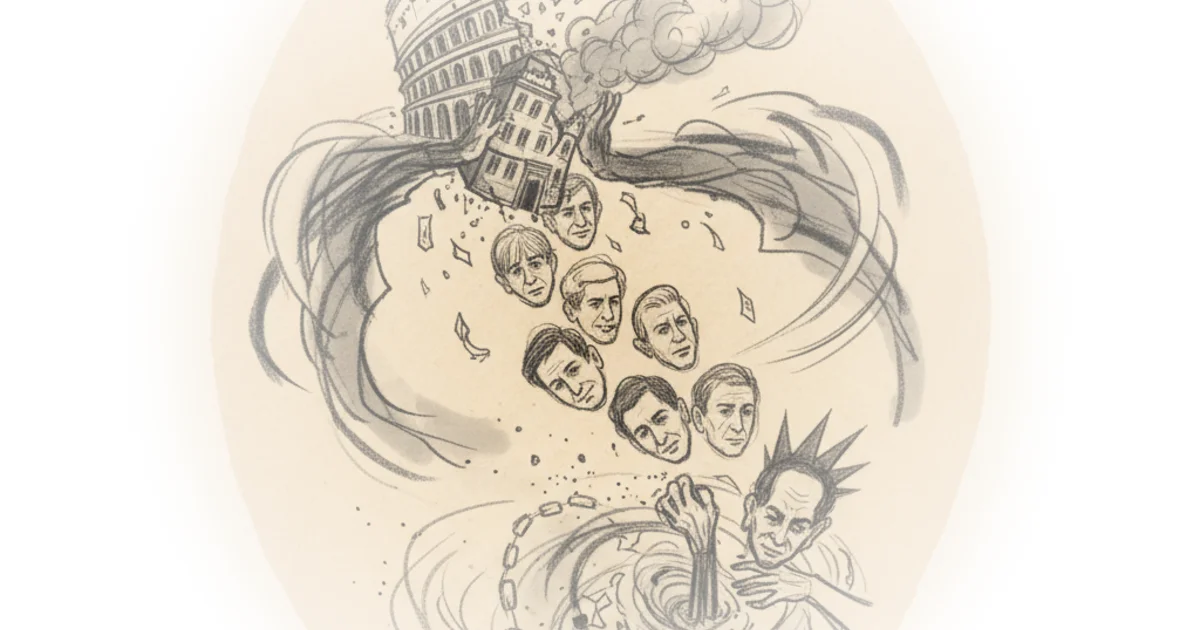
The Mandelson Gamble
The proximate cause of Starmer's trouble, Ferguson argues, was his own decision in December 2024 to appoint Lord Peter Mandelson as ambassador to Washington. The logic was straightforward: Mandelson's social fluency and transatlantic connections made him the ideal envoy to the Trump administration. The risk was equally obvious.
Starmer cannot have been ignorant of Mandelson's links to Epstein. They had been covered in the press. Nor was he unaware that Mandelson's political career had been interrupted not once but twice by scandalous allegations.
When the Justice Department released successive tranches of Epstein files, the correspondence was damning. Mandelson had emailed Epstein while the latter was serving time for procuring minors, arranging visits to Epstein's residences and exchanging government information about potentially saleable UK assets during the financial crisis.
"Are you sure the backpressure from your lack of sex is not turning your brain into fois [sic] gras?" he asked Mandelson in November 2009. "It's certainly a serious problem," Mandelson replied.
Ferguson, who discloses that he has known Mandelson personally for years, renders a measured verdict: the emails show "at best, shockingly poor judgment." But he places the greater blame on Starmer for making the appointment in the first place.
A Government Already Taking on Water
The Epstein connection did not sink a healthy government. It punched another hole in a hull already listing badly. Ferguson catalogues the earlier damage: undeclared gifts and Taylor Swift tickets, a string of policy reversals on winter fuel payments, inheritance tax on farmland, digital IDs, and income tax. Each U-turn humiliated the ministers sent out to defend the original position.
Now, according to Ipsos, Starmer's approval ratings after 14 months are the lowest at this stage of any prime minister in the past 50 years. Support for Labour has plunged by nearly 14 points, the second-largest decline for a governing party in postwar political history.
The upcoming by-election in Gorton and Denton, Manchester, is presented as a crucial test. Ferguson notes that Labour's leadership blocked the popular Andy Burnham from standing as candidate -- not because he was unsuitable, but because he might eventually challenge Starmer for the leadership. The defensive maneuver may prove self-defeating.
The Cummings Diagnosis
Ferguson draws heavily on research by Dominic Cummings, the architect of Brexit and Boris Johnson's 2019 victory. Cummings is hardly neutral, but his polling captures something Ferguson considers fundamental about the mood of the British electorate.
The deafening verdict of voters . . . is that Insiders have failed and voters want change -- a failure of ideas, institutions, and operational competence, a failure to take or impose responsibility for failure.
Cummings goes further, accusing the political establishment of responding to public anger by doubling down on the very policies voters reject, then blaming the electorate for embracing "populism, racism, fascism." Ferguson does not endorse every element of this critique, but he treats it as directionally correct.
MPs are hysterical over Epstein after spending 20 years suppressing investigation and reporting of industrialized child abuse here because it undermines their cross-party consensus on immigration policy.
That is a characteristically provocative Cummings line, and Ferguson includes it without much pushback. It deserves some. The suggestion that the Epstein outrage is performative because MPs ignored domestic abuse scandals conflates two different failures. Politicians can be genuinely appalled by Epstein while also having been negligent elsewhere -- hypocrisy and sincerity are not always mutually exclusive.
Why Ferguson Bets on Badenoch
The most forward-looking section of the piece concerns Kemi Badenoch, the Conservative leader. Ferguson argues that despite Reform UK's surging poll numbers, Nigel Farage faces structural problems that new right-wing parties in Britain always encounter.
The problem with new parties on the right is nearly always the same. It is very hard to keep out the opportunists, cranks, crazies, and outright fascists. It is equally hard to attract genuine political talent.
Badenoch, by contrast, benefits from near-invisibility. Voters know almost nothing about her, but unlike Starmer, she carries no "wall of negativity." Head-to-head polling shows her beating every rival: Starmer 62 to 38, Farage 64 to 36. Ferguson envisions an eventual Conservative-Reform merger, drawing a historical parallel to the Liberal Unionist alliance of 1886 that eventually folded into the Conservative Party.
There is a counterpoint worth registering here. Ferguson's confidence in Badenoch rests partly on her low profile being an asset -- voters have an "open mind." But open minds can close quickly once a leader faces the sustained scrutiny of a general election campaign. Name recognition cuts both ways, and the Tory brand, however resilient historically, carries the stench of the Truss and Johnson years in ways that may not dissipate by 2028.
The Long View
Ferguson closes by placing the current turbulence in deep historical context. Britain has had seven prime ministers in a decade before -- between 1762 and 1770, and again during the Great Reform Bill era, which managed nine in eight years. These convulsions, he argues, are a feature of the Westminster system, not a bug. They occur when the electorate is wrestling with a large, unresolved question.
Ten years ago, Britons voted for Brexit. Turns out, they are significantly worse off as a result. What better scapegoat than the political "insiders"?
That final line carries more weight than Ferguson perhaps intends. If Brexit is the root cause of the instability, then no amount of leadership reshuffling -- whether Starmer, Farage, or Badenoch -- addresses the underlying problem. The scapegoating of insiders may be cathartic, but it does not generate a trade policy or restore the economic relationships that were severed.
Bottom Line
Ferguson delivers a witty, historically informed diagnosis of a political system in accelerating dysfunction. The Epstein-Mandelson scandal did not break Starmer's government -- it merely accelerated a collapse that was already well underway. The most valuable insight is structural: Britain has entered a "zombie era" in which class-based loyalties have dissolved and the entire electorate consists of floating voters unified mainly by contempt for their leaders. Ferguson's bet on Badenoch and an eventual Conservative-Reform merger is plausible but premature. The next election is years away, and as the parade of seven prime ministers demonstrates, British politics has a way of devouring its favorites long before they reach the finish line.