This Eleventh Circuit ruling doesn't just strike down a Florida law; it forces a reckoning with who actually owns the classroom. While many headlines focus on the political battle over curriculum, Reason zeroes in on a far more technical and consequential legal failure: the state's attempt to hijack the "government speech" doctrine to silence professors before they even speak.
The Myth of State Control
The piece dismantles Florida's argument that because the state funds universities, it can dictate every word spoken within them. Reason reports that the court found this assertion "sweeping" and fundamentally unsupported by precedent. The logic is straightforward: government speech doctrine applies to things like license plates or monuments where the state exercises total control over the message. As the opinion notes, "Florida does not—and could not—exercise that kind of control over every postsecondary class lecture."
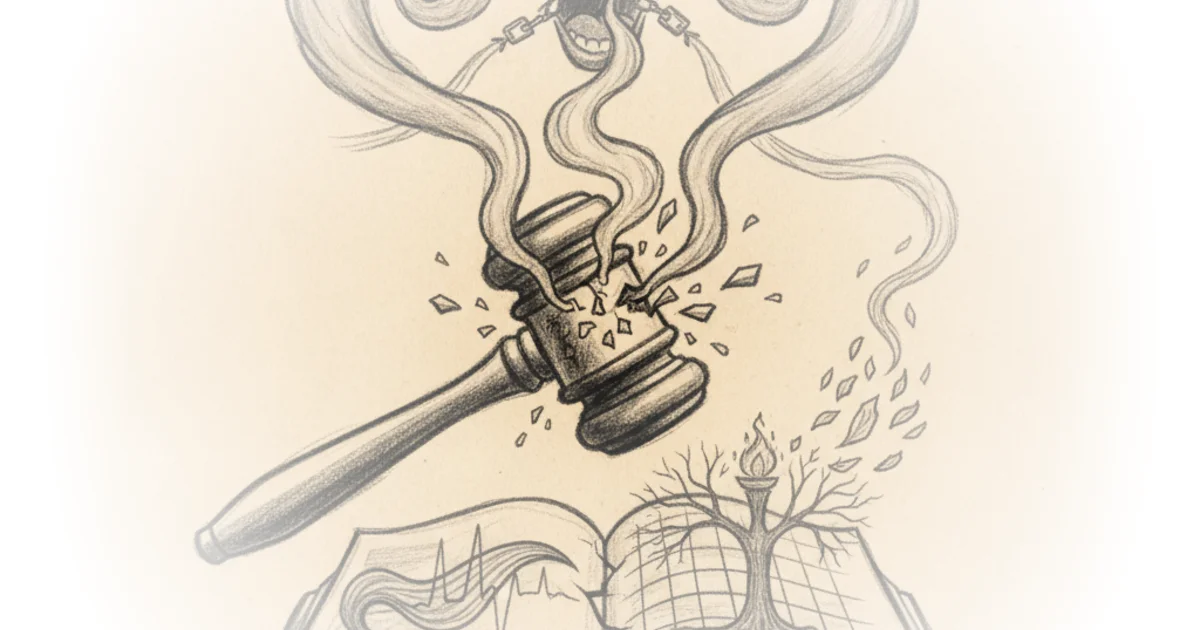
This distinction is vital. In primary and secondary schools, the state dictates curricula with thousands of specific standards. But in higher education, the law recognizes a different mission: to "enable[] all students to participate in the search for knowledge and individual development." The court points out that Florida's own statutes forbid limiting access to ideas students might find "uncomfortable, unwelcome, disagreeable, or offensive."
"Does anyone really think that every professor in every class at every public university is putting forward the official line of the State's political branches?"
The commentary here is sharp. It highlights a glaring contradiction: the state claims professors are its mouthpieces while simultaneously passing laws requiring universities to protect viewpoint diversity. If the government were truly speaking through these lectures, there would be no need for such protective statutes. The ruling suggests that treating academia as a state propaganda machine ignores centuries of institutional independence.
A Dangerous Precedent in the Classroom
The analysis deepens by contrasting this case with Bishop v. Aronov, an 1991 Eleventh Circuit precedent often cited by critics of academic freedom. In Bishop, a professor was barred from injecting religious views into a physiology class after student complaints about coercion. The court in that instance allowed the restriction because it was a specific, post-hoc response to actual disruption.
The current case is different. It involves a "wide-ranging, ex ante restriction on the speech of every public university professor in the state." Reason argues this shift from reactive discipline to proactive censorship changes everything. The court warns that when the government attempts to force uniformity of thought, it chills potential speech before it happens.
"Compelling certain beliefs by suppressing 'individual thought and expression' is 'especially' dangerous in the classroom context, where the State acts against a background and tradition of thought and experiment."
Critics might argue that without such restrictions, professors could easily indoctrinate students on sensitive topics like race and gender. They would contend that public funds should not support ideological advocacy. However, the piece counters that the law goes far beyond preventing coercion; it bans the mere discussion of specific concepts unless presented in a "neutral fashion" that effectively silences critique. This creates a paradox where teaching about racism is allowed only if done without passion or perspective, which is often impossible in a genuine academic inquiry.
The Market of Ideas vs. State Mandates
The core tension lies between the state's desire for ideological conformity and the First Amendment's protection of the "marketplace of ideas." The court emphasizes that universities are not government stages but independent forums. By attempting to ban concepts like "merit, excellence, hard work" from being labeled as racist or sexist, the law doesn't just regulate speech; it attempts to curate truth itself.
The opinion notes that while educators have editorial control over curriculum, that power must be "reasonably related to legitimate pedagogical concerns." A blanket ban on eight specific concepts relating to race and sex fails this test because it is not about pedagogy; it is about political orthodoxy. The court rightly observes that the state's interest in controlling employee speech is "circumscribed" when that control becomes a prophylactic ban on future expression.
"The State has traditionally exercised relatively little control over postsecondary education, especially as compared to public primary or secondary education."
This observation underscores the unique status of higher learning. Unlike K-12, where the state sets the syllabus to ensure basic literacy and civic compliance, universities are designed to challenge established norms. The ruling suggests that when a state tries to impose K-12 style control on university professors, it violates the very purpose of the institution.
Bottom Line
The strongest part of this argument is its rejection of the "government speech" shield as a tool for ideological censorship in higher education; it correctly identifies that funding does not equal ownership of ideas. The biggest vulnerability remains the practical difficulty courts face in defining where legitimate pedagogical control ends and unconstitutional viewpoint discrimination begins, especially when states claim they are merely preventing coercion. Readers should watch how other circuits apply this "ex ante" vs. "post hoc" distinction as similar laws emerge across the country.