In an era where liberalism is often dismissed as a hollow vessel for individualism, Yascha Mounk offers a startlingly robust defense: the ideology's silence on how to live is not a bug, but its most vital feature. He argues that the only way to answer the crisis of meaning driving modern authoritarianism is not to prescribe a new moral template, but to vigorously protect the conditions under which people discover their own.
The Dimensions of Flourishing
Mounk begins by dismantling the idea that liberalism has no positive vision. He distinguishes between the universal "dimensions" required for a good life and the specific "forms" those lives take. He writes, "Liberalism alone points nowhere in particular. Its answer—freedom—tells you what to protect, not what to do with it." This distinction is crucial because it allows liberals to claim objective truths about human needs without falling into the trap of cultural imperialism.
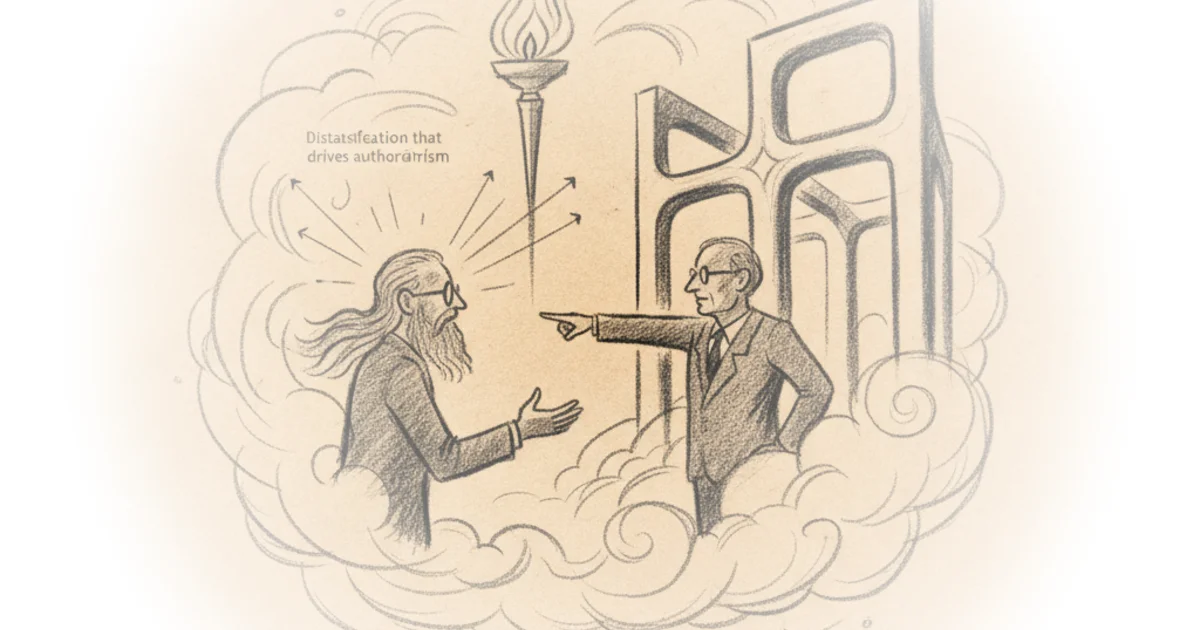
Drawing on decades of psychological research by Edward Deci and Richard Ryan, Mounk identifies four non-negotiable conditions for human thriving: autonomy, competence, relatedness, and purpose. He notes that "without those conditions being met, people, even in conditions of material comfort, languish." This is a powerful reframing. It moves the debate away from abstract rights toward concrete psychological necessities. Critics might argue that this framework still feels too individualistic to satisfy communities craving collective identity, but Mounk's inclusion of "relatedness" as a core dimension attempts to bridge that gap.
The knowledge required to direct the forms of a flourishing life is not dispersed in the way market knowledge is... That knowledge does not exist anywhere yet, because it is made only in the living.
The Hubris of Prescription
The article's most compelling section attacks "post-liberal" thinkers who claim that liberalism has failed because it lacks binding religious or civilizational commitments. Mounk identifies a fatal flaw in their logic: they assume we already know what the good life looks like. He argues, "The post-liberals have a fundamental hubris—a belief that the forms of human flourishing are known, that the process of 'discovery' is really a flip to the answers in the back of the book."
He illustrates this with the example of Wikipedia, describing it as a form of "disciplined, social, generative" cooperation that no central authority could have designed. This aligns with Friedrich Hayek's insight on dispersed knowledge and Karl Popper's theory of conjecture and refutation. Mounk writes, "John Stuart Mill's term 'experiments in living' is not a metaphor. It describes the mechanism by which societies discover which new forms a flourishing life can take." The implication is clear: any system that tries to enforce a single moral vision inevitably stifles the very experiments required for societal progress.
The Cost of Closed Societies
Mounk does not shy away from applying this theory to current geopolitical realities, using Hungary as a cautionary tale. He points out that while Viktor Orbán's government promised order and tradition, it systematically dismantled the institutions necessary for discovery. "A captured press is one of the first channels of unauthorized inquiry to close," he observes, noting how public universities were moved under loyalist control.
The result was not a renaissance of national spirit, but an exodus of talent. Mounk notes that "Hungarians turned Orbán out in April 2026, but many of those who would have done the most with a freer country had already gone." This serves as a stark reminder that closing off the discovery process has real, long-term human costs. As he puts it, "Post-liberalism represents a return to the closed society, where the forms of the good life are licensed rather than discovered."
A life discovered is owned, not imposed. Creating the conditions for that discovery is the quiet genius of liberal institutions.
Bottom Line
Mounk's argument succeeds by shifting the liberal defense from passive tolerance to active cultivation of human potential; it acknowledges that freedom requires more than just the absence of coercion—it demands an ecology where new forms of life can emerge. The piece's greatest vulnerability lies in its optimism: it assumes that the "discovery" process will naturally yield better outcomes, even as history shows that open societies can also produce chaos and polarization. Yet, his call for a "muscular liberalism" that defends the process of discovery rather than dictating the result offers the most coherent path forward for an ideology under siege.