Kings and Generals delivers a stark, materialist autopsy of the Mediterranean world, stripping away the romanticism of the 'Dark Ages' to reveal a brutal economic collapse driven by the disintegration of state infrastructure. Rather than focusing on the personalities of kings or the theological debates of bishops, the documentary frames the fall of Rome as a systemic failure of logistics, law, and commerce that turned a prosperous, urbanized civilization into a fragmented, agrarian survival zone. This is a crucial distinction for understanding how complex societies unravel: it wasn't just a change of rulers, but the total evaporation of the mechanisms that kept cities alive.
The Unraveling of Social Order
The piece begins by establishing the high-water mark of Roman stability before the collapse, noting that by the 5th century, slavery had largely given way to a system of free artisans and small landholders. Kings and Generals writes, "the existence of a still numerous middle class of small landed proprietors, merchants and artisans served to maintain a social equilibrium within the empire." This framing is vital because it highlights that the pre-collapse society was not merely a hierarchy of oppressors and slaves, but a functioning middle economy that provided stability. The narrative suggests that the loss of this specific class was the true tragedy, as it removed the buffer between the aristocracy and the peasantry.
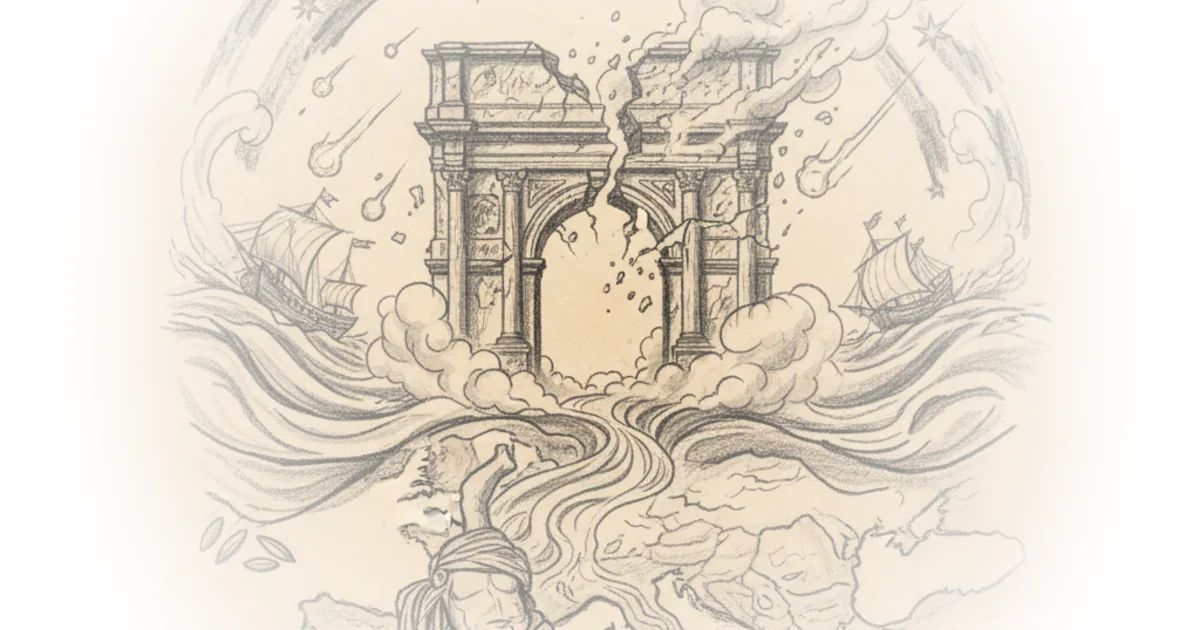
When the Germanic tribes arrived, the initial response was not immediate destruction but a complex, often awkward, integration. The documentary details how rulers like Theodoric the Great attempted to preserve Roman customs to maintain legitimacy. As Kings and Generals puts it, "Theodoric sought to safeguard the roman customs because of his appreciation of the benefits that this civilization had developed." This is a nuanced take that avoids painting the invaders as mindless vandals; instead, it portrays them as pragmatic actors trying to inherit a system they didn't fully understand. However, this fragile synthesis eventually broke down. The argument posits that once these new rulers felt militarily secure, they abandoned the pretense of Roman continuity, leading to a rapid institutional decay. The core of the argument is that the collapse was not a single event in 476, but a slow-motion erosion of the rule of law that took a century to complete.
The solid roman administration collapsed resulting in a loss of order and the reappearance of anarchy throughout the mediterranean.
Critics might note that this narrative leans heavily on the idea of a 'golden age' of Roman law that was abruptly lost, potentially underestimating the corruption and inequality that existed within the late empire. Yet, the documentary's focus on the disappearance of the middle class offers a compelling counter-narrative to the idea that the fall was merely a political transition.
The Economic Regression and the Rise of the Church
The most harrowing section of the coverage details the economic regression that followed the political fragmentation. With the central authority gone, the complex trade networks that fed the cities evaporated. Kings and Generals writes, "bartering reappeared as the main form of trade as money became rare and credit disappeared." This shift from a monetized economy to a barter system is the definitive marker of the era's decline, signaling the death of specialization and the return to subsistence living. The documentary effectively illustrates how the loss of infrastructure—roads, bridges, and ports—accelerated this process, turning the Mediterranean from a highway of commerce into a barrier of piracy and lawlessness.
Amidst this chaos, the Catholic Church emerges as the sole surviving centralized institution. The commentary explains that the old aristocracy and the church formed an uneasy alliance to preserve Latin learning and administration. "Together the old aristocracy and the church managed to preserve latin learning maintained the art of writing and kept in place a centralized administration through the network of bishops." This is a critical insight: the preservation of culture was not an act of pure piety, but a survival strategy by the elite to maintain their status in a world where their traditional power bases had vanished. The documentary argues that while the church saved the idea of Rome, it could not save the reality of Roman prosperity for the common person.
The human cost of this transition was staggering. The piece describes how the new Germanic aristocracies, such as the Visigoths and Lombards, seized vast amounts of land, often two-thirds of the Roman domains. "This great transference of property provoked the formation of a new aristocracy with romans and germanics mixing however it also caused the disappearance of these small free proprietors and a quick diminishing of the roman middle class." The result was a rapid re-feudalization of society, where free citizens were reduced to the status of serfs or slaves. Kings and Generals notes that "life in the mediterranean considerably deteriorated," a phrase that feels almost too mild to describe the reality of famine, plague, and the destruction of aqueducts that left cities like Rome as ghost towns.
The Eastern Exception: Byzantine Resilience
The documentary draws a sharp contrast between the West and the East, where the Byzantine Empire managed to avoid total collapse. While the West descended into anarchy, the East retained a strong military organization and a cohesive bureaucracy. Kings and Generals writes, "the strong military organization of the eastern empire enabled it to hold out until the time of justinian and heracles." This section is particularly instructive for understanding why some states survive systemic shocks while others do not. The East's ability to assimilate invaders as foederati (allies) while maintaining central control allowed it to weather the storms that destroyed the West.
Under Emperor Justinian, the East even launched a counter-offensive, reconquering parts of Italy and Africa. The documentary highlights the economic reforms that followed, such as the theme system, which tied military service to land cultivation. "The reform of the themes incited the byzantines to create numerous military colonies there soldiers of the byzantine army cultivated the lands given over to them as a form of military service." This policy not only repopulated deserted lands but also created a stable, self-sustaining military class. The argument here is that the East survived because it adapted its institutions to the new reality rather than trying to cling to the old Roman model or collapsing into feudalism.
Justinian's reign thus marked a new beginning for the roman empire.
A counterargument worth considering is whether the Byzantine model was truly sustainable or merely a delayed collapse. The documentary mentions the devastating impact of the bubonic plague and the eventual loss of territories to the Arabs, suggesting that the East's resilience had its limits. However, the piece successfully argues that for the 6th and 7th centuries, the East provided a vital bridge that kept Roman law, culture, and economic complexity alive when the West had forgotten them.
Bottom Line
Kings and Generals makes a powerful case that the fall of Rome was not a sudden event but a prolonged economic and social regression that dismantled the very foundations of Mediterranean civilization. The strongest part of this argument is its focus on the destruction of the middle class and the collapse of the monetary economy, which explains why the 'Dark Ages' were so dark for the average person. The biggest vulnerability is the somewhat binary view of the East as a success story, which glosses over the immense suffering and eventual stagnation that also plagued the Byzantine world. Readers should watch for how modern parallels of infrastructure decay and institutional collapse might mirror these ancient patterns, as the documentary suggests that the fragility of complex societies is a timeless lesson.