In an era obsessed with data-driven causality, Jonathan Rowson makes a startling claim: meaning exists independently of cause, and the universe communicates through coincidence rather than just physics. This is not a mystical retreat from reality, but a rigorous proposal that our survival in the 21st century depends on recognizing a "poetic order" that runs parallel to the causal one. For busy minds accustomed to linear problem-solving, Rowson's exploration of a dying fox, a forest poem, and a singing frog chorus offers a radical alternative to the anxiety of a world that feels increasingly chaotic.
The Fox as Emissary
Rowson begins with a visceral, unsettling encounter: a red fox appearing at his door, dying from an unknown cause in the middle of a London heatwave. He refuses to dismiss the event as mere biological happenstance, even while acknowledging the risk of narcissism. "I was in a hermeneutic mode, sensing that what I was obliged to witness meant something," he writes. This framing is crucial; he does not claim the fox died for him, but that the timing of the death coincided with a profound personal crisis, creating a "totemic communication" that demanded attention.
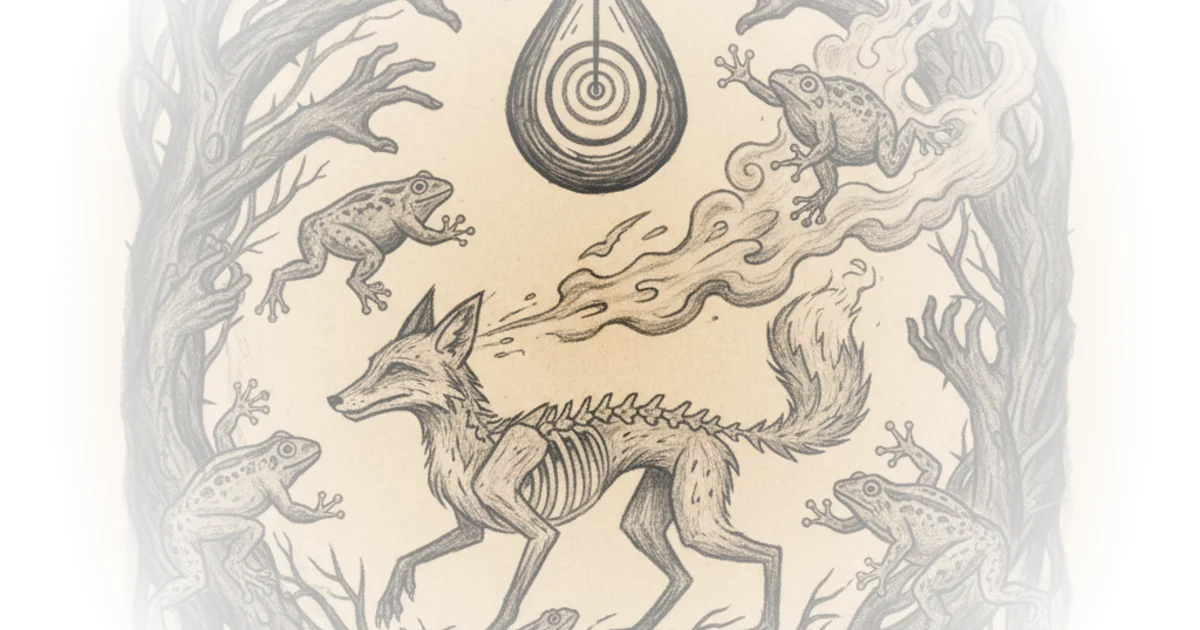
The author navigates the tension between scientific skepticism and spiritual intuition with remarkable grace. He admits the idea sounds "ridiculous, anthropocentric, narcissistic, or proto-psychotic," yet insists that the experience was an "objective occurrence in a shared lifeworld." This is the piece's first major pivot: moving from the specific tragedy of the animal to the universal human need for narrative. Rowson argues that we are not just passive observers of events but active participants in a "cosmic grammar" we have forgotten how to speak. Critics might note that relying on personal coincidence risks confirmation bias, where we find patterns in randomness to soothe our own fears. However, Rowson anticipates this by grounding his argument in "ontopoetics," a term he borrows from deep ecologist Freya Matthews, which posits an "inner aspect of reality" that coexists with physical laws.
The meaning of the fox arose from my experience of the beguiling ambiguity of it and the gift-like gratuity of it.
The Forest and the Poetic Order
To make sense of this "disequilibrium," Rowson turns to David Wagoner's poem "Lost," using it as a metaphor for navigating a world that feels increasingly unintelligible. He suggests that in an age of instant information, we have lost the capacity for memory and deep reflection, which are essential for "cognition, culture, sensibility and even resistance." The core of his argument here is that ecology alone is insufficient; we need a second phase of re-negotiation with reality that is rooted in "ontopoetics."
Rowson defines this field as the study of the "poetic order, of the meanings that structure the inner aspect of being." He lists a dizzying array of intellectual traditions—from Jungian synchronicity to Heideggerian truth as disclosure—that converge on this idea. The strength of this section lies in its synthesis; he weaves together philosophy, theology, and depth psychology to suggest that "story as the perennial grammar of value" is not just a human invention, but a feature of the universe itself. This reframes the human condition from one of isolation to one of connection with a "more-than-human world" that is "weird and wonderful."
As Rowson puts it, "If physics is the study of the causal order, then ontopoetics may be defined as the study of the poetic order." This distinction is vital for readers feeling overwhelmed by the sheer scale of global crises. It suggests that while we cannot control the causal chain of events, we can cultivate a relationship with the meaning that arises from them. A counterargument worth considering is that this approach might lead to passivity, encouraging people to "let the forest find them" rather than taking concrete action. Yet, Rowson's intent seems to be the opposite: to provide the psychological resilience needed to act effectively in a turbulent world.
Singing in the Rain
The essay culminates with a story from Kerala, India, where Rowson hears a frog chorus singing in the rain. He notes the paradox that the frogs sing even though it attracts predators and increases their risk of death. "No matter who or what is hunting us, we don't have to hide," he reflects, connecting the frogs' behavior to the human condition. The frogs become a symbol of "sublime" joy that persists despite the inevitability of death.
This final image serves as a powerful antidote to the despair often found in environmental and political discourse. Rowson writes, "The frog chorus reminded me that joy is our nature, and life is as beautiful as it is short." He argues that the capacity to "sing in the rain" is not a denial of danger, but a recognition of our shared vulnerability and the beauty of existence itself. This is not a call to ignore the threats we face, but a reminder that our response to them need not be solely defined by fear. The argument holds up because it is grounded in a specific, observable phenomenon rather than abstract theory, making the philosophical leap feel earned.
May we all gift each other the courage to continue singing in the rain.
Bottom Line
Rowson's strongest contribution is his ability to validate the human experience of meaning without retreating into superstition, offering "ontopoetics" as a rigorous framework for understanding coincidence. The piece's vulnerability lies in its reliance on personal anecdote, which may feel too subjective for readers seeking empirical proof. However, for those willing to engage with the idea that the universe speaks in poetry as well as physics, this commentary provides a necessary and uplifting roadmap for navigating the 21st century.