Chris Chappell reframes the recent escalation in the Middle East not as a standalone conflict over nuclear proliferation, but as a calculated geopolitical maneuver designed to sever China's strategic lifelines. While mainstream coverage often isolates the Iran strikes, Chappell argues that the administration's actions are a direct response to a long-running shadow war, targeting the very infrastructure that allows Beijing to bypass sanctions and project power globally.
The Strategic Pivot
Chappell's central thesis is that the United States is executing a grand strategy to isolate Beijing before a potential flashpoint in the Pacific. He posits that the administration is systematically dismantling the network of proxies and resource dependencies that China has cultivated over the last decade. "Trump is reacting to a war other countries have already been waging against the US," Chappell asserts, suggesting that the strikes are a defensive counter-offensive rather than an unprovoked aggression. This framing is compelling because it connects disparate events—regime change in Venezuela, military pressure in Iran, and diplomatic friction in the Gulf—into a single, coherent narrative of containment.
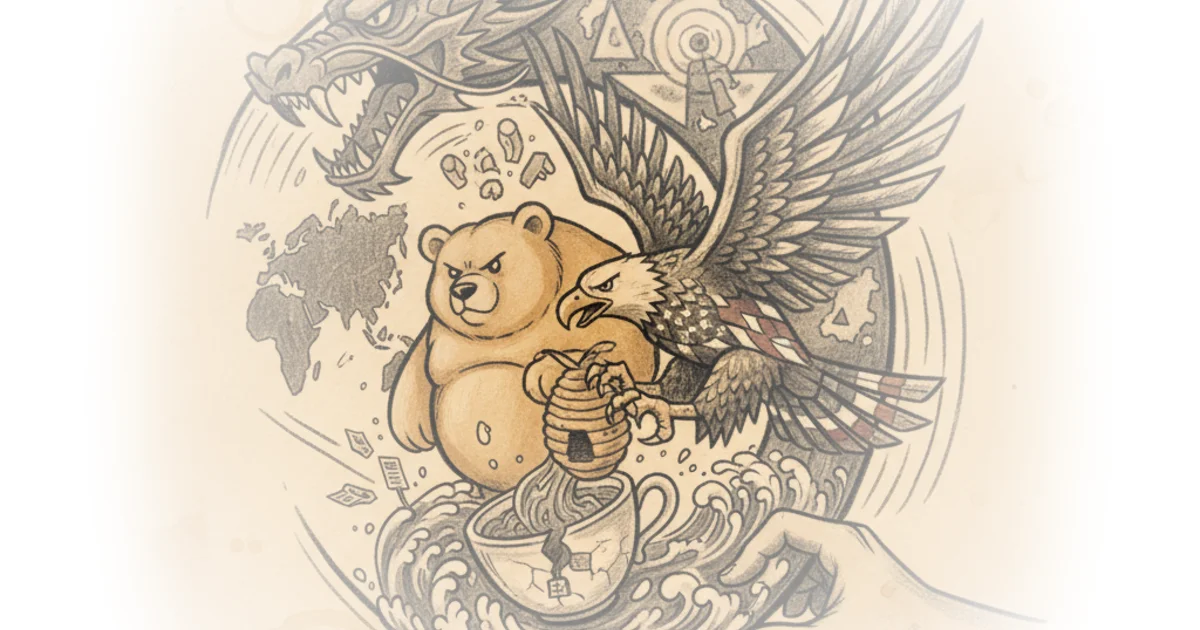
The author draws heavily on the economic reality of energy dependence to bolster this claim. He notes that "China is now Iran's biggest trading partner and has traditionally relied on Iran's oil to fuel economic growth," a dependency that has become a critical vulnerability. By highlighting that China purchases over 80% of Iran's shipped oil, Chappell illustrates how the disruption of Iranian output directly impacts Beijing's energy security. This is not merely about regional stability; it is about the fuel that powers the Chinese economy and the Belt and Road Initiative.
"The US goal is to focus 100% on the Pacific in the next 2 years."
Chappell's analysis of the military dimension is equally sharp. He points out that China has been the primary supply chain for Iran's weapons programs, providing everything from ballistic missiles to surveillance technology. "China was and is still the main supply chain for Iran for everything needed to build weapons," he writes, citing intelligence reports on the flow of missile fuel and supersonic anti-ship missiles. The strikes, therefore, serve a dual purpose: degrading Iran's immediate threat and exposing the fragility of Chinese arms exports. This argument gains weight when viewed through the lens of the "Shadow fleet" operations, where China has long relied on obscure shipping networks to move sanctioned oil; the recent US pressure on these networks mirrors the broader strategy of choking off illicit supply chains.
Critics might note that attributing such a coordinated, long-term strategy solely to the current administration overlooks the bipartisan consensus on China containment that has existed for years. However, Chappell's focus on the specific, aggressive tactics employed now—such as the use of advanced technology to dismantle command structures—distinguishes this phase from previous diplomatic efforts.
The Collapse of Chinese Leverage
Beyond the immediate military and economic impacts, Chappell argues that the strikes have a profound psychological effect on China's allies in the Gulf. The administration's actions are designed to shatter the illusion of Chinese reliability. "A stronger Iran makes Gulf powers like Saudi Arabia and the UAE, among others, nervous," Chappell observes, explaining that these nations previously turned to Beijing when they felt abandoned by Washington. Now, the demonstration of US military precision is intended to reverse that trend.
The author suggests that the failure of China's diplomatic mediation efforts is a key indicator of this shift. He notes that the trilateral meeting between Iran, China, and Saudi Arabia, brokered in 2023, "aged like milk left out in the sun" following the recent conflict. This vivid metaphor underscores the collapse of China's image as a neutral, effective mediator. By arming Iran and failing to prevent the escalation, Beijing has inadvertently strengthened the argument that the US remains the only power capable of enforcing order in the region.
Chappell also touches on the information warfare aspect, noting how Chinese state media rushed to spread disinformation about the strikes. "Chinese staterun media rushed to celebrate reports that the USS Abraham Lincoln aircraft carrier had been hit by Iranian missiles with AI slop," he writes, highlighting the desperation in the narrative battle. This reaction, he argues, reveals the depth of Beijing's anxiety. The censorship of a Malaysian song titled "It's a Pity It's Not You" serves as a bizarre but telling example of the regime's paranoia regarding any narrative that could undermine its authority or signal the failure of its proxies.
"The strikes expose the fragility of every client relationship Beijing has built from Iran outward."
This point is particularly strong. It suggests that the administration's strategy is not just about destroying hardware, but about breaking the political will of China's partners. If Gulf states believe that China cannot protect its investments or allies, they will be less likely to align with Beijing on critical issues like semiconductor export controls or the future of the dollar-based financial order. This aligns with the broader context of the "Manticore Tapes," which revealed the extent of China's efforts to infiltrate and manipulate global information networks; the current crisis is a direct challenge to those efforts.
The Long Game and Future Risks
Despite the apparent success of the strikes, Chappell warns against complacency. He emphasizes that the Communist Party of China plays a "long game" and will adapt regardless of the outcome in Tehran. "If Iran, more specifically the Iranian Revolutionary Guard Corps, remains in charge of Iran, the CCP will go back to arming and supplying them and buying their oil," he cautions. Even if the regime collapses, Beijing will seek to engage with whatever government emerges, using its economic leverage to maintain influence.
This nuance is crucial. It prevents the commentary from becoming a simple celebration of a tactical victory and instead frames it as a step in a much longer contest. The author argues that the US must remain vigilant to deny China any opportunity to rebuild its influence. "We can't lose sight of that," Chappell insists, urging a sustained focus on the region to prevent the re-emergence of a Chinese-backed proxy state.
Critics might argue that the focus on regime change could lead to prolonged instability, creating a power vacuum that other actors could exploit. While this is a valid concern, Chappell's argument rests on the premise that the current Iranian leadership is the primary vector for Chinese influence, and removing it is a necessary, albeit risky, step to secure long-term US interests.
Bottom Line
Chappell's most significant contribution is linking the kinetic strikes in Iran to the broader strategic competition with China, arguing that the administration is successfully dismantling the economic and military pillars of Beijing's global influence. The argument's greatest vulnerability lies in its assumption that Gulf states will immediately pivot back to the US, a shift that may be slower and more complex than the analysis suggests. Readers should watch for how the administration leverages this momentum to secure long-term alliances in the Gulf before the next phase of the Pacific strategy unfolds.