Most people believe they know the story of ancient Egypt: a civilization born along the Nile, its pyramids and temples rising from desert sands. But the discipline that gave us this knowledge was built on something darker than sand. David Wengrow, an archaeologist and professor at University College London, argues that the very foundations of Egyptology contain explicit racist beliefs—and those beliefs still shape how we think about human history today.
"The idea that the pyramids of Egypt were not constructed by ordinary African people comes straight out of the foundations of Egyptology," Wengrow says. "This is an important story."
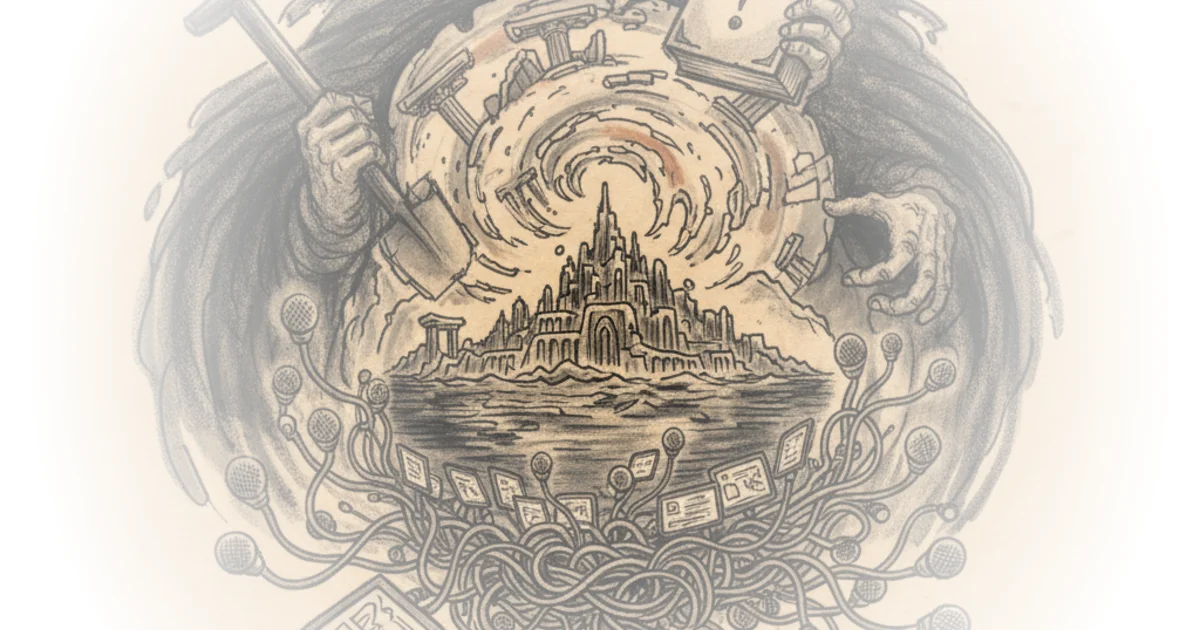
The Father of Archaeological Science
In the late 19th and early 20th century, the leading archaeologist in the world was William Matthew Flinders Petri. If you studied archaeology, you learned Petri as the father of archaeological science. He made enormous innovations that became central to how the discipline functions.
But Petri held deeply troubling views. He was a eugenicist who believed the working classes needed to be controlled or turned into a hereditary underclass. He believed intelligence and IQ were the preserve of certain select races.
"He was also a eugenicist who firmly believed that the working classes needed to be either controlled or turned into a sort of hereditary underclass," Wengrow explains. "And in his work on ancient Egypt, there is an enormous paradox at the heart of it."
On one hand, Petri produced much of the evidence that made visible for the first time the cultural roots of ancient Egyptian civilization—what existed before the pharaohs, before the pyramids. He was one of the main contributors to that.
But in producing this knowledge, he did something else: he placed an absolute division between the origins of Egyptian civilization and the continent of Africa.
"He explicitly denied that Africans could have achieved or produced literacy, monumental architecture, urbanization— all those things that happened in that part of the world," Wengrow says. "And he attributed them to what he called initially the new race."
Who Is the "New Race"?
Petri wrote numerous articles trying to get to the bottom of his self-created question. He measured skulls collected from ancient graves and concluded that the new race was definitely not African but had migrated from somewhere in western Asia, possibly with links toward the Caucasus.
"We're getting closer and closer to white people," Wengrow says dryfully.
Then there was another category called "hamite" or "hemitic" civilization—believed to be more Eurasian than African. These classifications may sound obscure, but they fed into modern ethnic conflicts in countries like Rwanda, right up until the modern era.
He explicitly denied that Africans could have achieved or produced literacy, monumental architecture, urbanization — all those things that happened in that part of the world.
"This is at the root of our own discipline," Wengrow argues. "And by creating that initial division, it opened that window into which you can insert whatever you like. The basic premise is that it couldn't possibly have been Africans. And then you can talk about whatever you like—aliens from Venus, whatever you like."
The Indo-European Paradox
The conversation shifts to another layer of this problem: Indo-European language studies.
Indo-European is a perfectly legitimate concept in historical linguistics. It goes back to William Jones, who pointed out the resemblances and connections among languages from Iran to Ireland—real linguistic connections.
But there's another history to these studies that goes way beyond language. This other branch posited links between language, culture, and biological race. In the early 20th century, researchers tried to reconstruct and search for an Indo-European homeland—a place where language, culture, and race formed a kind of perfect unity.
"If you ask a historical linguist, they'll explain about what they call proto languages," Wengrow says. "These are reconstructions from surviving languages or languages preserved in ancient texts."
A proto language is not a spoken language—it's a construction. We don't have the full range of languages that actually existed; we have only a small part of the spectrum of what was actually spoken, from which it's possible to reconstruct a kind of proto form.
"It's construction," Wengrow emphasizes. "It's a historical construction. It's not a population. It's not a group of people."
And yet in the mid-20th century, this whole field was hijacked by the Nazis and linked to the search for an Aryan homeland.
The Return of Racial Purity
After World War II, nobody wanted to talk about this very much. But through genuine scientific innovations—particularly in genetics and ancient DNA—this discourse is back again.
"Suddenly this whole language is back again and it's very prominent in my field," Wengrow says. "There was even a paper published recently, just last year in a top science journal, called The Genetic Origins of the Proto-Indo-Europeans."
What this means is that researchers are reintroducing and normalizing the idea that culture, language, and biology form a kind of unity—the idea that one can escape from the complexity and mixture of human cultures and get back to some kind of pure essence.
"The entities which are identified in this way map very faithfully onto the racial categories that were invented in the early 20th century," Wengrow argues. "And you get very similar looking maps of migrations—human populations moving often in rather bizarre ways that ignore topography, sort of striding across seas and rivers and mountains."
The European Enlightenment's Hidden Debt
Wengrow noticed something remarkable: there's still a remarkable resistance to the idea that the European Enlightenment owed an intellectual debt to anything that wasn't homegrown on European, Western European soil.
"This is a counterintuitive thing," he says. "All of this is happening after the so-called age of discovery—which was only an age of discovery for Western Europeans. They weren't discovering anything; people lived there."
In the 1930s, French historian Paul Haza wrote a book called The Crisis of the European Mind. It goes against what we're usually told about the Enlightenment: that it was a manifestation of confidence in Europe's growing economic power and military might.
"What Haza argues—and I think shows quite compellingly—is that this was also a kind of mental crisis for European nations which had only known monarchy and church dogma," Wengrow says. "They were suddenly exposed to a kaleidoscope of other ways of living with the encounter with the new world."
This encounter with societies living in different social forms caused European philosophers to reflect, perhaps for the first time, on the ingrained hierarchies in their own society.
The Imaginary Savages
One practice that emerged from this crisis was writing fictitious dialogues between European philosophers and indigenous people.
In the second half of the 18th century, writers like Voltaire found it extremely fashionable to craft dialogues with purely imaginary savages—exotic characters. Sometimes from China, sometimes a Tahitian, a Peruvian princess, an Inca princess.
"It was always the exotic figure," Wengrow explains. "But it was always imagined through European categories."
The practice allowed philosophers to explore alternative ways of living without ever having to actually listen to those who lived differently.
The Real History
Wengrow argues that ultimately, humans evolved on the continent of Africa—and you could look completely differently at all of this if you emphasized the connections, the degrees of connectedness among things.
"The idea that everything forms a kind of tree-like formation that gets you back to some pure original source is a model," he says. "It's an image. There's nothing essential about it."
The premise—that it couldn't possibly have been Africans—opens a window into which you can insert whatever you like.
Critics might note that Wengrow's analysis relies heavily on the historical record of 19th-century archaeology, which itself contains gaps and contested interpretations. Some scholars argue that modern genetic research has genuinely moved beyond these early biases, even if popular discourse still carries them.
Bottom Line
The strongest part of this argument is its exposure of how deeply racist assumptions were embedded in the foundations of archaeology—and how those same assumptions continue to shape debates about human history. Wengrow's vulnerability is that he's describing a historical structure rather than offering solutions; the practical question of what to do with this knowledge remains open. What readers should watch for next is whether modern genetic research truly escapes these frameworks—or simply reinvents them.