Most historical narratives treat the Sahara as a permanent barrier, a static wall of sand that isolated civilizations. Paul Cooper shatters this assumption by revealing the desert as a dynamic, shifting landscape that actively shaped the rise and fall of empires, arguing that the Songhai Empire's destiny was written in the slow wobble of the Earth's axis long before the first camel stepped onto the sand.
The Planetary Engine of History
Cooper begins not with kings or battles, but with the celestial mechanics that dictate climate. He posits that the story of West Africa is fundamentally a story of planetary cycles. "This is the wobble of the earth known more scientifically as its axial precession," he explains, noting that this 25,000-year cycle shifts the angle of the planet's tilt, driving the monsoon rains southward and creating the arid zone we now know as the Sahara. This framing is crucial; it forces the reader to see the desert not as a natural given, but as a recent geological event that displaced entire populations. The author reminds us that "until about five thousand years ago these bare sand dunes were rolling green grasslands," a fact that recontextualizes the entire region's history as a desperate migration rather than a static existence.
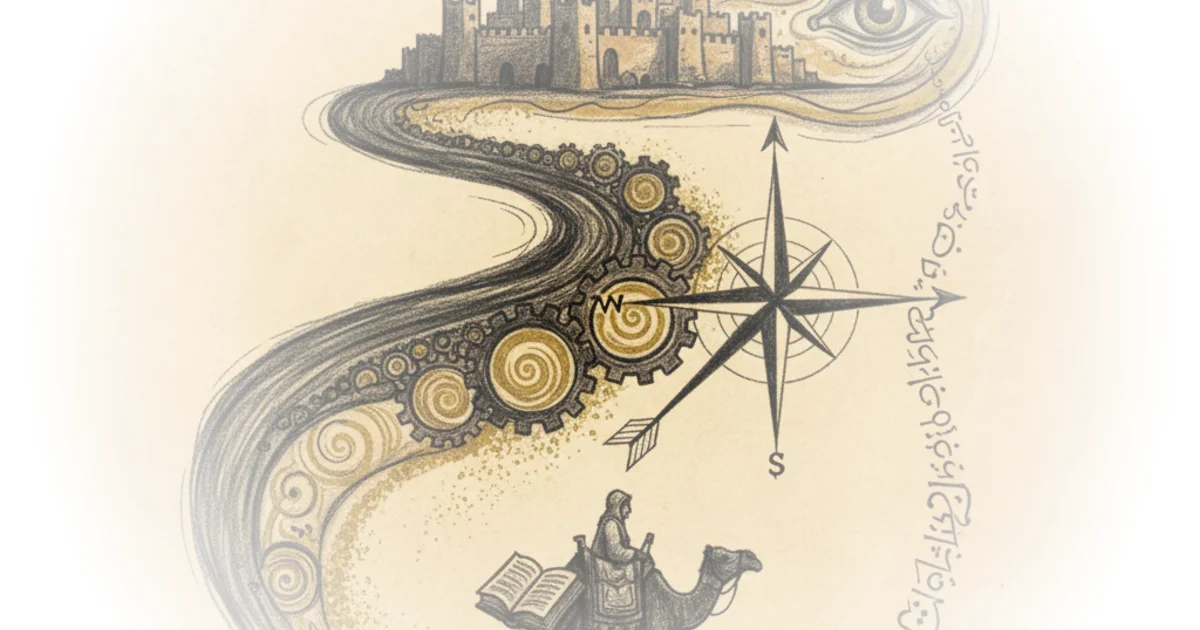
The narrative then pivots to the human response to this environmental collapse. As the green valleys turned to dust, people were funneled into the Sahel, a transition zone that became the cradle of a new society. Cooper describes this area as "neither the desert sand to the north nor the tropical savanna to the south," a liminal space where survival demanded innovation. The convergence of the Saco, the Gao, the Dyou, and the Songhai along the Niger River created a "blended society that survived by unifying formerly disparate elements into a successful whole." This synthesis of riverboat technology, hunting prowess, and farming acumen supercharged by the horse laid the groundwork for what would become Africa's greatest empire. The argument here is compelling because it grounds political power in ecological necessity; the empire didn't just happen, it was forged by the need to manage the river's bounty in a drying world.
The Sahara is a vast ocean of sand dunes rock plateaus and salt flats that covers an area totaling nine million square kilometers... but until about five thousand years ago these bare sand dunes were rolling green grasslands.
The Imperial Cycle and the Camel Revolution
Cooper does not shy away from the brutal reality of state formation. He defines an empire with stark clarity: "An empire is a violent phenomenon it occurs when one Kingdom or state becomes more powerful than its neighbor." He traces the "Imperial cycle" where a center extracts resources, imposes culture, and eventually fractures under the weight of its own overreach. This is not a romanticized view of history; it is a structural analysis of power. The author suggests that while the first empire, Ghana, rose on the back of iron working, the true game-changer was biological. "Until around the Year 300 horses were the main mode of transportation in West Africa," Cooper writes, but they were ill-suited for the desert's extreme heat and sandstorms.
The introduction of the camel from Arabia transformed the economic geography of the continent. Cooper details how these animals, with their "distinctive hump on their back designed for storing water," enabled large-scale trade across the Sahara. The scale of this operation was staggering. Citing the 14th-century writer Ibn Battuta, Cooper notes that caravans could swell to "12,000" camels, snaking across the red sands for miles. This connectivity linked the West African economy to the Mediterranean, turning the region into a hub of immense wealth. The author's description of the oases as "crucial stopping points" where military control meant control over an entire trade route highlights the strategic fragility of these empires. They were rich, but their wealth depended on the maintenance of a precarious logistical chain across a hostile environment.
Critics might note that focusing so heavily on the camel and trade routes risks underplaying the internal social dynamics and the role of religious conversion in stabilizing these empires. While the economic engine is undeniable, the cultural glue that held such a vast, pluralistic society together deserves equal weight. Cooper touches on the pluralism of the Songhai but prioritizes the material conditions of their rise.
The Ghost of Gao
The piece returns to the human scale through the eyes of Heinrich Barth, the 19th-century explorer who stumbled upon the ruins of Gao. Cooper uses Barth's disappointment to illustrate the sheer magnitude of the loss. Barth expected a metropolis and found "only a small collection of huts about 300 in total with heaps of overgrown rubble." The contrast between the "unanimous statements of four Reiter's" who called it the "most splendid city of Africa" and the "desolate abode of a small and miserable population" is haunting. Cooper captures the melancholy of the scene: "The town in his most flourishing period seems to have had a circumference of about six miles," yet now it is swallowed by vegetation and silence.
This section serves as a powerful reminder of the impermanence of even the greatest human achievements. The author notes that the inhabitants still pray in the sacred space where their "great Conqueror is interred," yet they lack the energy to repair the ruins. It is a poignant image of a civilization that has collapsed into the dust, leaving only the "rich Corona of vegetation" to reclaim the stone. Cooper's choice to end this segment with Barth's lingering questions—"how had the Empire of Songhai grown to such size... and why after rising to such great heights had they left it all here to crumble?"—sets the stage for the deeper analysis of collapse that follows in the full episode.
The once-mighty capital city might even go down in flames but for its most powerful client states the lack of central authority might represent an opportunity.
Bottom Line
Paul Cooper's greatest strength is his ability to weave planetary science with human history, demonstrating that the rise and fall of the Songhai Empire was not merely a political story but a climatic one. The argument's vulnerability lies in its heavy reliance on environmental determinism, which, while powerful, can sometimes overshadow the complex agency of the people who built and maintained these societies. Readers should watch for how Cooper balances the inevitability of the "Imperial cycle" with the specific choices that accelerated or delayed the collapse of this African age of gold.