The Infrastructure of Power
Brian Merchant's piece catches a moment when the architecture of authoritarianism becomes visible. Protesters gathered outside Amazon's Santa Monica campus last Friday, linking the company's cloud contracts with immigration enforcement to the broader machinery of state surveillance. What makes this notable isn't the protest itself—it's how thoroughly Amazon has embedded itself into the federal government's operational backbone, from border enforcement to national security.
The ICE Contract
Merchant opens with the scene: hundreds on the corner of Olympic and 26th, high schoolers marching, signs reading "AMAZON POWERS ICE." The connection is concrete. Amazon signed a $5 million contract with ICE last year to operate its cloud services and databases. Carter Moon, an organizer, told Merchant: "Our goal today was to draw the connection between ICE's cruelty and the digital infrastructure that Amazon provides to give them the ability to target and capture migrants."
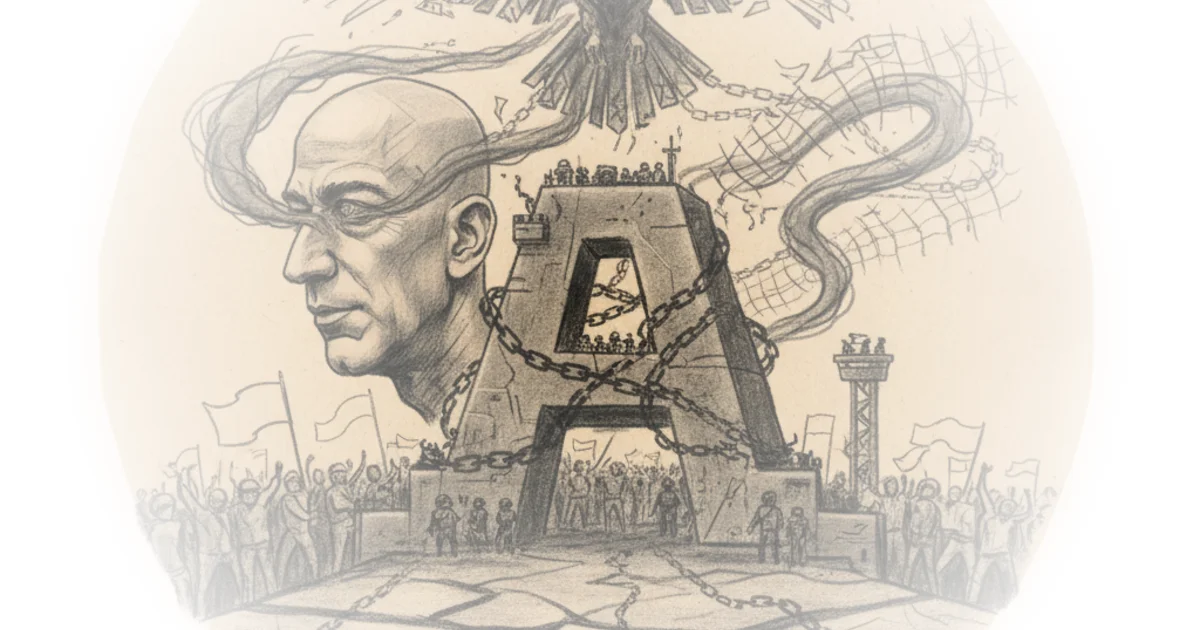
As Brian Merchant puts it, "Big tech has not caught enough heat for this." The screenwriter and former tech worker Olga Lexell added: "It's people like Elon Musk, Jeff Bezos, Sam Altman, Mark Zuckerberg—the tech CEOs who are using their tools to facilitate these deportations. They can actually do more now than anyone in our government probably can."
"Jeff Bezos has learned that he can submit the free press to authoritarianism to serve his interests, while the authoritarians have learned they can behave more like Amazon to serve theirs."
The Washington Post Dismantling
The week after the ICE protest, Bezos laid off 30% of the Washington Post's staff. He eliminated the books and sports sections, gutted tech, climate, and international coverage, fired war correspondents mid-deployment in Ukraine. The paper would "reset" to focus on national security and American politics—subject areas less likely to complicate matters for the administration.
Brian Merchant writes: "Bezos feared 'reprisal' against not just Amazon, but also against what the former Washington Post chief described as the 'object of his passion,' Blue Origin, the private space company that holds significant government contracts." The former top editor Marty Baron told MS Now that Bezos's motivation was singular: appeasing the president who had marked the Post as an enemy due to its coverage.
The Business of Alignment
The financial ties run deep. Amazon donated $1 million to the presidential inaugural fund and livestreamed the ceremony on Prime. Bezos intervened to kill the Post's endorsement of Kamala Harris before the election. Amazon spent $40 million on the Melania documentary project—$6 million more than Disney's bid—then budgeted $5 million marketing it, more than any other documentary.
Brian Merchant notes: "When Amazon leadership threatened to list the additional cost of products incurred by tariffs, a phone call from the president was all it took to dissuade them." The president's response, per CNN: "Jeff Bezos was very nice. He was terrific. He solved the problem very quickly. Good guy."
The contracts justify the alignment. Under the current administration, ICE has spent more on cloud services from Amazon and Microsoft than ever before. AWS entered a $10 billion deal to manage civilian government services. The NSA contract: $10 billion over ten years. The Pentagon's Joint Warfighting Cloud Capability: $9 billion with Google and Oracle alongside Amazon.
The Ideological Architecture
Merchant draws the parallel explicitly: ICE's acting director Todd Lyons said his dream is deportation squads operating "like (Amazon) Prime, but with human beings." The dehumanization Amazon perfected on its own workforce—surveillance, productivity metrics, workers peeing in bottles—becomes the template for immigration enforcement.
Brian Merchant writes: "Amazon is providing the technical architecture for the federal security state—for ICE, the NSA, the Pentagon, and many others—that is actively enabling that state to surveil residents of the United States, and to conduct its ongoing campaigns of violence."
Critics might note that government contracts are standard for large tech firms—Google, Microsoft, Oracle all bid on federal work. The question isn't whether Amazon should work with the government, but which functions it enables. Hosting email servers differs from building databases that track "domestic terrorists," a category the administration has expanded to include community organizers and legal observers.
Another counterpoint: worker organizing may have more leverage than consumer boycotts. Merchant reports that 800 Google workers formally demanded their company drop ICE contracts, organized by No Tech for Apartheid. Internal pressure from engineers who build these systems could matter more than external pressure from Prime subscribers.
Bottom Line
Amazon has chosen its side. The company's leadership has aligned institutional interests with the executive branch's enforcement agenda, trading journalistic independence and labor dignity for contract security. Merchant's piece shows the convergence: corporate infrastructure and state power, mutually reinforcing. The protesters outside Santa Monica understand what's at stake. The workers inside the buildings may be the ones who decide whether Amazon remains an instrument of authoritarianism or becomes something else.