In an era where artificial intelligence promises to automate creativity, filmmaker Gary Hustwit pivots to a counterintuitive thesis: the most urgent act of resistance for modern designers is to make things by hand. This piece is not a nostalgic lament for the pre-digital age, but a sharp critique of how algorithmic efficiency is eroding the cognitive muscle required to articulate original ideas. Hustwit frames the current technological surge not as a liberation, but as a potential trap for the human spirit, arguing that true innovation requires the friction of physical limitation.
The Atrophy of Articulation
Hustwit structures his argument around an interview with Everett Katigbak, a designer whose career spans the wild west days of Facebook to the high-stakes AI labs of Anthropic. The core of the piece rests on a startling observation about the relationship between tools and thought. As Hustwit writes, "One of my mentors, the legendary art director Lou Danziger, said the most powerful tool we have as designers is 'Microsoft Word,' meaning that you have to be able to articulate your ideas clearly. But when we start using AI to write for us, that muscle starts to atrophy." This is a profound reframing of the current AI narrative; rather than focusing on output speed, the argument centers on the degradation of the internal process that generates value in the first place.
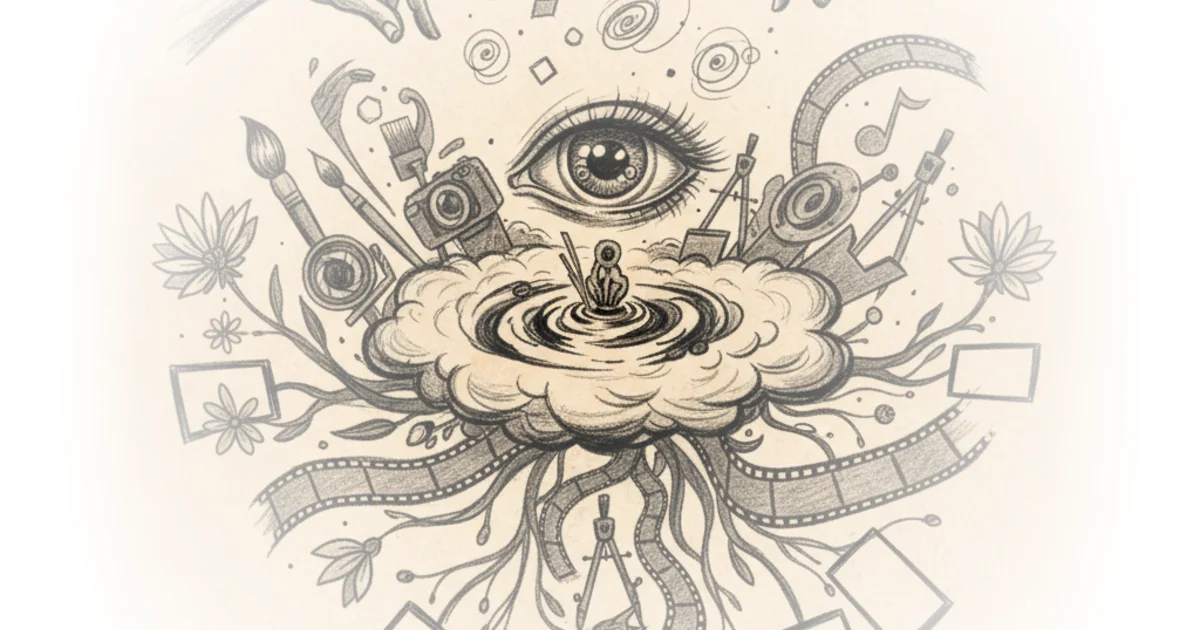
The commentary suggests that relying on prompts to generate final results transforms the creator into a passive manager of outputs, stripping away the agency that defines creative work. Hustwit notes that Katigbak warns against this shift, stating, "When we rely on prompting to get the final result, we become that same nagging client or stakeholder that drains all of our own creative energy." This distinction is vital. It suggests that the danger of AI isn't just that it might replace jobs, but that it might replace the thinking that makes those jobs meaningful. Critics might argue that this view romanticizes the inefficiency of manual labor, but the piece effectively counters that by positioning physical creation as a necessary cognitive offload that keeps the human element intact.
When we rely on prompting to get the final result, we become that same nagging client or stakeholder that drains all of our own creative energy.
The Analog Lab as Cultural Rebellion
Hustwit then traces Katigbak's history, using the "Analog Research Laboratory" at Facebook as a case study for how physical constraints can foster a unique corporate culture. The author details how Katigbak and his colleague Ben Barry bypassed digital design tools to screen-print posters and build conference tables by hand during the company's early expansion. Hustwit writes, "We were building technology for scale, but we were also building it for humans, and that was getting lost in the hype of silicon valley those days." This historical anecdote serves as a blueprint for the piece's broader argument: that the "human element" is not a byproduct of technology, but something that must be actively engineered into the environment.
The narrative highlights how this approach was initially viewed as a distraction, with some questioning the return on investment for hand-crafted items in a data-driven company. Yet, as Hustwit points out, the executive leadership eventually embraced the chaos, with Mark Zuckerberg and other executives telling the team to "Keep going, don't listen to people." This illustrates a key tension in modern management: the conflict between scalable, predictable processes and the messy, unpredictable nature of genuine innovation. The piece argues that Katigbak's success came from his ability to ask "Why not?" of himself and his organization, a question that often gets silenced by the pressure for immediate efficiency.
The Human-Centric Brand
The final section of the commentary shifts to Katigbak's work at Stripe and Anthropic, where the stakes were even higher. At Stripe, Katigbak launched a publishing arm for a financial company, a move that seemed illogical on paper but became a cornerstone of their brand identity. Hustwit captures the essence of this strategy when he notes, "Really it's not about any of that stuff, it's about the ideas, it's about the craft, and it's about the kind of brand investment we're making." This argument challenges the prevailing corporate metric of immediate revenue generation, suggesting that long-term cultural capital is built on things that do not immediately pay dividends.
At Anthropic, an AI company, Katigbak's role was to ensure the brand remained grounded in human values despite the explosive growth of the technology. Hustwit writes, "I realized it wasn't an AI company, but a human-centric company that just happens to be building AI because that's the most impactful thing for our society right now." This redefinition is the piece's most powerful insight. It posits that the value of AI lies not in its ability to mimic human creativity, but in its capacity to serve human needs, provided the creators remain connected to those needs. However, a counterargument worth considering is whether this "human-centric" approach is scalable in a market driven by the very speed and automation that Katigbak critiques. The piece acknowledges this tension but leaves the reader with the conviction that the alternative—a purely algorithmic future—is a path worth avoiding.
Bottom Line
Gary Hustwit's commentary succeeds in reframing the AI debate from one of capability to one of consequence, arguing that the preservation of human creativity requires a deliberate return to analog methods. The strongest part of the argument is the identification of cognitive atrophy as a hidden cost of automation, a point that resonates deeply in a world increasingly mediated by algorithms. Its biggest vulnerability lies in the practical application of these ideals within hyper-growth environments that demand speed over substance. Readers should watch for how independent creators like Katigbak navigate the tension between their human-first philosophy and the economic realities of the tech industry in the coming months.