In an era where literary criticism often devolves into a contest of moral posturing, a recent piece from The Baffler offers a startlingly different lens: it suggests that the most dangerous thing a reader can do is take a novel literally. The article argues that Missouri Williams's new book, The Vivisectors, is not a commentary on current culture wars, but a mirror designed to reflect the reader's own desperate need for certainty back at them. This is a crucial distinction for anyone tired of the performative outrage that has come to define public discourse.
The Trap of Literalism
The piece opens with a jarring admission from the novel's narrator, Agathe, who declares, "Readers, I despise every last one of you." The Baffler notes that this hostility is not a flaw in the writing but the central mechanism of the story. Agathe is a character who views the world through a lens of pure abstraction, detached from the messy reality of human suffering. The article argues that Williams uses this character to expose how easily we, as a society, fall into the trap of conflating the author with the narrator. As the piece explains, Agathe's uncle advises her that "if you wanted to write something terrible about somebody then it was best to use the first person, because they'll never be able to accept that you were capable of betraying them so utterly."
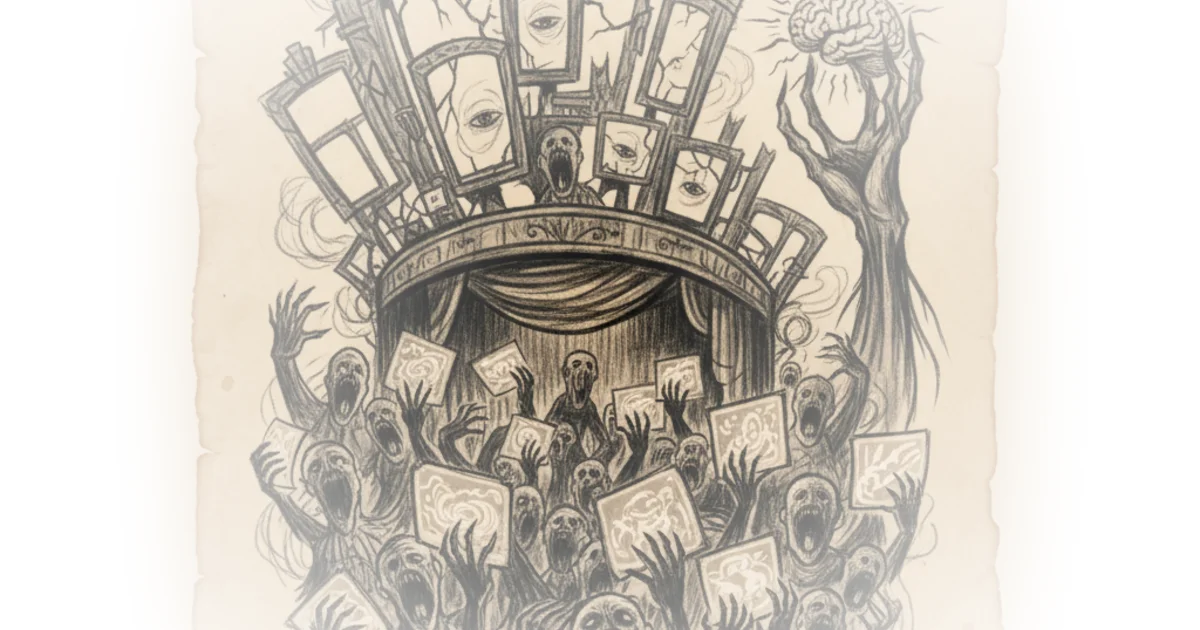
This insight reframes the entire reading experience. Instead of asking what the book is about, the reader is forced to ask what the book is doing to them. The article posits that The Vivisectors is a deliberate exercise in misdirection, designed to make the reader project their own anxieties onto a blank slate. "The Vivisectors is not just about whether its narrator means what she says," the editors argue. "It's about what we risk, and what we stand to gain, by taking her at her word." This is a bold claim, suggesting that our hunger for clear moral binaries is actually a weakness we bring to the text, not a feature of the text itself.
You see your face when you look in a mirror, but you're not looking at yourself. You're looking at something else.
The Prism of Academic Decay
The commentary shifts to the setting of the novel, a university city where social life is governed by "abstract discourse." The Baffler describes a world where "the academics wanted a world sapped of strength," preferring a reality dominated by concepts rather than tangible objects. This setting serves as a sharp critique of the modern institution of higher learning, where language has become untethered from reality. The article highlights a moment where a character observes, "Although there were more and more words, it was becoming increasingly harder to attach them to objects."
This detachment is portrayed not as a triumph of intellect, but as a fatal flaw. The novel depicts a society that is "seeking its own extinction" because it has lost the ability to engage with the physical world. The piece draws a parallel to the companion deep dive on The Society of the Spectacle, noting how the characters in The Vivisectors are trapped in a cycle of self-reference, much like the spectacle described by Guy Debord. The article suggests that the "prism" metaphor used throughout the book is key to understanding this decay. Agathe's boss describes her people as those who "rotated events like glass prisms that revealed unseen colors when placed in new light," yet this rotation prevents them from ever seeing the object itself.
Critics might argue that this portrayal of academia is overly cynical, ignoring the genuine progress made in fields like social justice and environmental science. However, the piece counters that the novel's target is not the pursuit of knowledge, but the "decadence" of a culture that prefers metaphor to truth. "In The Vivisectors, a preference for metaphor represents a culture at its apex; it becomes a stand-in for all other forms of decadence," the article states, quoting the author directly.
The Danger of Extreme Literalness
Perhaps the most provocative argument in the piece is its defense of ambiguity against the rising tide of "extreme literalness." The article notes that while many contemporary voices fear the deconstruction of objectivity, Williams suggests that the real danger lies in the refusal to imagine. "It seems to me that extreme literalness is much more dangerous," the author is quoted as saying. "I prefer a reckless imagination to a limited one."
The commentary connects this to the broader cultural moment, where debates over free speech and DEI often devolve into a contest over the precise definition of words. The piece argues that The Vivisectors exposes this as a "moral panic" that distracts from the "primal vitality of the environment." The novel's gardeners, who struggle to contain the overgrowth of nature, represent the reality that the academics try to ignore. The article suggests that the "clash the novel explores through its portraits of cities and gardeners and academics is very old," framing the current cultural moment not as a unique crisis, but as a recurring failure of human imagination.
The piece concludes by examining the novel's ending, where a story about a whale serves as a parable for faith and trust. Agathe notes that "it takes great strength of character to insist on coincidences," suggesting that the ability to believe in something unseen is the only antidote to the nihilism of the spectacle. The Baffler ties this back to the philosophical work of Stanley Cavell, noting that the novel is ultimately about the difficulty of "recognizing the other, to acknowledge the existence of other minds."
Bottom Line
The strongest part of this argument is its refusal to let the reader off the hook; it forces us to confront our own complicity in the culture of outrage and literalism. The biggest vulnerability is that the novel's heavy reliance on allegory may alienate readers seeking a more direct engagement with current events, a risk the article acknowledges but ultimately defends as necessary. For the busy reader, the takeaway is clear: in a world obsessed with decoding every message for hidden meaning, the most radical act may be to stop decoding and start imagining.