Freddie deBoer delivers a scathing takedown of the publishing industry's most condescending cliché: the suggestion that a writer simply "could use an editor." In an era where the phrase has become a weaponized insult rather than a constructive critique, deBoer argues that the fetishization of editing often masks a deep insecurity within a collapsing media landscape. This is not a defense of sloppy writing, but a forensic dissection of how the very profession meant to refine text has become a factory for performative, risk-averse mediocrity.
The Weaponization of "Good Advice"
The piece opens by dismantling the social function of the phrase "this needs an editor." deBoer observes that when critics deploy this line, they are rarely offering genuine help. Instead, "'You/This could use an editor' is sometimes true, rarely kind, and very rarely actually helpful." The subtext, he argues, is a refusal to acknowledge the writer as a peer. It is a gatekeeping mechanism designed to assert dominance by implying the target is still a student who cannot be trusted with their own instincts.
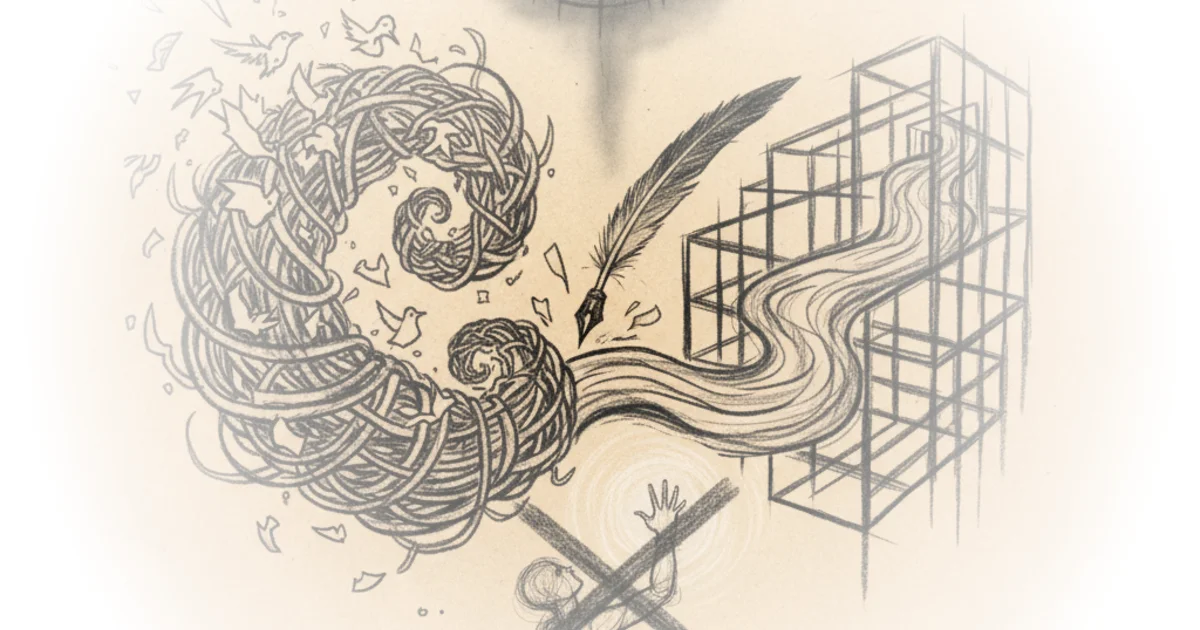
This framing is particularly sharp because it exposes the hypocrisy of the critic. deBoer notes that the phrase is "almost never said with any sincerity, but as a way to big-time someone, to assert their lack of professional stature." It transforms a potential collaborative act into a hierarchical judgment. The author draws a parallel to sports cliches, noting that saying a piece "could use an editor" is as empty of content as a coach shouting "defense wins championships!" It is a thought-terminating cliché that signals sophistication without offering any actual insight into the text.
"It's an empty move that's regularly pulled out by people who know nothing about good writing, deployed in exactly the way BDM alleges, as a way to big-time and dismiss writers without actually offering any critique."
Critics might argue that the phrase is sometimes a necessary shorthand for a lack of polish, but deBoer's point holds weight: the phrase is rarely used in a vacuum. It is almost always a social signal intended to dismiss rather than improve. The argument gains traction when he connects this behavior to the "insiderism and clubbiness" of the publishing industry, where anonymous insiders use the phrase to throw "condescension towards people who work outside of that industry."
The Collapse of the Mentor Model
The commentary shifts to the structural reasons why editing has degraded. deBoer contrasts the modern editor with the mythos of the mid-century mentor, a figure like Maxwell Perkins who served as a "tireless guide" and "selfless midwife to genius." In that era, the editor was often a peer or a seasoned craftsman who understood the genre and the writer's voice. Today, however, the "traditional professional structures that produced editors with a lot of experience... have collapsed."
The loss of local and regional newspapers has been catastrophic for this ecosystem. These institutions once served as incubators for editors who had the "credibility" to manage a writer's attitude while protecting the piece's integrity. Without that foundation, the industry is now staffed by "anxious young strivers" who lack job security and feel compelled to justify their existence through "performative editing." deBoer describes this as a psychological crisis where an editor, fearing they are not adding value, will "move commas, swap synonyms, and restructure paragraphs not because the prose demands it, but because the editor's ego and job security demand it."
This dynamic creates a specific kind of mediocrity. The result is work that has been "sand it down into the smooth, characterless house style that makes every article on the internet sound like it was written by the same sentient AI." The author suggests that this is not a failure of individual character, but a "disastrous incentive structure" born of financial precarity.
"The assumption that editing is good in and of itself implies a belief that any given change to a piece is an improvement, which is of course not true."
The historical context here is vital. Just as Gordon Lish famously reshaped Raymond Carver's work into something entirely his own, the modern editor often reshapes work into something unrecognizable to the author, not out of artistic vision, but out of bureaucratic necessity. The shift from a creative partnership to a risk-management exercise means that editors are no longer looking for the "soul of the piece," but rather for "risk, risk to their employer and thus to themselves."
The Triumph of the Managerial Class
Perhaps the most provocative claim in the piece is that this shift represents a "triumph of the managerial class over the creative act." The modern editor is described less as a literary steward and more as a project manager whose primary goal is the "transit through a bureaucratic system." They are tasked with navigating sensitivity reads, ensuring SEO-friendly headlines, and preventing friction with the institutional brand.
deBoer writes, "They manage 'deliverables' like a mid-career executive at a car insurance company." This comparison is jarring but effective. It highlights how the aesthetic integrity of the work has been subordinated to the safety of the institution. The editor's role has devolved into pruning anything that looks like a liability, a process that is inherently reductive. The author notes that this is particularly evident in major publications like the New York Times, where freelancers complain that their work is "relentlessly over-worked like dough by an inexperienced baker, until it has none of your own flavor."
This is a profound critique of the current media economy. The "fetish for revision" and the mantra that "all writing is rewriting" are exposed as "deepities"—statements that sound profound but are actually trivial. deBoer argues that "there's no inherent value to revision, only the value of the specific revisions." The blanket statement that "editing is good" is as vapid as saying "writing is good." It ignores the reality that bad editing is destructive, and that overediting is just as harmful as underediting.
"Good editing is good. Bad editing is bad. All editing is therefore not good. This shouldn't be controversial."
A counterargument worth considering is that even inexperienced editors bring a necessary fresh perspective that authors, blinded by their own work, might miss. However, deBoer's evidence suggests that when the editor is driven by insecurity and a need to prove their worth, their interventions are more likely to be clumsy than insightful. The problem is not the presence of an editor, but the type of editor the current market produces.
Bottom Line
deBoer's argument is a necessary correction to the romanticized view of the publishing industry, exposing how financial instability has turned editors into risk-averse managers who prioritize safety over art. The piece's greatest strength is its refusal to blame individual editors, instead pointing a finger at the "labor market" and the "incentive structure" that forces them to perform edits that degrade the work. The biggest vulnerability lies in the difficulty of reversing this trend without a fundamental restructuring of media economics, leaving writers to navigate a system where the "editor" is often just a gatekeeper with a track-changes habit.