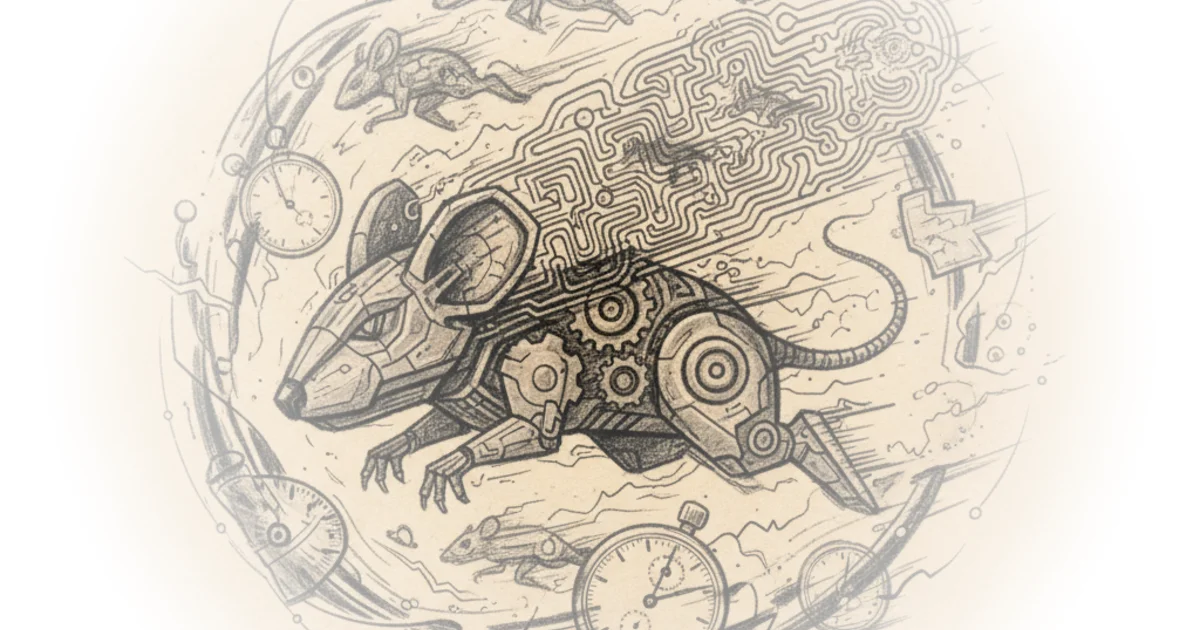
There's something delightfully absurd about a robot the size of a palm-sized mouse beating a maze in under seven seconds. But Derek Muller uncovers something far more interesting: these tiny machines represent nearly five decades of obsessive engineering, where competitors solder on every upgrade imaginable and where even dust on wheels can ruin an entire run.
The Origin Story
Muller begins with a piece of history most viewers won't know. In 1952, mathematician Claude Shannon constructed an electronic mouse named Theseus that could solve a maze using telephone relay switches built into the maze itself. "The mouse was just a magnet on Wheels essentially following an electromagnet controlled by the position of the relay switches," Muller writes. This early experiment is often referred to as one of the first examples of machine learning — a claim that inspired the whole field of AI, according to a director at Google.
By 1977, IEEE's micromouse competition attracted over 6,000 entrants but only fifteen reached the finals. The public interest was enough to be broadcast nationwide on the evening news. And just like the rumor that inspired the competition, micromouse began to spread across the world.
The Algorithms Behind Tiny Robots
What makes these competitions fascinating is how the algorithms evolved. Muller explains that most micromouse competitors spend their first run carefully learning the maze and looking for the best path, then use their remaining tries to sprint down that path for the fastest run time possible.
The core of this strategy involves sophisticated search algorithms. The depth-first search will eventually get the mouse to the goal but might not find the shortest route. Bread-first search finds the shortest path but requires extensive backtracking. The most popular approach is flood fill, where "their map of the maze doesn't have any walls at all they simply draw the shortest path to the goal and go."
When their optimistic plan inevitably hits a wall that wasn't on their map they simply mark it down and update their new shortest path to the goal.
This algorithm follows decreasing numbers from every square in the maze down to zero, updating values based on what Muller describes as "the flow" — like flooding the maze with water. The mouse eventually finds the shortest path but may not be satisfied that it's found the optimal route.
The Fosbury Flop of Robotics
Muller draws an elegant parallel to Olympic high jumping: "If micromouse had indeed stopped in the 1980s, the competition would have missed its own Fosbury Flops." One innovation completely changed how mice turned corners. Every mouse used to turn corners like this — meaning they would stop and pivot through two right turns. Then along came Mighty Mouse 3, which implemented diagonals for the first time.
"That turned out to be a much better idea than we really thought," Muller observes, noting that maze designers now often put diagonatics into the maze. The chassis of the mouse had to be reduced to less than eleven centimeters wide or just five centimeters for half-size micromouse. These diagonals are still one of the biggest sources of crashes in competition today, but they transformed what was once a series of stops and starts into "a single fluid snaking motion."
Dust: The Invisible Enemy
Even with all these mechanical upgrades, Muller identifies one challenge that went unaddressed for decades. At competitions, you'll see almost every competitor holding a roll of tape — not for repairs but to gather specks of dust off the wheels between rounds.
"At the speed and precision these robots are operating that tiny change in friction is enough to ruin a run," Muller writes. If you want to turn while driving fast, you need centripetal force, which comes from friction determined by "the static coefficient of friction which is the friction of the interface between the tire and road surface." This is why race tracks have banked turns — the steep angles help cars turn with less friction.
The Winning Strategy
In the 2017 All Japan Micromouse competition, both bronze and silver placing mice found the shortest path to the goal in about 7.4 seconds. But Red Comet did something entirely different: it took a full five and a half meters longer path but won by 131 milliseconds because "micromise aren't actually searching for the shortest path they're searching for the fastest path."
The mouse figured out that this longer path had fewer turns to slow it down, so even though the path was longer, it could end up being faster. This insight — that the maze is not really about finding the optimal path but rather about navigation and going fast — represents what Muller calls "the Fosbury Flop" of micromouse strategy.
Critics might note that this approach requires significant trial and error; if the mouse takes a risk on a longer path and crashes, it loses the competition entirely. The algorithm may work beautifully in theory but demands precise execution under pressure.
Bottom Line
Muller's strongest move is reframing what we think these competitions are about. We assume it's purely software — find the shortest path — but actually, "micromouse is far from solved because it's not just a software problem or a hardware problem it's both." The cleverness comes from how the brains and body interact together. This insight transforms micromouse from an amusing novelty into a genuine robotics challenge that continues to evolve after nearly fifty years.