The most important philosophical correction you've probably never heard: Heidegger is attempting to fundamentally rethink what it means to exist. Not as a detached subject analyzing an external world of objects — but as something that has always already been immersed in and shaped by that world.
The Metaphysical Rebuke
Martin Heidegger was among the most significant philosophers in a movement that sought to question metaphysics at a depth never before attempted. This was around the 1920s, early in his career. As a German thinker, he was reacting to the ripple effect created by another German thinker who came before him: Friedrich Nietzsche.
Nietzsche's work "The Twilight of the Idols" included what he considered a list of idols — metaphysical traditions that philosophers had built up over centuries. He argued for focusing on the here-and-now, the real world we actually have access to, rather than unverifiable speculation about ideal or otherworldly stuff. Nietzsche believed his work was moving beyond the entire metaphysical tradition.
But one philosopher who came along after Nietzsche agreed that getting away from metaphysics was necessary — yet ultimately concluded that Nietzsche hadn't gone far enough.
That philosopher was Martin Heidegger.
Heidegger argued that every piece of philosophy Nietzsche ever wrote was built on top of a metaphysical foundation that is completely wrong about the nature of being. He's talking about assumptions from the history of philosophy that claim human beings are primarily subjects navigating a world of objects.
The Cartesian Trap
This subject-object framing seems natural to most people. The assumption goes something like: "I am a self, a mind, and I exist in a spatial realm of objects outside of me." The task of philosophy then becomes figuring out the relationship between me as a subject and all the objects out there — other subjects included.
Rene Descartes formalized this in what he called "Cogito ergo sum" — I think therefore I am. This became the starting point for further analysis: I am a self, a subject, existing in a world of objects that is external to me.
But Heidegger argued this isn't the primary way we experience existence. There's something ontologically prior to any claim about how subjects relate to objects. Any claim about how things relate to other things is ultimately a secondary theoretical abstraction. What makes abstractions like science or the history of philosophy possible is something more fundamental — and that something is what Heidegger wants us to take seriously.
"You are the world. Being and the world have never not been unified."
Rethinking Existence
To understand where Heidegger's critique comes from, we need to abandon many terms we've used throughout the history of philosophy: subject, consciousness, person, self, mind, body — as distinct entities. These carry way too many assumptions.
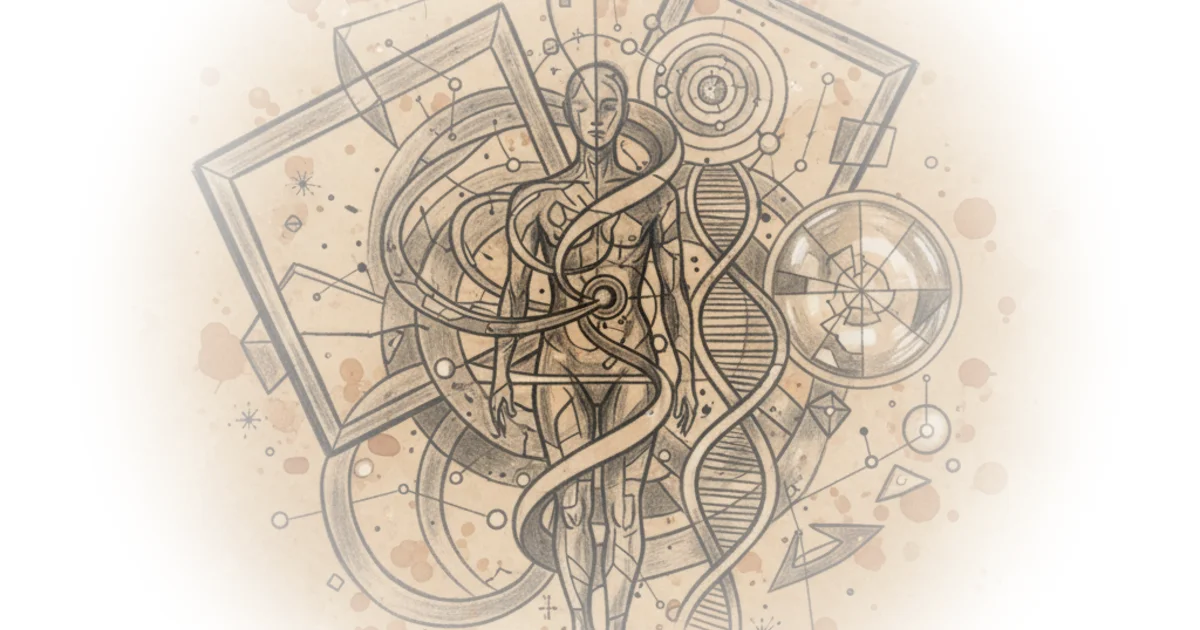
Instead, Heidegger uses a German term that translates into English as "being-in-the-world" — Dasein. Not as a mind with a detached material body in the way Descartes and many other philosophers assumed it — but as a type of existence that is always spatially situated in the world.
To bend your mind toward this framing: think of the substance of what you are as existence itself, though not in the usual sense of "substance." This shifts thinking from studying what things are made of to understanding the existential structures that make up what it means to be. Dasein is more of a "who" than a "what."
Heidegger identifies several existential structures constituting fundamental aspects of our being. The first and most important: being-in-the-world.
The World as Experience
Consider how you spend most of your life interacting with the world. When you walk across the floor to get somewhere, you're not thinking about the floor as an external object with properties for you to study. Your experience is that you just walk across the floor to get where you need to go. The floor as a theoretical object fades into the background.
Another example: when you type on a keyboard writing an email, you're not thinking about the keyboard as some external thing. The keyboard becomes equipment — an extension of yourself — fading into the background as you accomplish a task that matters to you.
This is the primary level we experience the world. Heidegger calls this "ready-to-hand" — things we encounter in our immediate, practical involvement with the world.
But when something happens to that keyboard — it breaks, or a key falls off — we take a step back and see it as an object. In that moment, it becomes "present-at-hand." It becomes part of abstract theoretical categories.
The point isn't that looking at things in a detached theoretical way is bad. Science and philosophy are enormously important to Heidegger. Rather, this framing is always secondary. There's something ontologically prior that makes these abstractions possible — and mistaking the subject-object framing as the starting point limits us to a scientific framing of reality that can never tell us about the most important aspects of what we are.
The Consequences
In practice, when thinkers look at things only through this framing, it leads many people into nihilism. It leads them into lives of confusion as they try to find naturalistic explanations for everything around them. It leads people to think of themselves and others as objects to be studied, optimized, and manipulated for the sake of benefit.
Heidegger calls this a "technological" framing of the world — where everything becomes a resource to be managed rather than something we genuinely exist within.
The most common way to view things in the modern world: look for naturalistic explanations. If something exists, it is out there outside of me, and the best way to understand it is by finding its origins in nature and explaining how it fits into that framework.
But again — this isn't the only way to frame reality. This isn't the final word on what reality is. In Heidegger's terminology, this is always a study of the "ontic" rather than the "ontological." The ontic is the study of beings and how they relate to each other: trees, asteroids, volcanoes. The ontological is the study of being itself — the more fundamental question of what it means to be.
The mistake many people make when caught up in the subject-object framing: trying to explain everything through terminology that only makes sense in conversations about how things relate to other things.
Counterpoints
Critics might note that Heidegger's alternative framing, while profound, risks dissolving too many important philosophical questions into vague existential structures that are hard to analyze systematically. The shift away from objectivity and toward being-in-the-world can make rigorous debate difficult — some would argue it opens the door to relativism. Additionally, his critique of science and naturalistic explanation, while insightful, has been accused by subsequent thinkers of undervaluing empirical inquiry itself.
Bottom Line
West's core argument is compelling: Heidegger's reframing of existence from detached subject to immersed being-in-the-world fundamentally changed how philosophers approach questions of meaning, truth, and knowledge. His strongest point is demonstrating that the subject-object duality we take for granted is actually a secondary abstraction — not the foundation of understanding. His vulnerability lies in the difficulty his framework creates for rigorous philosophical analysis; dissolving problems rather than resolving them can feel like intellectual evasion. This piece serves as an accessible entry point to one of twentieth century philosophy's most radical ideas: that you are not separate from the world — you are it.