Rohin Francis tackles a biological myth that feels intuitively true: the idea that every living creature is allotted a fixed, predestined number of heartbeats before death. What makes this piece essential listening is not just the debunking of the "one billion heartbeat" rule, but the fascinating pivot into the complex, unresolved physics of aging, metabolism, and the surprising role of body temperature in longevity.
The Myth of the Fixed Quota
Francis begins by dismantling the popular arithmetic that suggests a human heart, beating 60 times a minute, should exhaust a billion-beat limit by age 32. "That's not how the force works," he quips, immediately grounding the discussion in reality. He traces the origin of this misconception to ancient philosophy and a convenient, albeit flawed, observation of prehistoric life expectancies. "If you rewind a few thousand years to a time before humans started improving their living conditions... you'll find that rule is remarkably accurate," Francis notes. However, he quickly pivots to modern medicine, reminding us that cardiovascular disease and cancer are driven by modifiable risk factors like diet and exercise, not a cosmic countdown.
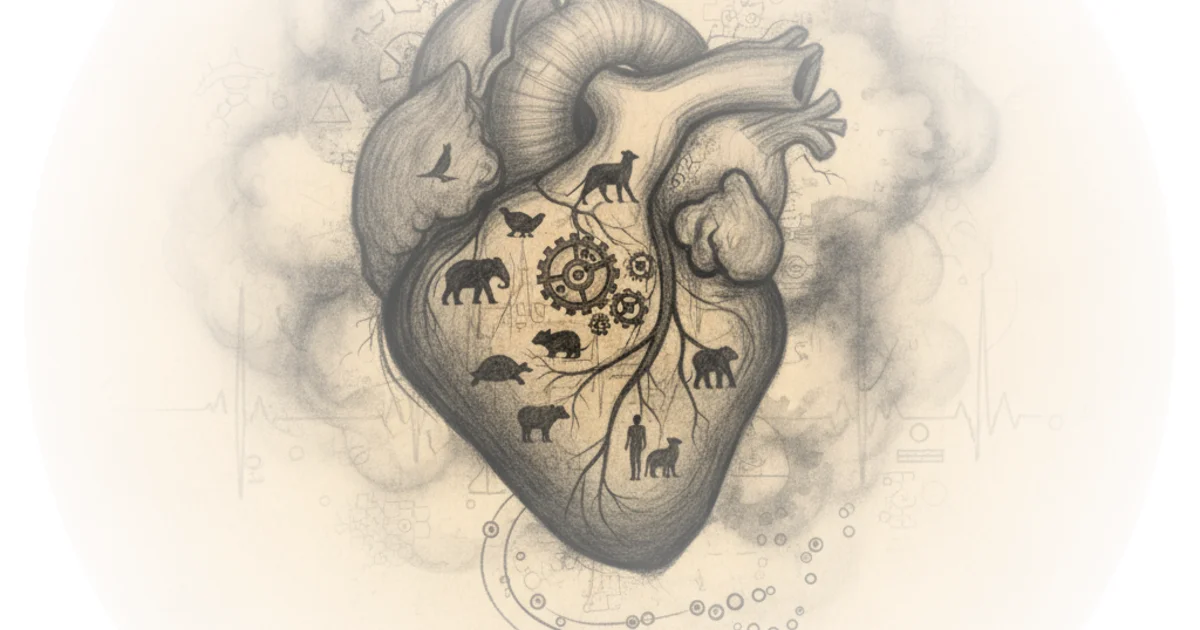
The author's strength lies in his ability to simplify complex biological scaling laws without losing nuance. He uses a vivid analogy involving a hot pie to explain why small animals, like mice, must burn energy faster than large ones, like cows, to maintain body heat. "Small things lose heat far more rapidly than big things as they have more surface area per volume," he explains. This leads to the "rate of living theory," proposed in 1908, which suggests that a faster metabolic rate inevitably shortens life. Francis, however, is careful to label this theory as "essentially been debunked," noting that biology rarely adheres to simple thermodynamic rules.
Critics might note that while the rate of living theory is flawed as a universal law, the correlation between high metabolic rates and shorter lifespans in many species remains a robust statistical observation, even if the causality is more complex than Francis suggests.
The Mitochondrial Mystery
Moving beyond simple heat loss, Francis dives into the cellular machinery of aging, specifically the mitochondria. He posits that the "mitochondrial free radical theory" offers a more compelling explanation for why a mouse ages faster than a cow. The argument is that the intense energy production required by small animals generates more reactive oxygen species, causing oxidative damage that accelerates cellular decay. "The fact that Mouse mitochondria are more active and producing more energy might translate into the mouse literally aging faster than the cow," Francis writes.
Yet, he maintains a healthy skepticism, reminding the audience that correlation does not equal causation. "The simple but complicated answer is probably aging," he admits, highlighting a profound truth in science: "The thing with aging is that nobody really understands it." This humility is refreshing; instead of offering a false sense of certainty, Francis leans into the complexity, noting that there are roughly a dozen competing theories of aging, and all likely play a role.
"The simple but complicated answer is probably aging... The thing with aging is that nobody really understands it."
The Cold Hard Truth
Perhaps the most actionable insight Francis offers concerns the relationship between body temperature and lifespan. He points to the extreme longevity of creatures in icy waters, from Greenland sharks to ancient sponges, and the ability of the wood frog to freeze solid and survive. While humans cannot freeze and thaw without catastrophic failure, Francis highlights that even minor reductions in core temperature can extend life in mammals. He cites a study where mice with a core temperature reduced by just 0.3 degrees Celsius lived significantly longer. "Hypothermia can alter a plethora of cellular pathways resulting in less inflammation and fewer cells dying," he explains.
This leads to a practical, if counterintuitive, conclusion for human health. Francis connects lower resting heart rates to better physical fitness and, indirectly, to a slightly lower metabolic state. He references a Danish study of 3,000 men followed over 16 years, which found that heart rate is an independent predictor of life expectancy. "It's not because there's something magical about heart rate," Francis clarifies. "It's because a low heart rate is reflective of a good state of physical fitness." He explicitly warns against dangerous shortcuts like sleeping in a freezer or using thyroid medication to lower heart rate, urging readers instead to "get out there stay active and see how low you can go."
Bottom Line
Francis's commentary succeeds by replacing a comforting myth with a more challenging, yet empowering, reality: we are not bound by a pre-set heartbeat limit, but by the complex interplay of our metabolism, our cellular repair mechanisms, and our lifestyle choices. The piece's greatest strength is its refusal to oversimplify the science of aging, while its only vulnerability is the sheer difficulty of translating cellular theories of hypothermia into practical, safe advice for the average person. The takeaway is clear: while we cannot stop the clock, we can certainly slow its ticking through exercise and metabolic health.
"It's not because there's something magical about heart rate. It's because a low heart rate is reflective of a good state of physical fitness."
The Verdict
This analysis is a masterclass in scientific skepticism, effectively dismantling a popular biological myth while illuminating the genuine, albeit messy, science of longevity. The strongest argument is the shift from a fatalistic "fixed quota" mindset to an active, fitness-based approach to extending life, grounded in the real-world data of heart rate and metabolic efficiency.