Wayfare challenges a deeply entrenched assumption among believers: that the Church is merely a flawed human vessel for a perfect gospel. Instead, the piece argues that the institution's very imperfections are not obstacles to truth, but the essential mechanism through which salvation is actually achieved. This is a provocative reframing for a faith tradition often obsessed with doctrinal purity, suggesting that the friction of human interaction is where the divine work truly happens.
The Flawed Instrument
The article opens by dismantling the common cliché that the gospel is perfect while the Church is a "human instrument, historybound, and therefore understandably imperfect." Wayfare reports, "I am persuaded by experiences like that one at a stake conference and by my best thinking that, in fact, the Church is as 'true,' as effective, as sure an instrument of salvation as the system of doctrines we call the gospel." This claim is significant because it elevates the messy, organizational reality of the church to the same spiritual plane as abstract theology. The piece suggests that the "pearl" of grace is often found not in a moment of perfect revelation, but in the mundane duty of attending a meeting where one might otherwise feel bored.
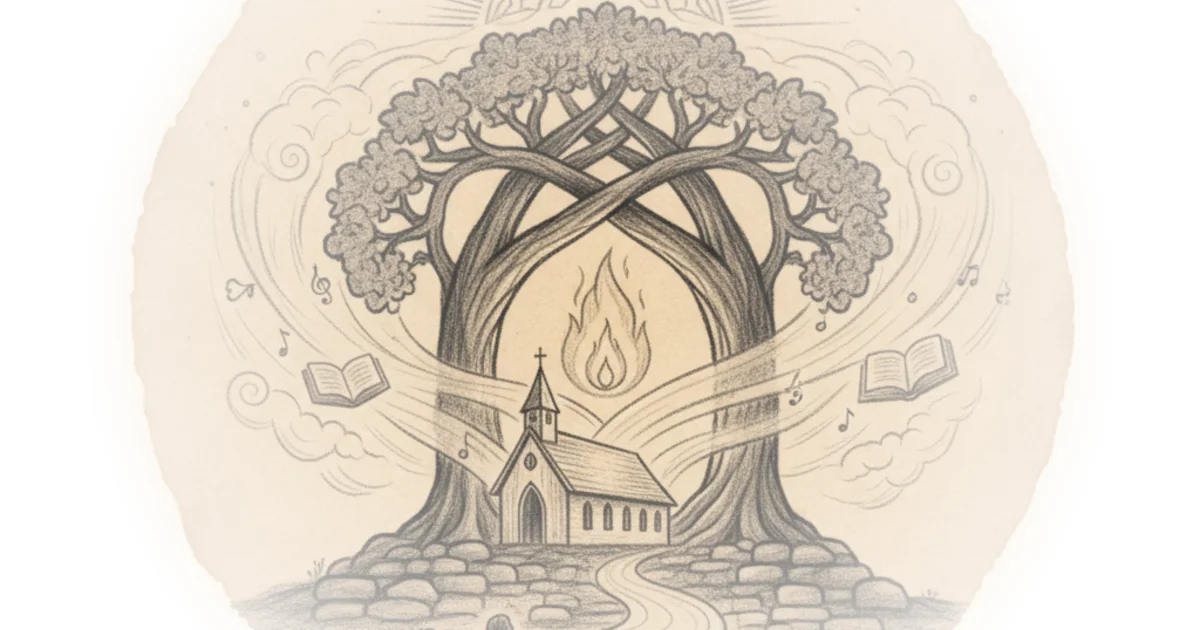
The argument rests on a sobering interpretation of scripture. Citing the first section of the Doctrine and Covenants, the editors note that God's commandments were given "in their weakness, after the manner of their language." This admission is crucial: if the divine message itself must be filtered through human limitations, then the "gospel" as we know it is already an approximation. Wayfare posits, "Even revelation is, in fact, merely the best understanding the Lord can give us of those things. And, as God himself has clearly insisted, that understanding is far from perfect." This moves the conversation away from a search for a static, error-free dogma and toward a dynamic process of interpretation and struggle.
"The Church is as true—as effective—as the gospel because it involves us directly in proving contraries, working constructively with the oppositions within ourselves and especially between people."
The Necessity of Opposition
The piece leans heavily on the theological concept of opposition, drawing on the counsel of Lehi in the Book of Mormon that "it must needs be, that there is an opposition in all things." Wayfare argues that this is not just a rule for human experience but a fundamental law of the universe, intrinsic to "intelligence and matter." The editors suggest that without this tension, existence itself would vanish. This theological grounding is used to defend the Church's internal conflicts. The article asserts that the institution is the "best medium... for grappling constructively with the oppositions of existence."
This perspective reframes the frustration of dealing with imperfect leaders or disagreeable members. Rather than viewing these as failures of the system, the piece argues they are the system's primary feature. It draws a parallel to the US federal system of checks and balances, noting that just as political pluralism requires friction to function, spiritual growth requires the "conflict and opposition" found in community life. The editors quote William Blake to reinforce this: "without contraries is no progression," and warn that "whoever tries to reconcile [the contraries] seeks to destroy existence." A counterargument worth considering is that this framing could be used to excuse genuine abuse or systemic failure by labeling them merely as "necessary oppositions." However, the text distinguishes between the friction of growth and the harm of "unrighteous dominion," suggesting the former is redemptive while the latter is a failure to engage the process correctly.
The School of Love
The commentary shifts to a practical application, comparing the Church to marriage as a "school of love." Citing theologian Michael Novak, Wayfare reports that marriage is an "assault upon the lonely, atomic ego" and a "threat to the solitary individual." By substituting "Church" for "marriage," the piece argues that the institution forces individuals out of their comfort zones. The editors write, "Marriage [the Church] is not the home or the result of love so much as the school." This is a powerful reorientation of the believer's motivation: one does not join the Church to find a community of like-minded people, but to be challenged by those one would not otherwise choose to associate with.
The piece highlights two structural features that make this possible: the lay ministry and geographic congregation. Because members are assigned to wards based on where they live rather than their preferences, they are forced to "grapple with relationships and management, with other people's ideas and wishes." Wayfare argues that this lack of choice is the source of its power. "Being active in the Church... has impressed on my mind certain lessons, for whose learning I cannot help being grateful. Most are lessons of difficulty and duress." The argument is that the "bonds and responsibilities" that feel like restrictions are actually the "liberation" that forces a person to become a different, better sort of human being.
"My dignity as a human being depends perhaps more on what sort of husband and parent [Church member] I am, than on any professional work I am called on to do."
Bottom Line
Wayfare's strongest contribution is its theological justification for the Church's imperfections, transforming them from liabilities into the very engine of spiritual growth. By grounding this in the concept of opposition, the piece offers a robust defense against the cynicism that often plagues long-term members. Its biggest vulnerability lies in the potential for this logic to minimize real institutional harm if the distinction between "productive opposition" and genuine failure is not carefully maintained. For the busy reader, the takeaway is clear: the value of the institution is not in its perfection, but in its capacity to force us to love the unlovable and endure the difficult, which is where the actual work of salvation occurs.