The Myth of the Financial Genius
A documentary interview once hailed as a window into Jeffrey Epstein's financial brilliance instead reveals something far more ordinary: a man who couldn't explain how banks actually work, and who placed himself at the center of events he demonstrably wasn't part of.
Eric Salzman writes, "The man demonstrated no expertise in either finance or economics. When he wasn't getting basic banking concepts and historical events completely ass-backwards, he was telling improbable tales and reaching for the same contorted medical analogies." What makes the piece striking isn't merely that Epstein lacked expertise — it's that he lacked it at the most elementary level, while powerful people accepted his reputation uncritically.
The Fractional Reserve Fantasy
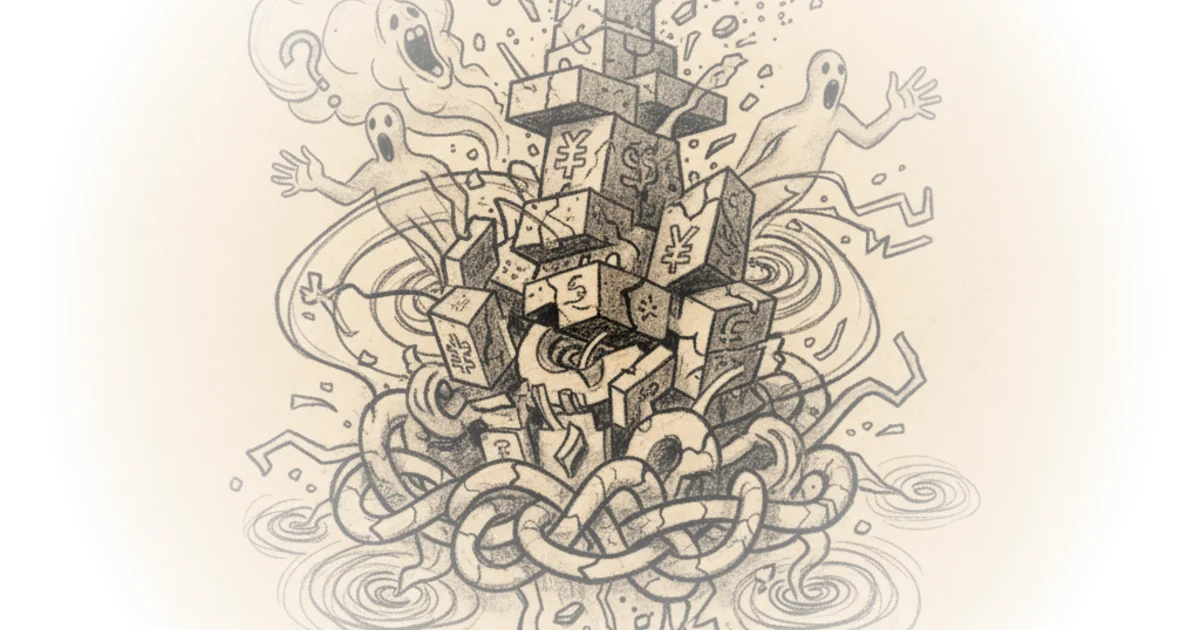
Salzman focuses on Epstein's explanation of banking, which turns out to be backwards. Epstein described a system in which depositing one dollar somehow enables lending out nine dollars — as if money materializes from nothing. The actual mechanism is the opposite: a bank receiving a dollar must hold a fraction in reserve, lending out only the remainder.
Epstein claimed: "If you have one, you can lend out nine. That's the way our system works." He then added, "And so not only do world leaders not understand banking, but the man on the street, my father who worked in the park department, it would be beyond his imagination that people could lend out more money than they actually had in their pocket."
Salzman notes that Epstein "assumes Bannon Bank could borrow ten dollars and lend out nine dollars, creating nine dollars out of thin air. Who knows though, maybe Epstein was a magician who could conjure currency and that is why everyone needed to speak to him."
Fractional reserve banking — the actual system underpinning modern finance — is hardly glamorous, but it's a concept taught in introductory economics. Epstein inverted it with total confidence. The irony is that he invoked this confused explanation while sitting on the board of Rockefeller University, an institution whose financial management presumably demanded actual financial literacy.
"Epstein resembles Lyndon B. Johnson in this ability to forge father-son relationships with powerful mentors decades his senior... Of course, LBJ was a genuine master of politics, so I imagined Epstein must have had some mastery of finance to earn the support of his senior mentors."
The Bear Stearns Alibi Collapses
The interview's timeline problems are even more revealing. Epstein claimed to have been in solitary confinement during the Lehman Brothers bankruptcy in September 2008, fielding calls from Jimmy Cayne, the head of Bear Stearns, and a JP Morgan contact simultaneously. He described holding two short phone receivers, "going between two phones talking to Bear Stearns and JP Morgan at the same time."
There's one problem: Bear Stearns had already been absorbed by JP Morgan six months earlier. The initial takeover was announced on March 16, 2008, and closed by May 30. By September, Bear Stearns as an independent entity no longer existed. Epstein was narrating drama that had already concluded.
Salzman writes, "Epstein claims he had a call with Bear Stearns's Cayne and a simultaneous call with a phantom JP Morgan official in September 2008, when any 'advice' would have been meaningless." When Bannon gently pushes back, Epstein simply waves the six-month gap away: "No, no. This is the same time. This is part of the same deal."
It gets worse. Epstein had lost approximately $40 million in the Bear Stearns Asset Management subprime bond funds that collapsed in 2007 — widely considered the opening shot of the financial crisis. The man positioning himself as an oracle at the center of the storm was, in fact, a casualty of it.
Derivatives as Hair on a Head
Epstein dismissed derivatives as the cause of the 2008 crisis with a bizarre analogy: "It's like saying your hair was the cause of your heart attack because it was on the top of your head."
Credit default swaps and synthetic collateralized debt obligations — both derivative instruments — played a central role in amplifying the subprime lending collapse. The Bear Stearns funds that cost Epstein his $40 million relied heavily on these exact products. The analogy wasn't just wrong. It was wrong in a way that suggested Epstein either didn't understand his own losses or was actively rewriting history to distance himself from them.
The Confidence Game
Salzman's underlying observation matters beyond Epstein specifically. The piece demonstrates how reputation, carefully cultivated through proximity to powerful people, can substitute for actual competence. A Texas Instruments calculator story. An appointment at an elite university. A seat in the Trilateral Commission. These were the props. The financial mastery was fictional.
Critics might note that Epstein clearly did generate real wealth and build genuine influence networks — which suggests either that his actual financial operations differed sharply from what he described in interviews, or that the financial world's gatekeeping mechanisms are porous enough to let convincing impostors through. Critics might also observe that the Bannon interview is a single data point and that private conversations with actual financiers might reveal more sophistication than a filmed documentary exchange.
Bottom Line
Jeffrey Epstein's financial reputation was built not on understanding how money works, but on understanding how powerful men want to be talked to. The documents Salzman reviews don't prove Epstein was a fraud in every respect — he was clearly effective at cultivating access. But on finance itself, the record speaks plainly: the emperor wasn't just naked. He didn't even know what clothes were.