The Wish Becomes the Work
Alberto Romero's latest essay cuts through the hype about agentic AI with an uncomfortable observation: when execution becomes trivial, choice becomes the bottleneck. For knowledge workers who spent decades mastering the "how" of their craft, this inversion feels less like liberation and more like vertigo.
The Genie in the Lamp
Romero frames the shift with a thought experiment that echoes ancient folklore. The jinn in the lamp grants wishes without explanation—the mechanism is irrelevant, only the desire matters. "AI is the closest thing in the world to a genie lamp," he writes. This is not a metaphor about power, but about effort allocation. When the "how" collapses, mental energy must redirect entirely to the complementary question: what do you want?
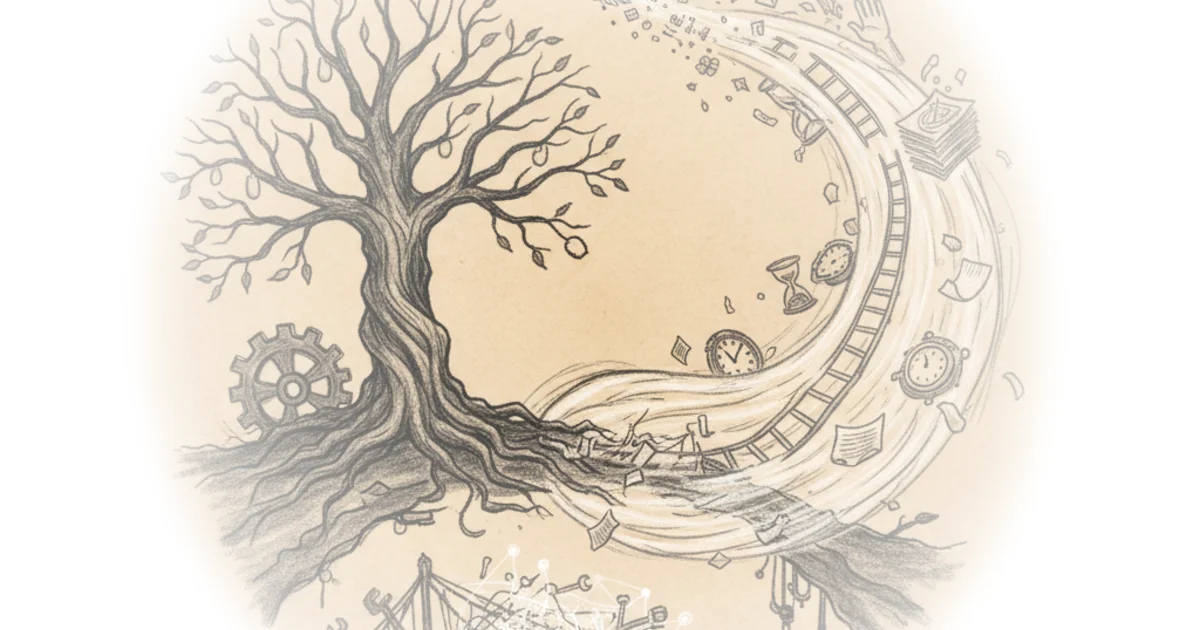
As Alberto Romero puts it, "The most powerful AI tools today collapse the process of doing things inside a computer into basically a wish." But wishing well requires a skill most never developed. "But when you put it this way, you realize that wishing well is more critical than you're used to thinking."
The career question illustrates the trap. "The question of 'what do I want to do?' changed, sometime in the forgotten past, to 'what can I do?'" The first assumes infinite options; the second accepts constraint. Life compressed desire into viability. Romero suggests AI loosens that compression—not completely, but enough to reopen the original question.
"The thing you spent years getting good at is now a commodity."
Skills Behind the Boulder
Romero identifies a stack of capacities that remained invisible while execution was expensive:
- Taste: selection among infinite options
- Judgment: weighing trade-offs under uncertainty
- Agency: deciding to act at all
- Curiosity: the seed that starts everything
"As Alberto Romero puts it, 'Taste is about selection... Judgment is about evaluation... Agency is about initiation.'" These are not interchangeable. Someone can have extraordinary taste and zero agency—the critic who never creates. Someone can have strong agency and terrible judgment—the founder who moves fast toward the wrong thing.
The Warren Buffett anecdote fits here: if you could invest in a friend and earn 10% for life, who would you choose? What traits made you decide? And then: why not embody those traits yourself? The question shifts from external selection to internal cultivation.
The Vertigo of Worthlessness
Here the essay turns psychological. When execution gets cheap, it doesn't feel like progress. It feels like your skills are becoming worthless. "The thing you spent years getting good at is now a commodity," Romero writes. The immediate consequence is avoidance. People use AI for small, safe tasks—email templates, summaries—because it's terrifying to confront the reality that everything you ascribed value to can be automated.
"If you don't feel a bit of vertigo, you're not going far enough," he writes. This is the honest register of the piece: no celebration, no triumphalism. Just the uncomfortable recognition that adaptation requires internal shift matching external change.
Counterpoints
Critics might note that Romero's framing assumes office work—the "software-shaped problems" he describes don't apply to nursing, manual labor, or careers requiring physical presence. The genie lamp doesn't teleport a body, only a wish.
Others might argue that "what vs. how" is itself a how. Deciding what to do is still doing something, and the cognitive load of managing fifteen agents may exceed the load of executing one task. The bottleneck doesn't disappear; it relocates.
Finally, the claim that everyone has access to the same tools as Sam Altman or Dario Amodei overlooks institutional advantage. Better internal models, proprietary data, and engineering support still create asymmetry—the lamp is not equally bright for all.
Bottom Line
Romero's essay is valuable because it refuses to celebrate AI as pure empowerment. The shift from how to what is real, but it demands courage over comfort. Those who develop taste, judgment, and agency will navigate the vertigo. Those who don't will automate their email and wonder why they feel more useless than freed.