Sarah Kendzior does not merely compare American political rhetoric to foreign authoritarianism; she argues that the United States is actively replicating the specific mechanics of a Central Asian massacre to manufacture a domestic enemy. By drawing a direct line between the fabricated terrorist group "Akromiya" in Uzbekistan and the current designation of "antifa" in the United States, Kendzior offers a chilling framework for understanding how state power criminalizes dissent. This is not a standard political op-ed; it is a forensic analysis of how propaganda is weaponized to justify violence against civilians, grounded in the author's own decades of experience debunking state lies.
The Anatomy of a Fabricated Enemy
Kendzior anchors her argument in the 2005 Andijon massacre, where the Uzbek government killed hundreds of protesters by inventing a non-existent terrorist organization called "Akromiya" to justify the slaughter. She explains that the regime needed a scapegoat for public unrest, so they created a boogeyman that allowed them to label any dissenter a terrorist. "The Uzbek government had invented 'Akromiya' in reaction to mounting frustration among the Uzbek public," Kendzior writes, noting that the label was slapped on anyone who dared to oppose the state regardless of actual affiliation. This historical precedent is crucial because it demonstrates that the existence of the group is irrelevant; what matters is the state's power to define reality and enforce that definition with lethal force.
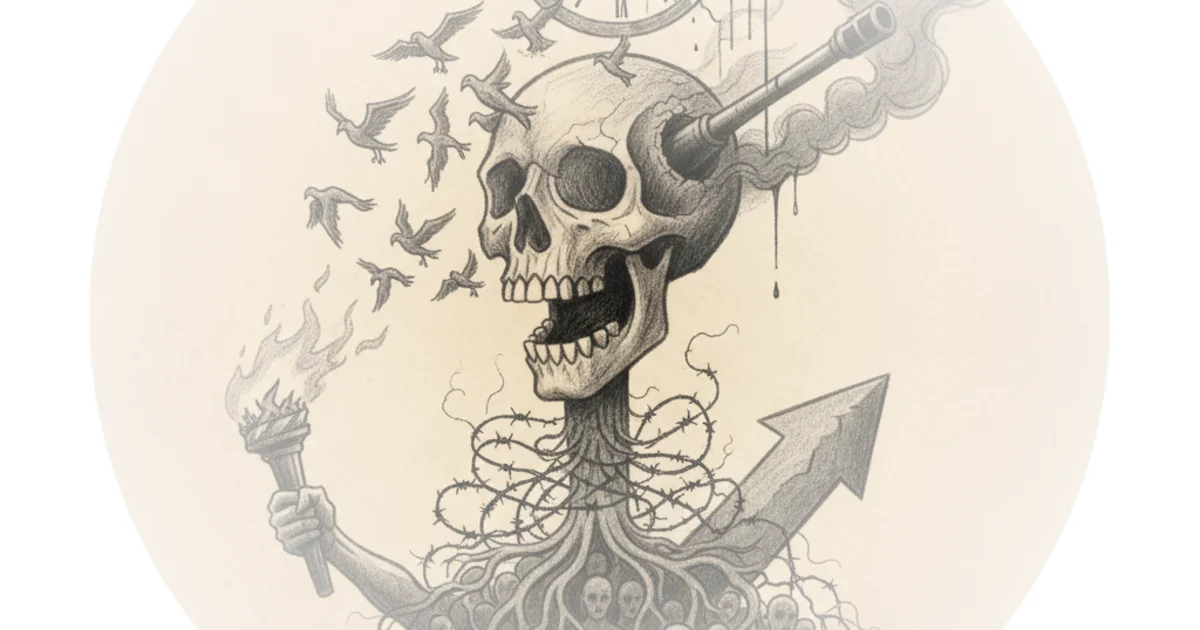
The author's personal history adds a layer of gravity often missing from contemporary analysis. She reveals that she was the one who debunked the myth of Akromiya through academic research, a move that cost her career and led to her being banned from the country. "I said I'd rather kill my career than do nothing when hundreds of people are killed," she states, highlighting the moral imperative to speak truth to power even when the cost is professional suicide. This choice frames her current commentary not as a political opinion, but as a warning from someone who has seen the endgame of such propaganda. Critics might argue that drawing a parallel between a brutal Central Asian dictatorship and the United States is hyperbolic, yet Kendzior's evidence suggests the mechanisms of control are identical, even if the scale of violence has not yet reached the same heights.
"Nothing is free anymore: not research, not people, not truth."
The Continuum of State Violence
Kendzior argues that the current administration has not created a new phenomenon but has rather perfected a tactic that has been building for years. She posits that the rhetoric surrounding "antifa" serves the same function as "Akromiya": it is an intentionally vague catch-all used to delegitimize and target anyone who opposes the government. She points out that while the Biden administration did not use the specific term "antifa," their policies laid the groundwork for the current crackdown by expanding police infrastructure and funding agencies like Immigration and Customs Enforcement (ICE) at record levels. "Instead of stopping police violence, Biden built Cop Cities and funded ICE at record levels, creating the infrastructure Trump uses to make his 'antifa' fantasies a grim reality," she observes. This reframing challenges the notion that the current crisis is solely the result of one administration, suggesting instead a bipartisan continuum of state violence.
The piece details how the executive branch has moved from vague rhetoric to concrete legal action, declaring "antifa" a terrorist organization through an executive order and utilizing the Racketeer Influenced and Corrupt Organizations (RICO) Act against a loosely organized movement. Kendzior notes the irony that RICO, originally designed to combat organized crime, is now being used by a government she describes as a "transnational crime syndicate masquerading as a government." She writes, "Under Trump, RICO is now a tool of a transnational crime syndicate masquerading as a government. Somewhere, Lansky and Cohn are looking up, flames reflected in their eyes, smiling." This vivid imagery underscores the author's view that the legal system has been inverted, turning laws meant to protect citizens into weapons of repression.
The Logic of the Mafia State
The core of Kendzior's warning is that in an authoritarian system, the definition of guilt is fluid and based entirely on the state's needs. She explains that the name "antifa" is short for "anti-fascist," yet the administration's embrace of fascist tactics creates a paradox where opposing fascism is framed as supporting it. "The name 'antifa' is short for 'anti-fascist', meaning that those who oppose it are 'pro-fascist', which would seem like a self-own if the Trump administration and its lackeys were not so explicit in embracing fascist tactics and tropes," she writes. This circular logic is designed to trap citizens: any opposition is automatically criminalized.
She draws on her experience with Uzbek dissidents to illustrate the psychological toll of living under such a regime, where suspicion is treated as guilt. "Suspicious is the same as guilty," she quotes an Uzbek dissident, a sentiment that now resonates in the American context where an offhand remark can lead to arrest. Kendzior warns that the administration is using protests as a pretext to map out opposition strategies, fearing that the "No Kings Day" demonstrations will be used to justify a broader crackdown. "I fear that even if I am wrong, I will be right at some point, and that frightens me," she admits, acknowledging the terrifying possibility that the worst-case scenario is not just a prediction but a trajectory.
"They will label your kindness as treachery and your generosity as terrorism."
Critics might suggest that this comparison ignores the robust democratic institutions that still exist in the United States, arguing that the rule of law remains a check on executive overreach. However, Kendzior counters that in a "mafia state," law is a plaything and evidence is an illusion, suggesting that institutional safeguards are only as strong as the political will to uphold them. She argues that the resilience of everyday people, who have "less to lose," may be the only remaining defense against this consolidation of power.
Bottom Line
Sarah Kendzior's most compelling argument is that the fabrication of "antifa" is not a political gaffe but a calculated strategy to replicate the logic of foreign dictatorships, turning dissent into a capital crime. While the comparison to the Andijon massacre is stark, her evidence of how legal frameworks like RICO are being repurposed for political repression offers a terrifyingly plausible roadmap for the future. The piece's greatest vulnerability is its reliance on the assumption that the current trajectory will inevitably lead to mass violence, yet its strength lies in its urgent call to recognize the early warning signs of authoritarianism before it is too late.