Ryan Grim and Jeremy Scahill deliver a harrowing inventory of global violence that refuses to let the reader look away from the human cost behind the headlines. This is not a standard news digest; it is a forensic accounting of death, where the return of a single captive is juxtaposed against mass graves and the execution of a nurse acting as a legal observer. The piece forces a confrontation with the reality that while political leaders negotiate tariffs and blockades, the ground reality remains one of systematic erasure and unchecked force.
The Human Toll in Gaza
The coverage opens with a stark statistical reality that challenges the narrative of stability. Grim and Scahill write, "Since the October 11, 2025 ceasefire, there have been 486 killed, 1,341 injured, and 714 bodies recovered, bringing the documented toll from the Israeli genocide in Gaza to 71,660 deaths and 171,419 injuries." This framing is deliberate and heavy; by labeling the conflict a "genocide" and citing a death toll that dwarfs most modern conflicts, the authors reject the euphemisms often found in mainstream reporting. The evidence suggests that the ceasefire has not stopped the killing but merely altered the tempo of the violence.
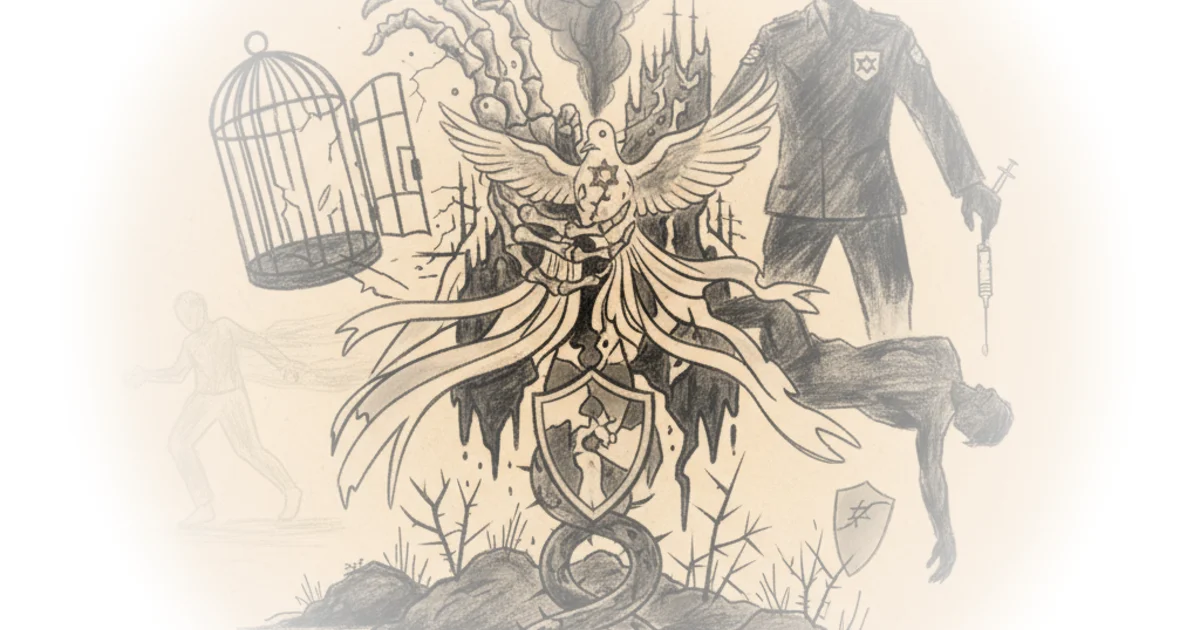
The authors highlight the grim irony of the Rafah crossing reopening. "Israel has agreed to a limited reopening of the Rafah Crossing for pedestrian passage only, subject to a full Israeli inspection mechanism," the Israeli prime minister's office said, yet the context provided is that this follows the recovery of a single set of remains. Grim and Scahill note that "Thousands of Palestinian bodies remain under the rubble," a detail that underscores the futility of a border opening when the interior remains a graveyard. The administration's refusal to allow foreign journalists into the enclave, even as aid workers enter, further isolates the population from independent verification.
Thousands of Palestinian bodies remain under the rubble, while the world watches a limited reopening of a border crossing that offers little hope for the living.
The report also exposes a disturbing dynamic regarding aid distribution. Grim and Scahill report that "Israeli military-escorted 'humanitarian' convoys delivered food, water, cigarettes, and sealed boxes with unknown contents to Israeli-backed militias." This revelation complicates the standard narrative of aid, suggesting that humanitarian resources are being weaponized to undermine political rivals while the general population starves. Critics might argue that the complexity of the battlefield makes neutral aid distribution impossible, but the specific admission by a former Gaza division officer regarding direct Israeli involvement in arming these militias suggests a calculated strategy rather than logistical necessity.
Violence on the Home Front
The narrative shifts abruptly from the Middle East to Minneapolis, where the authors document the lethal escalation of domestic immigration enforcement. The killing of Alex Pretti, an ICU nurse, is presented not as an anomaly but as a symptom of a broader policy shift. Grim and Scahill write, "Despite the administration's claims that Pretti and his cohort of protesters were 'violent,' all available video of the incident shows him and his group either blowing whistles or recording ICE activity in the neighborhood, which he was doing before he was fatally shot." This direct contradiction of official claims is the piece's most powerful evidentiary moment, stripping away the justification for the use of lethal force.
The authors describe Pretti as a "good man" with a "great heart," grounding the political analysis in personal tragedy. The reaction from the community was immediate and widespread, with protests demanding an end to federal operations in the city. Grim and Scahill connect this local violence to a national legislative battle, noting that Senate Democrats have threatened a government shutdown unless the Department of Homeland Security funding bill includes reforms to "restrain, reform and restrict ICE." This linkage suggests that the violence in Minneapolis is the catalyst for a potential constitutional crisis in Washington.
The scope of the administration's aggression extends far beyond the US border. The authors detail a plan where the executive branch is "debating a plan to use U.S. naval power to cut Cuba off from foreign oil in an effort to force regime change." This proposal, backed by Secretary of State Marco Rubio, represents a dangerous escalation of economic warfare. Grim and Scahill note that Mexican President Claudia Sheinbaum has defiantly stated that Mexico will continue sending oil, calling the shipments "an act of solidarity." This international pushback highlights the fragility of unilateral US foreign policy when faced with regional alliances.
Despite the administration's claims that protesters were violent, all available video shows a nurse recording federal activity before he was fatally shot.
The authors also touch upon the pressure exerted on Latin American nations, noting that the US is "pressing Bolivia to expel suspected Iranian intelligence operatives." This move is part of a broader strategy to curtail Tehran's influence, aligning with similar designations in Ecuador and Argentina. While the stated goal is counterterrorism, the authors imply a pattern of regime change efforts and interference in sovereign nations, from Cuba to Bolivia.
The Unseen Wars
The coverage widens its lens to Sudan, where the human cost is measured in mass graves and systematic rape. Grim and Scahill report that "Two mass graves containing the remains of thousands of people were discovered in Khartoum's Al-Riyadh neighborhood, with victims believed to have died under torture." The scale of the horror is further compounded by the social affairs minister's statement that rape is being carried out systematically by the Rapid Support Forces, with survivors ranging from toddlers to the elderly. This is not collateral damage; it is a weapon of war.
The authors describe the conflict dynamics in the Blue Nile region, where attacks appear aimed at opening pressure fronts rather than seizing territory. The drone strike in South Kordofan that killed two civilians is cited as an example of the deliberate targeting of residential areas. Grim and Scahill's inclusion of these details serves as a reminder that while the world's attention is fixed on Gaza and the US border, other conflicts are consuming entire populations with equal ferocity.
Bottom Line
Ryan Grim and Jeremy Scahill have constructed a narrative that refuses to separate the violence abroad from the violence at home, revealing a global pattern of unchecked executive power and human suffering. The piece's greatest strength is its unflinching reliance on video evidence and casualty counts to dismantle official justifications for lethal force. Its vulnerability lies in the sheer overwhelming nature of the tragedy presented, which risks paralyzing the reader with despair rather than mobilizing them for action. The reader must watch for the outcome of the Senate Democrats' threat to shut down the government, as this may be the only remaining institutional check on the administration's escalating enforcement policies.