A Third Way for the Humanities
This is the uncomfortable truth at the heart of Justin E. H. Smith's argument: the traditional university has failed the humanities completely. And rather than face this failure honestly, universities have instead transformed the crisis into something that looks almost like success — enrollment in "innovation" programs, corporate partnerships, and a bewildering array of new interdisciplinary majors that sound more like management consulting gigs than scholarly inquiry.
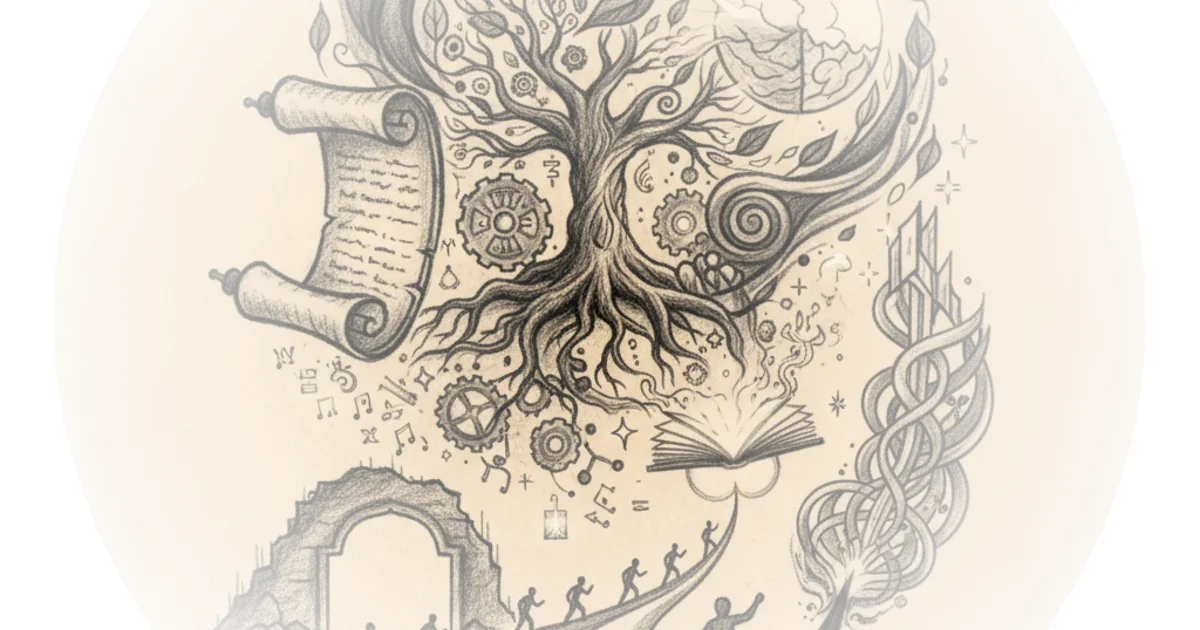
Smith's piece is not a lamentation. It's an autopsy. And buried in that analysis is a surprising solution: the humanities might have to find a life outside the university entirely.
The Collapse Wasn't Sudden — It Was Gradual
The story begins in the aftermath of the 2008 economic crisis, when the familiar response to complaints about declining standards — "we must not let our spirits flag" — started to sound, as Smith puts it, "ever more late-Soviet." No one wanted to be the first worker on the assembly line to acknowledge that the factory wasn't meeting production quotas. But by the early 2020s, a combination of technological, economic, political, and cultural forces had effectively pummeled the tradition of university-based humanism into unconsciousness.
The arrival of generative AI was, for many humanities professors, the event that finally pushed them over the edge. But AI wasn't so much a new threat as it was the final blow in a long siege — delivered by a many-fisted menace that had been stalking the humanities for years.
Professors could still "report for duty" in a narrow sense. They could show up, collect their greatly devalued paychecks. What they couldn't do is fulfill their actual duty — guiding students from beacon to beacon of a millennia-long tradition of reflection and discovery that represents the greatest hope a person has for achieving true freedom.
The humanities have been transformed into something that looks almost like success — enrollment in programs that sound more like management consulting gigs than scholarly inquiry.
The Florence Problem
The collapse is confirmed by both data and anecdote. But Smith argues it's already a symptom of the total domination of a non-humanistic spirit to suppose that data have more power than narrative.
Consider this story: an American student on a semester-abroad program in Florence — Florence — who, when told just a thing or two about Michelangelo or Dante in an introductory Italian class, complained to the program director that precious class time was being wasted simply to indulge the professor's eccentric interests.
From the student's perspective, the entire purpose of learning Italian is exhausted by ordering panini. Why bother to go to Italy at all?
This student's "major" didn't exist prior to the present century. It involves some ad-hoc concatenation of terms like "leadership," "innovation," and "sustainability." On such a course of study, students can easily end up in Florence rather than Barcelona — where they'll spend the weekend anyway, thanks to budget airlines — as the result of a choice as hasty and unreflected as the one between "Innovation Mindset" on Mondays and Wednesdays or "Team Building for Social Impact" on Tuesdays and Thursdays.
The students have no idea why they're in Italy. They barely know they're in Italy. There's some dim awareness that they should be there, eventually to put "Italian" among their languages on LinkedIn. But this "Italian" is entirely separated from history, literature, and culture. And this "should" is an imperative imposed from outside — entirely unconnected to a student's exercise of his or her own freedom.
Freedom has to be cultivated. The student has no freedom. One feels for the student whom the system has so tragically betrayed; and one feels for the professor who simply cannot, under the circumstances, come good on their true life-calling.
Business-Schoolification
If you check the data, you'll see there aren't that many humanities majors left. Have humanities departments responded to falling enrollment by renewing their commitment to the great tradition? They have not.
Instead, like hoverflies that found their niche inside beehives through Batesian mimicry of their hosts' outer morphology, humanities are undergoing what Tyler Austin Harper called "business-schoolification."
The blame is not entirely on the professors — though they'll get their share soon enough. The real explanation has everything to do with top-down economics: decisions made by administrators whose primary function is to raise money, an enormous portion of which now comes from corporate partnerships.
We have heard from a California-based specialist in medieval cosmology whose courses, which he spent decades gaining the expertise necessary to teach, have been replaced by courses on "video-game ethics." He has been told he's welcome to stay on, and teach these if he wishes. You can roughly guess, given Silicon Valley's proximity, what sort of deal was made that would explain this change in curricular priorities.
We have spoken with countless young Ph.D.s who squeezed through with dissertation topics from an ancien régime — beautiful topics, universe-in-a-grain-of-sand topics on Vedic ritual and Hildegard of Bingen and Ptolemy's Almagest and Navajo verb tenses and Mexica calendars — who are now desperately bouncing from place to place, adjunct-teaching fake courses for paltry sums on topics fundamentally unworthy of their attention: "Critical Thinking for Executive Leaders" and "Philosophy for Public Impact" and all those other confabulated subjects that fall within the genus of what is ultimately an irremediable oxymoron: "Business Ethics."
One feels for these precaritized intellectuals whom the system has so tragically betrayed. But the time has come to do more than feel for them.
The Myth-Busters
The universities are not going to reform themselves, not without significant external pressure from independent para-academic initiatives capable of modeling how the humanities are actually done.
Most academics who are not yet retired or dead are young enough to have spent their entire careers in a milieu dominated by some strain of "myth-busting." The principal purpose of what has passed for humanities education has been to convince students that the humanistic tradition is not what they think it is.
This is a peculiar pedagogical goal. At the outset, students do not have any idea what the humanistic tradition is, or even that it exists at all. They're being rushed straight from ignorance to contempt without any serious effort to familiarize them with their contempt's object.
And in contrast with our loose use of the term in the previous section, this is a tragedy in the literal Greek sense: it's a blindness as to the nature and consequences of the professoriat's own choices that ultimately contributes to their own downfall.
For nothing has been more useful to administrators seeking to transform the entire university into a business school than to hear from humanists themselves that their tradition is really only the propaganda wing of white supremacy, patriarchy, and imperialism. Imagining themselves as occupying a site of resistance to capitalism, they end up among its most obedient running-dogs.
In the 1980s and '90s, many powerhouse intellectuals had a hand in promoting what Paul Ricoeur called the "hermeneutics of suspicion." Even today you're hardly much of an intellectual if you feel no frisson in your encounter with what cultural reactionaries classify as "postmodernism" or even more imprecisely as "postmodern Marxism." Much of the work these reactionaries ignorantly dismiss is exciting stuff — it uncovered real truths about our reigning ideological order, because all the leading figures of its first generation were extremely well-educated and knew the objects of their critique inside and out.
But revolutionary movements almost always degenerate into mediocrity once they pass into institutions, where the succeeding generation preserves little memory of what the revolution had defined itself against.
The particular flavor of our current mediocrity results precisely from the collision between this now-institutionalized, half-educated spirit of contempt and the vastly more powerful forces of financialization and hyper-quantification.
It is as products of this collision that we must understand the delirious proliferation of ostensibly peer-reviewed articles — if their reviewers read them, they will almost certainly be alone in having done so — on topics that would best be investigated in the form of a personal or literary essay. Their authors fail to understand, or pretend not to understand, that what interests them is best pursued through cultivation of an individual expressive style rather than through a weak semblance of argument and a flimsy citational apparatus.
And thus we find young humanities professors maintaining a cargo-cult-like system for the publication of reflections on their personal motivations for adopting non-binary avatars when playing video games, shoehorning a question that really ought to be explored through cultivation of a personal authorial voice into the ill-fitted, incongruous frame of abstracts, keywords, works cited, and so on.
The results cannot fail to be laughable. If those who participate in this cargo cult are unable to see this, it's because they preserve no real memory of a humanistic tradition that brought its practitioners out of themselves and onto a horizon much larger than their gaming screens.
A Third Way
The present moment is ripe for the flourishing of independent para-academic initiatives. We see them burgeoning all around us, and this fills us with hope.
Smith argues that if the humanities are going to be salvaged, it will not happen through intra-university change of priorities. Universities have proven themselves incapable of reform. The solution lies in external pressure — in independent movements outside the academy that can model what humanities education actually looks like when it's done right.
The time has come to see whether something might be done for these precaritized intellectuals, not just to string them along in a system that's plainly no longer their natural home. The time has come to think seriously about how we might salvage their beautiful spirits intact, and enable them to carry forward, to the next generation, the things that really matter.
Critics might note that Smith's proposed solution — independent para-academic initiatives — remains vague. How exactly would these initiatives work? Who would fund them? What would prevent them from simply becoming another form of corporate capture? The piece doesn't fully answer these questions, and that's its most significant gap.
Bottom Line
Smith's strongest argument is the diagnosis: universities have systematically failed both students and professors, transforming humanities education into something that resembles business training rather than intellectual formation. His weakest point is the remedy — suggesting independent initiatives without explaining how they would actually function or survive in our current economic landscape. The most interesting question the piece raises isn't whether the humanities are dying. It's whether anyone outside the academy can revive them.