In a legal landscape often dominated by procedural technicalities, a federal judge in Tennessee has pierced through the veil of university administrative immunity to ask a stark, human question: when an institution knows a student is suicidal, does it have a duty to pause before delivering a life-altering verdict? Reason reports on a ruling that refuses to let Vanderbilt University hide behind the claim that it took "reasonable precautions" while proceeding with a suspension call after being explicitly told the student's support system was absent. This is not just a story about campus discipline; it is a rare judicial acknowledgment that the timing and manner of delivering bad news can be as consequential as the news itself.
The Duty of Care in a Digital Age
The piece highlights a chilling disconnect between the university's awareness of a student's mental state and its actions. Reason notes that the court found "there is no dispute that Defendants were on notice of Poe's serious mental health issues," citing emails from the student's mother warning that an adverse decision "will take his life." Yet, despite a suicide risk assessment rated as "moderate-to-elevated," administrators proceeded with the outcome call after the student lied about his mother's presence. The court's reasoning is compelling: once the university decided to involve the mother as a safety measure, they created a specific duty to ensure she was actually present before proceeding. "Defendants failed to exercise reasonable care by proceeding with the outcome call after learning that she was not there to support him," the piece argues, quoting the judge's finding that the risk of suicide was "sufficiently foreseeable."
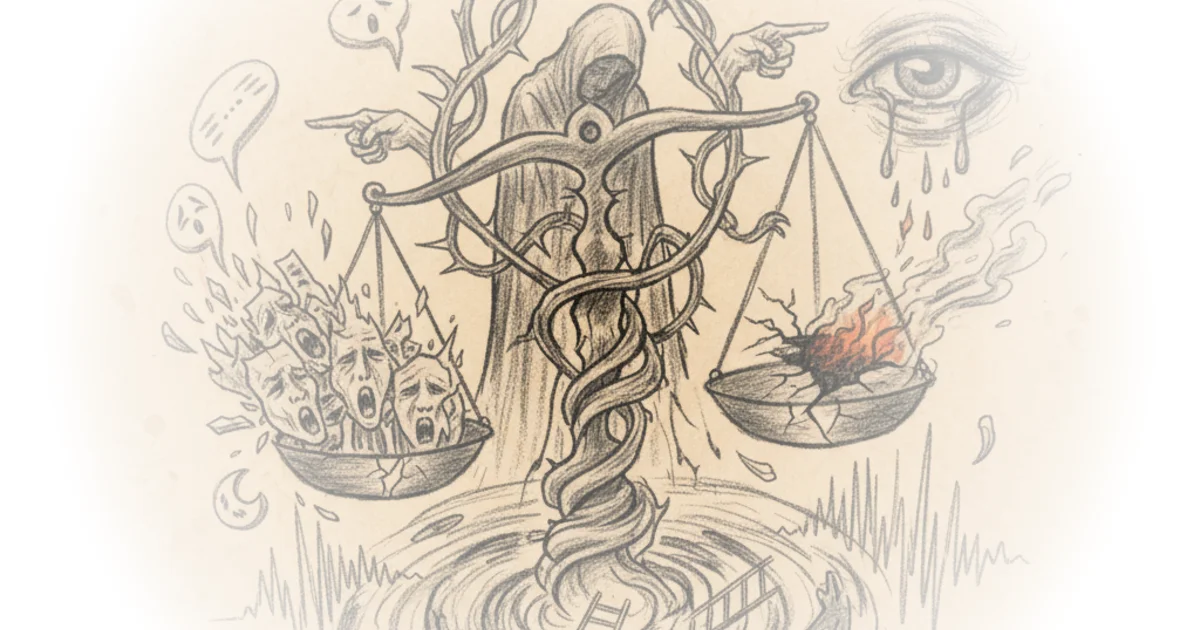
This argument gains significant weight when viewed against the backdrop of the "gaslighting" culture that often plagues online harassment cases. The source text reveals that the student, Poe, had accused another student of sexual misconduct on the anonymous app Yik Yak, echoing a pattern of accusations that had previously led to a female student, L.N., being investigated. However, the university's handling of the crisis suggests a failure to adapt its care protocols to the specific, high-stakes reality of the digital age. The court rejected the university's defense that the student "thwarted one of the main aspects of their reasonable care plan" by lying, noting that the administrators were told the truth during the call and continued anyway. This suggests that institutional rigidity can be just as dangerous as malice.
Having already decided to involve Poe's mother, a jury could find that Defendants failed to exercise reasonable care by proceeding with the outcome call after learning that she was not there to support him.
Critics might argue that universities cannot be expected to guarantee the safety of every student in every interaction, and that the student's deception complicates the chain of causation. However, the court's refusal to grant summary judgment suggests that the evidence of foreseeability is too strong to dismiss. The university knew the stakes were life and death; proceeding regardless of the support system's absence is a gamble with human life that the law may finally be willing to scrutinize.
The Gendered Double Standard
Beyond the immediate tragedy of the suicide attempt, the ruling exposes a potentially systemic bias in how the university enforces its own rules. Reason details a selective enforcement claim where the court found sufficient evidence that a female student, L.N., who made similar false accusations on Yik Yak, received only probation, while Poe was suspended for a year. The piece points out that "Bourgoin knew that Poe was male and L.N. was female," and that the university official initially believed L.N.'s accusations to be true, even after learning they were knowingly false. "There is evidence from which a reasonable jury could conclude that gender affected Vanderbilt's decision to selectively enforce a disciplinary process against Poe," the article states.
This finding strikes at the heart of how Title IX and campus disciplinary processes are often applied. The court noted that the university failed to show Poe the evidence against him, including the identities of other posters, violating the Student Handbook's promise that students may "examine all information that may form the basis for corrective action." The piece argues that the university's failure to provide a fair hearing, combined with the disparate treatment of male and female students, creates a "genuine dispute of material fact" regarding gender bias. This is particularly poignant given the history of anonymous apps like Yik Yak, where false accusations can spread rapidly, yet the institutional response often varies wildly based on the gender of the accuser and the accused.
The court also rejected the university's claim that the appeal process was fair, noting that the appellate chair relied on a "sanitized file" that omitted evidence of bias, including a text message where a staff member described Poe as "very unwell and not stable." The piece observes that this omission "infected Lowe's review," rendering the appeal a mere "rubber stamp." This procedural failure undermines the very concept of due process, turning a disciplinary hearing into a predetermined outcome.
The Limits of Legal Recourse
Despite these significant victories for the plaintiff, the piece acknowledges the high bar remaining for the student. The court dismissed the defamation claim because Poe could not prove that the university's internal letter was shared with his internship employer, a requirement under Tennessee law. Similarly, the claim for intentional infliction of emotional distress was rejected because the court found the university's conduct, while offensive, did not meet the "atrocious and utterly intolerable" standard required for such a tort. The piece notes that even the "lol" in an email from a staff member, which Poe argued showed a callous mindset, was deemed insufficient to prove the extreme malice needed for that specific legal claim.
The court can conclude that at least six people knew about Bourgoin's letter to Roe... Poe has not offered evidence that any of those people shared the letter with his internship employer or other students.
This limitation highlights a frustrating reality of civil litigation: even when an institution acts with clear negligence or bias, the legal system often requires a specific, tangible harm that is difficult to trace back to the institution's actions. The dismissal of the emotional distress claim, despite the university's knowledge of the student's suicidal ideation, serves as a stark reminder that the law is often ill-equipped to fully address the psychological toll of bureaucratic indifference.
Bottom Line
The strongest part of this argument is the court's willingness to treat the delivery of a suspension not as a mere administrative formality, but as a critical moment where the university's duty of care is paramount. The biggest vulnerability remains the high evidentiary bar for defamation and emotional distress, which may leave the student without full compensation for the reputational and psychological damage suffered. Readers should watch for how the jury interprets the gender bias claim, as a finding in Poe's favor could force a major reckoning for how universities handle false accusations and the disparate treatment of male and female students in disciplinary proceedings.