A Legal Scholar's Case for Church Silence on Politics
Steven D. Smith, a retired Warren Distinguished Professor of Law at the University of San Diego who has also taught at Notre Dame, the University of Colorado, and the University of Idaho, opens with a fictional composite he calls "Brother Jones" -- a faithful Latter-day Saint who has grown frustrated with church leadership's political timidity. Smith does not reveal which side of the aisle Brother Jones occupies, and that is entirely the point. The essay's central move is to argue that the desire for prophetic political endorsements is a shared delusion across the ideological spectrum, rooted in twin misunderstandings about how politics works and how scripture functions.
Although he insists that his testimony of the Church is as rock solid as ever, Brother Jones doesn't participate much in the ward lately, in part because he is deeply unhappy with the Church's leaders. They lack the courage of their convictions, he thinks -- the courage to stand up for (or against) political positions and figures as the scriptures and Church doctrine prescribe.
Smith concedes some sympathy for the complaint. He has friends on the left alarmed by Donald Trump and friends on the right worried about creeping socialism or government overreach. The common thread, he observes, is disappointment that church leaders confine themselves to "bland pieties" when they could be deploying prophetic authority on contested political questions.
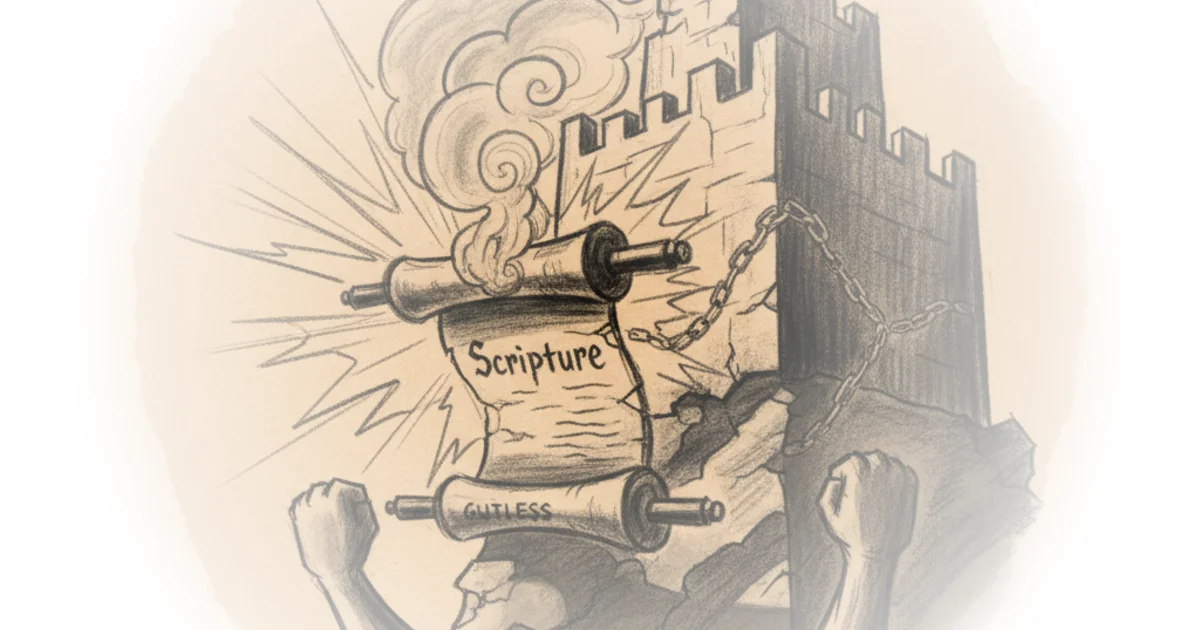
But Smith thinks this expectation rests on two fundamental errors. He spends the essay unpacking each one.
The Nature of Politics: Prudence Over Principle
The first error, Smith argues, is about what politics actually is. In idealistic moods, people imagine politics as the straightforward application of true principles to governance. Smith rejects this flatly. Politics, he insists, is the art of the possible, constrained by scarce resources, inherited traditions, and the stubborn diversity of human opinion.
In our times, politics occurs in a cultural war zone in which people disagree, ferociously, about what is good and bad, just and unjust; and in a democracy, for better or worse, all of these cacophonous voices are supposed to count.
He draws on the Constitutional Convention as his primary historical example, noting that the Founders had to compromise on principles they held dear -- including the moral catastrophe of slavery -- or else there would have been no Constitution and probably no country. Smith then escalates the argument: attempts to govern rigorously by idealized philosophy, from Plato's Syracuse experiments to Lenin, Stalin, Mao, and Pol Pot, have ended in atrocities.
This side of the Millennium, our ambition should perhaps be to live in a less ambitious, less idealistic political order in which aims are lower and willingness to compromise is something to admire, not to condemn.
The implication is clear. If politics inherently requires prudential judgment and compromise, then demanding that church leaders deliver unambiguous political directives is asking them to do something that the nature of the enterprise does not permit.
Critics might note that Smith's argument risks becoming a blanket excuse for institutional inaction. There have been historical moments -- the civil rights movement, opposition to totalitarianism -- where religious leaders' willingness to take clear, costly political stands proved not just defensible but morally necessary. Smith's framework, taken to its logical conclusion, could rationalize silence in the face of genuine moral emergencies.
Scripture as Something Other Than a Legal Code
Smith's second argument draws on his decades of legal scholarship to make a point about textual interpretation. He contends that many believers treat scripture the way Latter-day Saints treat the Church's General Handbook -- as a comprehensive code where you look up section 3.4.1.2 and find your definitive answer. This, he says, fundamentally misunderstands what scripture is.
Words do not lose this double-edged capacity to instruct and to confound just because they appear in a scriptural text. Although we regard scripture as "the word of the Lord," the Lord of necessity speaks to us in our words, and in words suited to (or "dumbed down" for) our exquisitely finite cognitive capacities.
Revelations, Smith reminds the reader, were received over millennia by different people in radically different circumstances. They were usually responses to particular questions or problems. Most were not originally delivered in words at all but through impressions, feelings, visions, or dreams, which then had to be translated into human language. He cites Wilford Woodruff's observation that while Joseph Smith said "Thus saith the Lord" almost daily, his successors led by the Holy Ghost without always claiming such direct verbal authority.
Smith pushes this further with an unexpected reference to Thucydides, who composed political speeches for his history of the Peloponnesian War that were his own reconstructions "appropriate for each situation." Could scriptural writers, Smith asks, use a similar device to convey what a transcendent Being communicated?
"You shall not oppress a stranger," Exodus says, "for you were strangers in the land of Egypt." That's important, yet it would be a mistake to treat it as a complete answer to complicated questions of immigration in the very different world of today.
Even when God spoke audibly -- as Jesus did with his apostles for years -- misunderstanding was constant. Smith highlights the disciples' repeated confusion, their literalism ("Did somebody bring him lunch?"), and the internal contradictions that appear within single sermons. The letter kills, Smith concludes, but the spirit gives life. And this is especially true in matters of public policy, which scripture was almost never directly addressing in the first place.
What Faith Does Offer Politics
Having argued at length about what scripture cannot do in politics, Smith pivots to what it can. He is careful not to land in pure relativism. For believers, he writes, the most basic convictions about life's purpose, human nature, and the meaning of good and evil remain firmly grounded in revelation.
These basic understandings are the framework within which we make our political judgments. In this way, our scripture-based faith informs, infuses, and superintends our political deliberations, commitments, and efforts.
But a believer's political positions will always be a blend of religious premises and contextual, prudential considerations. Reasonable minds will differ. Smith notes that different prophets and church leaders over the years have held different political positions while sharing a common faith. Thoughtful Christians across centuries have argued from the same premises toward radically opposed conclusions: for and against monarchy, democracy, pacifism, collectivism, revolution, and the separation of church and state.
A counterargument is that Smith may understate how often scripture does speak with clarity on political questions. The Book of Mormon, for instance, contains extended narratives about governance, liberty, and righteous political leadership that many Latter-day Saints read as more than vague spiritual guidance -- they see specific political philosophy embedded in the text. Smith's framework largely sidesteps these passages rather than confronting them directly.
The Wisdom of Institutional Restraint
Smith's most practically consequential argument comes near the end. He contends that the Church's political restraint serves its universal mission. If church leaders took explicit sides on contested political questions, it would fracture congregations along partisan lines and "cheapen and deflate the eternal truths and goals of the gospel by conflating them with earthly concerns that, however important to us in the here and now, are nonetheless of passing significance viewed against the backdrop of eternity."
I can (and do) regard Brother Jones as a good friend even though I may believe (and in fact I do) that he is mistaken in his political views. Indeed, I may think those views are dangerous, and at some level incompatible with gospel truths.
The relationship between Smith and Brother Jones survives because the Church has not officially taken sides on the issues that divide them. Neither man is directly, deliberately violating any explicit church teaching. Smith extends this to the broader theological point: if the purpose of mortal life is testing and growth, then God leaving political questions for believers to work out on their own is not a failure of leadership but a feature of the divine plan.
He closes with the final chapter of John's Gospel. After the resurrection, the disciples go back to fishing -- literally returning to their old business -- until Jesus appears again, not to issue detailed instructions but to remind them of their calling. He cooks them breakfast, gives a gentle correction, and leaves them to figure the rest out. Smith reads this as the model: God provides principles and then respects human agency enough to let people apply them.
We are commanded to serve the Lord with our "heart, might, mind, and strength." I've emphasized the third term in the list because I think we often skip past it.
Bottom Line
Smith's essay is a carefully constructed argument from a legal philosopher who knows how to build a case. His twin pillars -- that politics inherently requires prudential judgment, and that scripture was never designed as a political rulebook -- reinforce each other effectively. The essay's greatest strength is its deliberate bipartisan framing; by refusing to name Brother Jones's politics, Smith makes the argument applicable to anyone who has ever wished their church leaders would validate their political convictions.
The vulnerabilities are real but bounded. Smith's account of political compromise as inevitable and even admirable can slide toward a conservatism of temperament that treats all bold moral stands as suspect. His treatment of scripture as inherently ambiguous on political questions, while sophisticated, will strike some readers as conveniently self-serving for an argument that depends on that ambiguity. And he acknowledges but does not deeply engage with the occasions when the Church has taken explicit political positions, such as Proposition 8, which complicate his thesis that restraint is the norm.
Still, for readers wrestling with frustration at institutional caution -- from any direction on the political spectrum -- Smith offers a genuinely useful reframing. The question is not whether church leaders lack courage. The question is whether the kind of courage being demanded of them is the right kind at all.