Tom van der Linden argues that the digital revolution hasn't just made travel easier—it has quietly erased the very thing that made it meaningful: the feeling of being truly lost. By juxtaposing Ewan McGregor and Charlie Boorman's 2004 motorcycle journey with their 2025 return, van der Linden exposes a spiritual shift that goes far beyond better cameras or GPS apps. This is not a nostalgia trip; it is a diagnosis of a world where the unknown has been mapped, reviewed, and streamed into oblivion.
The Last Analog Adventure
The piece anchors its argument in a specific historical moment, treating the 2004 documentary Long Way Round as a cultural artifact from a vanishing era. Van der Linden notes that this journey occurred "one year away from the first ever YouTube video, 2 years away from the first digital GoPro camera, and 3 years away from the first iPhone." He positions the show as "one of the last documented analog adventures, one of the last portraits of a world that was right on the precipice of changing forever." This framing is effective because it moves the discussion from technology to psychology, suggesting that the tools we use fundamentally alter our perception of reality.
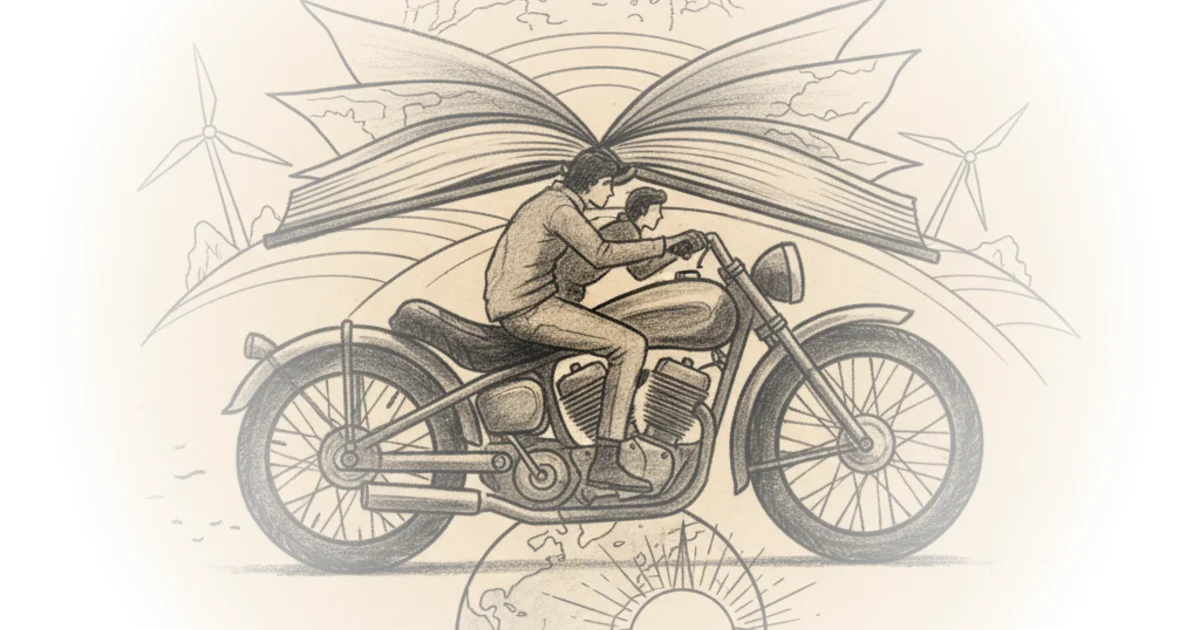
The author highlights the sheer physical and psychological weight of the original trip. In the 2004 footage, the riders face broken bridges and river crossings with no safety net. Van der Linden describes the scene: "There's been a mounting sense of fear about the whole thing... The roads just deteriorated and deteriorated. It was just everything thrown at us at once." This raw vulnerability is what the author identifies as the core of the adventure. The riders were "hundreds of kilometers into what is essentially no man's land," isolated from the digital tether that now binds us. The argument here is that true exploration requires a gap in knowledge that technology has since filled.
"In this overwhelming flood of images, videos, and documents, in this rapid digital charting of the world around us, it feels like we've accidentally killed the meaning of an adventure."
Critics might argue that accessibility is a net positive, allowing more people to experience the world safely and inclusively. Van der Linden acknowledges the democratization of travel but suggests a trade-off: convenience has come at the cost of wonder. The "fear" that once defined the journey has been replaced by the comfort of knowing exactly what lies around the next bend.
The Death of Symbolic Distance
The commentary shifts to the concept of "symbolic distance," a term van der Linden uses to describe the psychological gap between the traveler and the unknown. In the modern era, this gap has collapsed. The author points to a specific moment in the 2020 season where McGregor uses a phone to translate a foreign language instantly. "Together with my husband, they undertook a family project to sell meals," the translation app reads. Van der Linden calls this "indicative of how our interaction with the world... has become so different now." Language barriers, once formidable walls, are now mere software glitches.
The author argues that we have transitioned from a world of imagination to one that is "entirely encapsulated within our symbolic field." We no longer encounter places; we encounter our pre-existing digital expectations of them. "Seeing you and Charlie visit the great lost city of the Incas, for example, feels entirely different now because you've probably already seen the exact same pictures of it a thousand times already on Instagram reels, YouTube videos, and friends photos." The surprise is gone before the trip even begins. The world has been "digitally domesticated," turning once-adventurous frontiers into familiar, curated content.
This observation lands with particular force because it addresses the paradox of modern travel: we have more access to the world than ever, yet we feel less connected to it. The author suggests that the "blank spaces of curiosity have been completely inundated with images," leaving no room for the personal discovery that defines a true journey. The journey is no longer about finding the unknown; it is about confirming the known.
The Spiritual Reconfiguration
Ultimately, van der Linden posits that this is not merely a technological shift but a "spiritual reconfiguration in our relation to the world." The transition period captured by the two decades of Long Way documentaries reveals a society that has traded the risk of the unknown for the safety of the familiar. The author writes, "It's something that I'd already been feeling kind of intuitively and somewhat pessimistically for a while now... And yet, I don't think I'd ever seen the contrast between then and now as clearly and as insightfully as I did while watching this show."
The piece serves as a mirror, reflecting our own discomfort with the loss of mystery. It challenges the reader to consider whether the ease of modern travel has made us poorer in spirit. While the visual language of the shows has evolved with drones and 4K cameras, the emotional core has shifted from "I am far away from home" to "I am connected everywhere." The author's conclusion is that we have forgotten how to travel because we no longer allow ourselves to be lost.
"It's a fundamental transformation not just of how we travel, but also of what it means to travel in the first place."
Bottom Line
Van der Linden's strongest contribution is the concept of "symbolic distance," which elegantly explains why modern travel feels less profound despite being more accessible. The argument's vulnerability lies in its romanticization of danger and ignorance, potentially overlooking the genuine barriers that kept many travelers away in 2004. However, the piece succeeds in forcing a necessary conversation about what we lose when we map every corner of the globe before we ever leave our homes.