Chris Smaje challenges the comforting assumption that urbanism and global trade are permanent fixtures of human civilization, arguing instead that the collapse of the welfare state will force a quiet, radical migration away from cities. While politicians dismiss agrarian localism as irrelevant to the urban poor, Smaje suggests that the very people they claim to represent are already preparing for a future where the city can no longer feed them.
The Illusion of Permanence
Smaje opens by confronting the "ignorance and complacency of the political class" regarding the fragility of the current global economy. He recounts a recent debate with a Member of Parliament who insisted that mass urbanism is a settled fact of history. Smaje's rebuttal is stark: "Yes, that's true; ... Well, it's a bit more complicated than that; and, (3) Yes it is." He argues that the belief in the permanence of the current system is not just wrong, but dangerous because it blinds leaders to the impending need for renewal that cannot come from centralized politics.
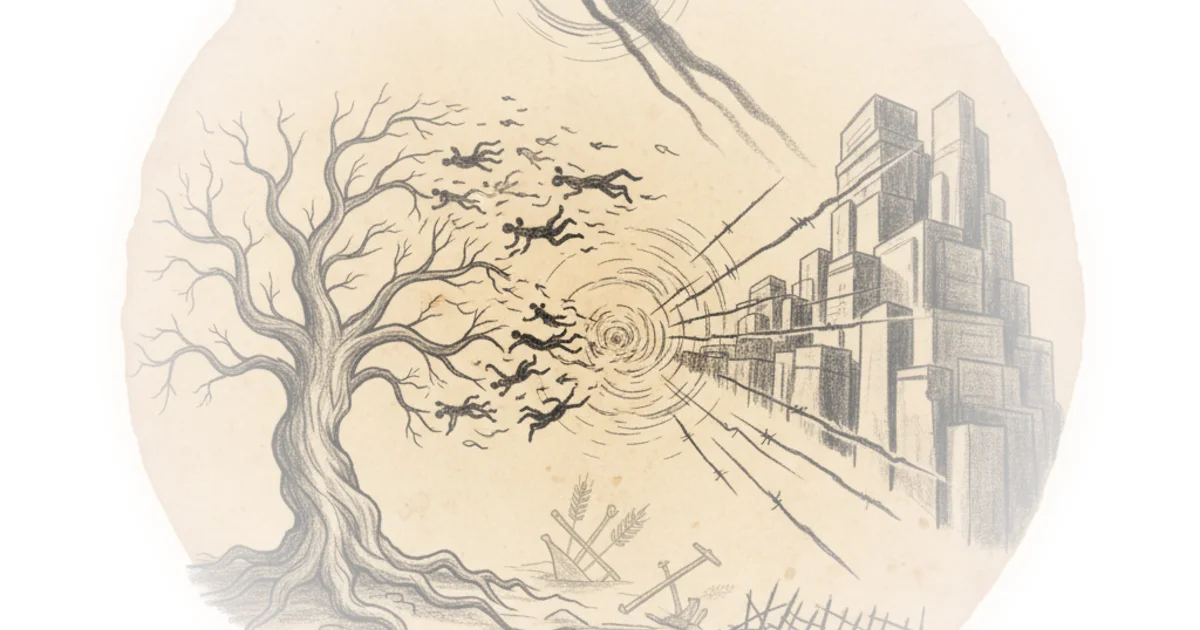
The author's framing is effective because it strips away the technocratic confidence that usually dominates policy discussions. Instead of offering a new policy tweak, he posits a fundamental shift in how people will survive. He writes, "The ignorance and complacency of the political class on this last point, the precariousness of the existing global political economy, is one reason why I find it hard to see the kind of renewal that's needed emerging from centralized mainstream politics." This lands with force because it reframes the "status quo" not as a stable platform, but as a house of cards waiting for the wind to change.
The concepts of 'the urban poor' or 'my constituents' invoked by leftwing politicians become ironically conservative thought-stoppers harking back to a managerial capitalist politics rapidly fading into history.
The Urban Poor as Agents, Not Problems
A significant portion of Smaje's commentary addresses the common political objection that agrarian solutions do not fit the lives of the urban poor. He suggests that politicians use the plight of the urban poor as a "status claim" to shut down discussions about ruralism, while simultaneously relying on outdated Marxist theories that view industrial workers as the sole agents of historical change. Smaje counters this by arguing that as the state withdraws support, the urban poor will not wait for a savior; they will innovate their own survival strategies.
He posits that the "disadvantage" of being urban and poor may be less significant than assumed, noting that the "typical comfortably off middle-class professional is also generally urban, clueless about how to create a material livelihood." This is a provocative claim that upends the usual class analysis. Critics might note that this view risks underestimating the sheer logistical difficulty of transitioning millions of people from high-density urban environments to small-scale agrarian living without significant infrastructure collapse. However, Smaje's point is not that the transition will be easy, but that the current path is impossible.
As Smaje puts it, "My approach to the urban poor is that while they're not the agents of history, they – along with every other kind of person – are agents of history all the same, rather than being a problem for somebody else to solve." This shifts the narrative from one of charity to one of agency, suggesting that the future will be built by those forced to adapt, not by those waiting for legislation.
The Vacuum of Belonging
Smaje then pivots to the psychological drivers of politics, specifically the rise of right-wing nationalism. He argues that mainstream politics fails to address the human desire for "belonging," leaving a vacuum that extremist movements fill. He references a debate where a politician warned that agrarian narratives could be co-opted by the far-right. Smaje rejects this fear, arguing that the real danger lies not in the idea of localism itself, but in the "business-as-usual hopium" of mainstream parties that ignores the desperation of the farming sector and the wider public.
He writes, "It's pretty easy for far-right ideas to get a hearing among farmers when every other shade of politics fiddles while their sector burns." This metaphor of "fiddling while the sector burns" effectively captures the frustration of stakeholders who feel abandoned by the executive branch and established institutions. Smaje suggests that the far-right succeeds not because their tactics are superior, but because they offer a "grander, purer" sense of purpose that rationalist left-wing politics fails to provide.
The real problem with mainstream politics is the business-as-usual hopium, which is quite unequal to the task of staving off the crisis that the far-right exploits.
Critics might argue that dismissing the threat of "far-right appropriation" of localist movements is naive, given the historical tendency of nationalist movements to co-opt environmental and rural rhetoric. Smaje acknowledges the reality of racist nationalism but insists that the solution is not to abandon localism, but to offer a "worthy" alternative that satisfies the human need for belonging without the hate.
Bottom Line
Smaje's most compelling argument is that the political left's defense of urbanism is a relic of a fading era, and that the "urban poor" are not a barrier to agrarian localism but its potential pioneers. His biggest vulnerability is the lack of a concrete roadmap for how this transition occurs without catastrophic social disruption. Readers should watch for how the "quiet innovation" Smaje predicts manifests in the coming years as economic pressures mount.