A decade ago, two contrarian academics warned the American left that it was trading its most powerful weapon — class solidarity — for a politics of recognition that corporations could adopt without surrendering a dollar. The left ignored them. Compact Magazine now offers a reckoning.
The piece opens with a scene that functions as the piece's moral center: a 2016 event at a University of Chicago bookstore where political science professor Adolph Reed Jr. and literary scholar Walter Benn Michaels laid out a thesis that the assembled progressive intellectuals largely rejected. Their argument, which Michaels had first made in his 2006 polemic The Trouble With Diversity, was structural and uncomfortable: the more a political movement emphasizes the disproportionate suffering of particular identity groups, the more it implicitly accepts inequality as legitimate, provided that inequality is adequately diversified at the top. A multiracial executive class presiding over a gutted working class is not a victory for the left. It is a rearrangement of faces at the table while the kitchen staff goes on strike.
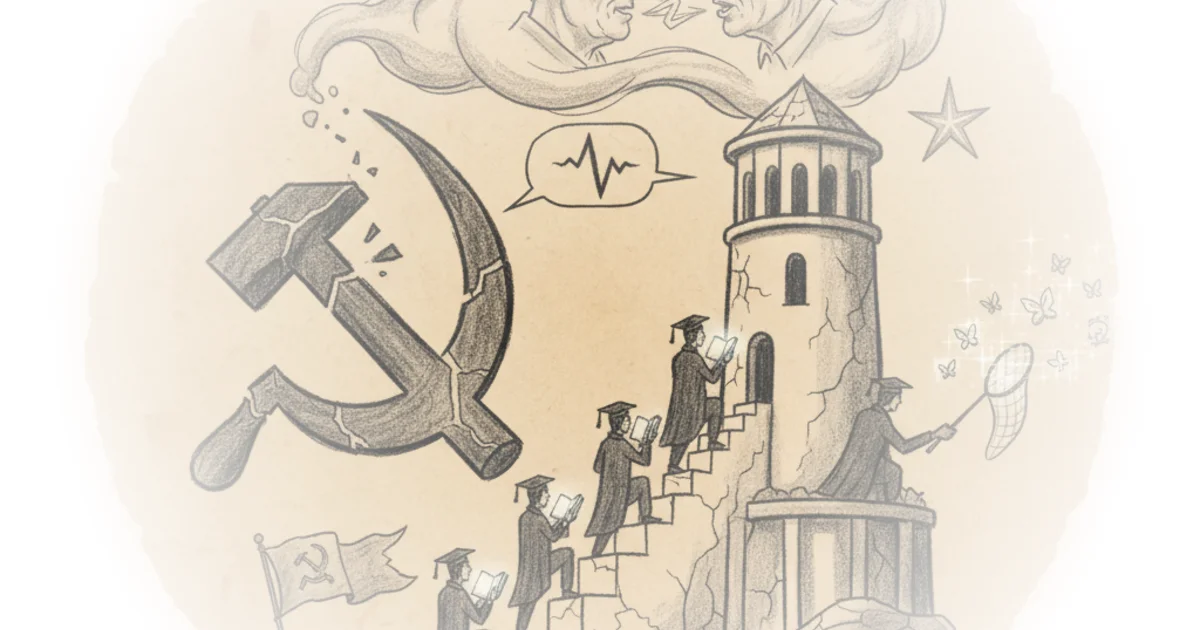
The Choice That Wasn't Made
Compact Magazine traces the decisive moment to the 2016 Democratic primary. Bernie Sanders entered that race as something close to a class-first candidate — invoking, as the piece notes, a tradition stretching back to Jesse Jackson's Rainbow Coalition in the 1980s. His pitch was direct: wealth and income inequality were the defining crisis of American life, and racial disparities could not be meaningfully addressed without confronting the economic structures that produced them. When Black Lives Matter activists confronted him at campaign events demanding he speak specifically to anti-Black violence, he responded with proposals for jobs, free college tuition, minimum wage increases, and trade policy overhaul.
Hillary Clinton spotted the opening. The piece quotes her directly: "There are some who say, 'Well, racism is a result of economic inequality.' I don't believe that." She went further, inverting Sanders's causal logic entirely, arguing that income inequality was "in large measure a symptom of underlying racism." This wasn't merely a tactical difference in campaign messaging. It was a fundamental argument about what the left was for — and Clinton won it, with consequences that extended far beyond her own political fortunes.
The piece is blunt about what that victory settled: "When Sanders lost to Clinton, it wasn't merely a political defeat. The war of ideas had been won, and it foreclosed certain questions before they could be seriously asked." The activist infrastructure, the media, the donor class — all realigned behind an identity-first framework that would govern progressive politics for the next decade.
"You can have a Black CEO and a Latina senator and a queer cabinet secretary and still have an economy in which the bottom half of earners own almost nothing. Diversity is perfectly compatible with plutocracy."
Corporate Capture of Dissent
The piece's sharpest analysis concerns what happened after the 2020 killing of George Floyd. The uprising that followed was, by any measure, the largest protest movement in American history. What did the dominant institutions do with it? Compact Magazine's answer is pointed: corporate America embraced the moment — not with sectoral bargaining or wealth redistribution, but with diversity, equity, and inclusion departments, reading lists, and a surge of foundation money. "Above all," the piece argues, "it was about changing the conversation — and making sure it was about race, not class."
This dynamic — the institutional capture of radical energy and its redirection toward symbolic rather than material change — is the piece's central accusation. The critique of American elites, as framed by the activist infrastructure that emerged in this period, was not that those elites had presided over deindustrialization, asset inflation, monopolization, financialization, and the erosion of the welfare state. It was, as the piece puts it, "that those elites were too white, too male, too straight, too culturally insensitive, and insufficiently 'aware of their privilege.'" A ruling class that might have faced demands for structural economic reform instead faced demands for better optics. It complied, and continued.
Compact Magazine offers a striking illustrative contrast: Nancy Isenberg's 2016 book White Trash, a rigorous history of American class stratification, came and went. The 1619 Project, arriving three years later with the full institutional backing of The New York Times and a Pulitzer Prize, reorganized Americans' understanding of their past around race. Both were serious works. Only one was permitted to matter at scale.
The Cost of Getting It Wrong
The human cost of this ideological turn, as the piece renders it, is not primarily abstract. It is the multiracial working class — downwardly mobile, increasingly cynical, left to navigate rising rents, weakened unions, and algorithmic disruption without institutional support. Private-sector union density now sits at 5.9 percent of the workforce. A writer for Jacobin, the flagship publication of the democratic socialist left, recently described unions as being in a "death spiral." The piece does not soften this: without radical change, the labor movement could "effectively cease to matter."
Adolph Reed, meanwhile, was canceled by the very constituency he had spent his career trying to build. When Reed was scheduled to speak to New York City's chapter of the Democratic Socialists of America in 2020, the event was cancelled after backlash to his insistence that the disproportionate effects of the COVID-19 pandemic on Black Americans could not be understood apart from poverty and the healthcare system. A Black lifelong socialist, treated as "problematic" by the organization that should have been his natural home. Reed's assessment of the experience was characteristically terse: "The DSA thing — that was a bunch of stupid kids."
The 2024 election provided what the piece calls a "crushing irony": the coalition Democrats had assembled on the premise that young, non-white voters would constitute a permanent bulwark against right-wing populism cracked decisively along the diploma divide. Highly educated white voters moved further into the Democratic column. Multiracial working-class voters defected in sufficient numbers to shift the popular vote. Class — written off by progressive theory — reasserted itself at the ballot box with the bluntness of a systems check.
A Correction That May Not Correct Enough
Compact Magazine gestures toward a possible path forward in the figure of New York City Mayor Zohran Mamdani, inaugurated in early 2026. Mamdani campaigned on affordability, rent, transit, and wages — the material conditions of daily life. His early months in office included expanded free childcare, action against predatory junk fees, and a push for housing deregulation to increase affordable supply. The piece finds this promising.
But it also notes the contradictions. Mamdani has established the first-ever Mayor's Office of LGBTQIA+ Affairs in New York City history and marked Trans Day of Visibility with a post declaring that trans lives are "not a political issue" — while, as the piece observes, making it clear that they actually are. The piece is careful not to suggest hypocrisy. Mamdani, it notes, is a sincere progressive who genuinely holds these commitments. But they are also, precisely, "the kind of pieties that the professional activist class requires as the price of coalition membership." A class-first politics that must pay an identity-politics toll at every junction is not, structurally, a class-first politics.
Critics might reasonably object that this framing presents a false binary. The evidence that working-class voters abandoned the left specifically because of identity politics, rather than because of inflation, housing costs, or cultural condescension from credentialed professionals, remains genuinely contested. Exit polling and post-election analysis suggest the picture is more complicated than a simple identity-versus-class narrative allows. Some researchers have found that material grievances and cultural resentment are so thoroughly entangled in working-class political behavior that separating their effects is methodologically suspect.
Critics might also note that Reed and Michaels's argument, for all its intellectual force, has historically found a more comfortable home in publications read by left academics than in actual organizing. The labor movement's decline predates the rise of identity politics and has roots in deliberate legal and legislative changes — the Taft-Hartley Act, decades of National Labor Relations Board hollowing, and the structural transformation of the American economy — that no recalibration of progressive ideology can reverse on its own.
And there is something worth examining in the piece's implicit assumption that the professional-managerial class's adoption of identity politics was a strategic error rather than a rational choice. For educated professionals whose economic position was relatively secure, a politics of recognition — which cost them nothing materially and conferred significant social status — was straightforwardly advantageous. They didn't make a mistake. They made a calculation.
What Was Actually Lost
The piece's most clarifying passage may be its description of the anti-administration resistance that emerged after 2016: "an online-driven movement made up primarily of credentialed professionals. Their central question was not who owns what or who works for whom, but who is being harmed, erased, or insufficiently recognized. The economy that mattered most in progressive politics was the attention economy." This is a precise diagnosis. A left organized around attention is a left organized around the professional-class habit of treating discourse as action. It produces language changes, institutional statements, corporate training programs, and prestige battles. It does not produce material redistribution.
Walter Benn Michaels, now in his late seventies, has watched two decades of warnings go unheeded. When the piece's author asked for his current view last month, he responded via email with characteristic economy: "My current view is fuck 'em all."
It is a sentiment that contains multitudes — exhaustion, contempt, and the particular bitterness of being right in a way that benefits no one. The left Michaels critiqued in 2006 is largely intact, if somewhat chastened, and the working class whose interests he argued were being sacrificed remains, as the piece puts it, "fragmented, downwardly mobile, increasingly cynical, left to fend for itself in a country of rising rents, weak unions, and algorithmic upheaval."
Bottom Line
Compact Magazine's indictment of the identity-politics turn is historically detailed, intellectually serious, and largely persuasive in its account of how symbolic inclusion became a substitute for material change. The harder question — how a class-first politics actually gets built in 2026, against the institutional gravity of credentialed progressive culture, a collapsed labor movement, and a political economy that rewards attention over organizing — goes largely unanswered. Getting the diagnosis right is not the same as having a cure.