The AI conversation in corporate America has been stuck on the wrong question. While most companies ask "how many jobs can we cut?" the real opportunity — what execution costs dropping by ten or hundred times makes possible — gets lost in the noise.
Nate B Jones, a strategic advisor who works with boards and leadership teams making these decisions, says the doom narrative dominating headlines blinds operators to an staggeringly large opportunity set that's almost completely unexamined. The companies breaking out of the doom frame first aren't just getting a head start. They're getting the whole race because everyone else is still arguing about headcount while customers move toward companies that dream bigger.
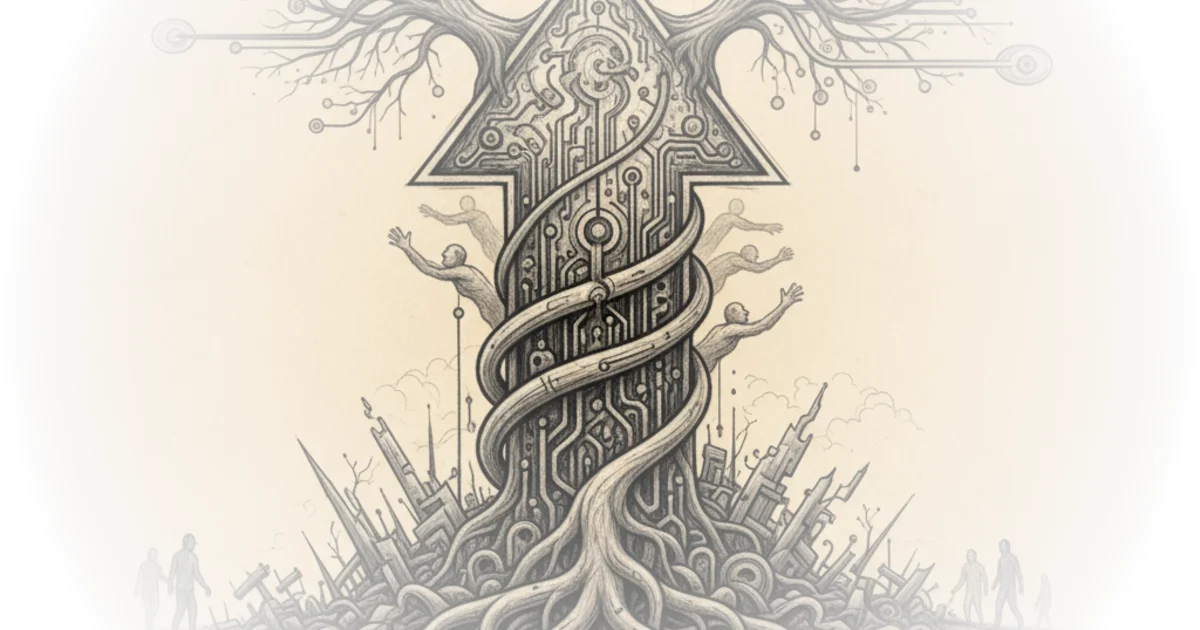
The question getting air time right now — how many fewer people do we need — can feel sophisticated. You can model it in a spreadsheet. But Jones argues it's the wrong question entirely.
The Right Question
Given that execution cost just dropped by an order of magnitude, what can we do right now that was previously impossible?
This is the shift from the efficiency frame to the ambition frame. The efficiency frame assumes a fixed pie of value and optimizes for capturing your slice efficiently. The ambition frame assumes the pie was artificially constrained by the cost of execution, and removing that constraint creates a larger opportunity than all the savings from cutting headcount.
History tells which frame wins. When steel got cheap, industry expanded into skyscrapers, railroads, and cars. When computing got cheap, it created personal computing, the internet, mobile, and cloud. When distribution got cheap, media companies playing defense got destroyed by companies building new categories.
This pattern has a name: Juban's paradox. When efficiency increases, consumption goes up — not down. Because cheaper resources make new applications viable. AI is the most dramatic efficiency improvement in the history of work.
If Jan's paradox applies, and every structural indicator says it does, the total demand for insight, judgment, creativity, and domain expertise is about to explode. The cutters will be pocketing the savings. But the people betting on the paradox are the ones who will win.
Unlock One: Go Fast
The iteration rate AI enables is going to change the mechanics of strategy. When you can compress an entire product iteration cycle from months to days, everything changes. You don't get a faster version of old strategy. You have a different relationship between what you understand about the market and what you can do.
Right now, a product bet takes maybe six months — maybe three if you're lucky. That means two to four options a year to get it right. The cost of being wrong is a quarter at best. This is why the dominant strategy in corporate America is copy the other guy. The iteration cost is so high that exploration is irrational.
Now compress that cycle to days. You can get something in a single working session. Cursor's February 2026 cloud agents update lets developers spin up twenty parallel agents on isolated cloud VMs simultaneously. Every single one working on a separate branch, testing changes, opening pull requests. About a third of Cursor's code and pull requests are written by agents operating autonomously — and that number is going up.
What happens when you can run 200 learning cycles a year? What happens to your people when they can run 200 learning cycles a year?
The tech already enables this. The reason it isn't everywhere is because the people aren't there yet. They either don't believe they can go fast, think they'll get wrists slapped, or haven't been given the infrastructure as leaders. Or they don't dare to dream that big.
Startups die because they exhaust their funding before they exhaust their hypothesis. If you drop the cost of testing each hypothesis by a couple of orders of magnitude, the runway equation changes. It becomes rational to test so much more.
The human role in this new world is not smaller — it's bigger. You need people who can generate good hypotheses, have deep customer intuition, have contrarian market insight, have creative vision. Today, those people spend 80% of their energy shepherding a single bet through the organization. Tomorrow, they're generating and evaluating ten bets a week. The bottleneck shifts from "can we build it" to "should we build it?" And that's a human question.
Unlock Two: Builders Everywhere
The equation for builders has fundamentally changed. This will reshape the entire economy — it's bigger than anything else here. It will change our civilization.
Right now, we have something like 35 million developers — maybe 40 million. And we have hundreds of millions of people who are legitimate domain experts. The doctor who knows what software her patient panel needs. The logistics manager who can draw the warehouse routing algorithm on a whiteboard. The teacher who knows exactly what adaptive learning her students need.
All these domain experts have been blocked by overloaded software teams — whether those are overloaded internal software teams with backlogs, or overloaded software teams selling them bad software. They're fundamentally locked out of building by the translation layer: the gap between knowing what should exist and making it exist as a piece of software. That translation is super lossy. It's slow. It's expensive.
That translation layer is going away. When a doctor can describe what she needs and an agent can build it in an afternoon, you're unlocking an entirely new class of builder. Platforms like Lovelike, like Bolt, like Replit are already putting production-quality development in the hands of non-coders.
If you work at a big company, this is relevant to you. The bigger the company, the more internal ideas people have and do not act on. They are the domain experts in their corners of work, in their corners of the business, and they can't solve stuff because they've been locked out of building. They don't have to be locked out anymore. They can just build.
The scale of this is massive. We are about to go to hundreds of millions of builders. The total surface area of human problems addressed by custom tools is going to increase by an order of magnitude — if not two or three.
The challenge for you on a people scale: how can you start building against the problems you see? Understand what you're an expert in. If you're a leader, how can you unlock your people to do that? Give them the ambition. Give them the tools. Take it seriously. This is not pie-in-the-sky thinking. People are already doing this.
Unlock Three: Quality Is Default
Quality software is the default today — it's not at a premium. This is going to break so many developers' minds.
So much of our software has been mediocre, and we all know why. It's not because engineers are bad. It's because we lack the execution capacity to do great testing, great documentation, great security review, great performance optimization, great accessibility, and great visual polish — all on time, all under budget.
These problems are all agent-verifiable. We can get them done. They're just very labor-intensive, and for most of history, we've chosen not to prioritize them. Now it's just table stakes.
When agent harnesses run testing and security review and documentation and everything else — not as expensive add-ons but as standard procedures — the baseline quality of all software goes up dramatically. Shipping a new feature is not going to be a big deal anymore. Shipping a feature with polish is not going to be a big deal.
Every shortcut we take today that we think is rational is predicated on the idea that building is hard and complicated — and that's going away.
This is a massive mindset shift. It takes actually experiencing it. You need to find someone on your team, or if you have a team, get them together and work on this as a project. Find a way to use agents in an evaluation-driven development loop that forces the agent to work until it's tested a complete finished working product. And do that entire process until you have a working product out the door.
Then you're going to realize: even if the first one isn't perfect, even if you get a little bit better over time — what is possible? For so long, the gap between the top 5% of engineering teams and everyone else has been polish. What they can spend money on that we can't. Not anymore. The quality of software in our world is just going to be incredible.
And that's going to push differentiation to product. What is the amazing customer experience we bring? That's a challenge for us. But it's a challenge we should be excited about.
Unlock Four: Every Company Is a Platform
Building and maintaining integrations is a nightmare for anyone in product or engineering. We all hate integrations. That's been the way we've done it so long.
Open AI reminds us that world has shifted beneath our feet. Instead of thinking of the world as our system is closed and we have to build bridges, we need to think of our system as fundamentally open because agents will get into it — and we can choose to do that reactively and let them figure out a way using a browser, or we can choose to proactively build integrations very cheaply.
And what this means: every company is now a platform. You don't have to spend lots and lots of money on becoming a platform. Now the question is whether your platform is sticky, whether you deliver something that's valuable. That's what matters.
From a human perspective, the implicit lesson here — this is high-level platform strategy stuff. It typically operates at the VP level and you don't talk about it to ICs very much unless it's at one all hands. Everybody needs to get fluent in this kind of thinking.
And the challenge is to recognize that you need to socialize that thinking down and really take time to talk about strategy in a way that matters because people are going to have this kind of impact. You can have someone roll out two or three integrations in an afternoon. If that's the power they have, they should probably know more about corporate strategy.
Unlock Five: The Market for Ambition
The market for ambition is through the roof right now. Companies throw so much money on the floor. Companies will look at a $10 million market and won't touch it because the engineering team costs $3 million a year. They'll look at an R&D project with a 20% shot at success and say, "I don't think it's worth pursuing. Failures would cost us two quarters in roadmaps. We're just not going to do it."
But remember the structural changes: execution cost is going down by ten times or 100 times. All of those calculations flip. Now the $10 million market is viable. The experiment you could do five of them.
This is not a conversation about I can't justify the investment anymore — CFOs need to change their mindset here and capture those expanded opportunities. Guess what it takes? It takes people. People doing different work. People with vision and domain expertise and creative insight who can see the opportunities and go after them aggressively.
When you are looking to tell people to raise their sights and dream big, you are tapping into something that's a little bit like the childlike wonder we were sold when we watched Disney and Pixar films. You are looking for people who could dream that kind of big because for the first time in history, the cost of execution is dropping that far.
And that's a huge deal. And so if you're working with people — that dreaming part — that's actually the part you need to get them to buy.
Counterpoints
Critics might note that betting on Juban's paradox — while structurally compelling — carries real risk. Execution costs dropping dramatically has historically created new possibilities, but it has also enabled unprecedented scale of workforce reduction. The history of automation is not just expansion of roles but displacement of labor. The optimism about "people doing different work" assumes the workforce can pivot to higher-value tasks, which may not happen at pace with falling execution costs.
A counterargument worth considering: the article frames the question as either headcount reduction OR expanded ambition. But in practice, many companies will do both — pursuing efficiency gains while also exploring new opportunities. The real challenge is whether organizations can walk and chew gum at the same time rather than treating this as an either-or choice.
"The cost reduction frame assumes a fixed pie of value and optimizes for how efficiently you capture your slice. The ambition frame assumes the pi was artificially constrained by the cost of execution."
Bottom Line
Jones's strongest argument is structural: when execution costs drop dramatically, history shows consumption increases — not decreases. His biggest vulnerability is that "people with vision and domain expertise" who can drive this transformation are exactly the people being cut in today's headcount reductions. The piece assumes these workers will be reallocated to higher-value work without acknowledging they may simply be laid off before the new opportunities emerge.
Watch for whether companies like Whoop — which just announced hiring over 600 people — prove the ambition frame works at scale, or whether the efficiency frame continues dominating corporate America.