Annie Levin identifies a rare literary anomaly: a novelist who refuses to succumb to the reactionary fatigue plaguing his generation. In her analysis of Alan Hollinghurst's Our Evenings, Levin argues that the book is not merely a coming-of-age story but a precise diagnosis of how political dread infiltrates the quietest corners of private life. This is essential reading for anyone trying to understand why the promise of mid-century liberalism has curdled into the harsh realities of the present, without needing to look at a single headline to feel the shift.
The Architecture of Exclusion
Levin posits that Hollinghurst achieves something his contemporaries have failed to do: he writes with a "radical presentation of power dynamics through intimate relationships" rather than retreating into political paranoia or cultural bitterness. She contrasts Hollinghurst favorably against his peers, noting that while others have broken under the weight of modern paradoxes, "Hollinghurst dances through them." This framing is crucial because it shifts the focus from a simple critique of prejudice to a structural examination of how privilege operates. The novel's protagonist, Dave Win, is a gay, half-Burmese man whose life is shaped by the benevolent yet suffocating patronage of the white, upper-class Hadlow family.
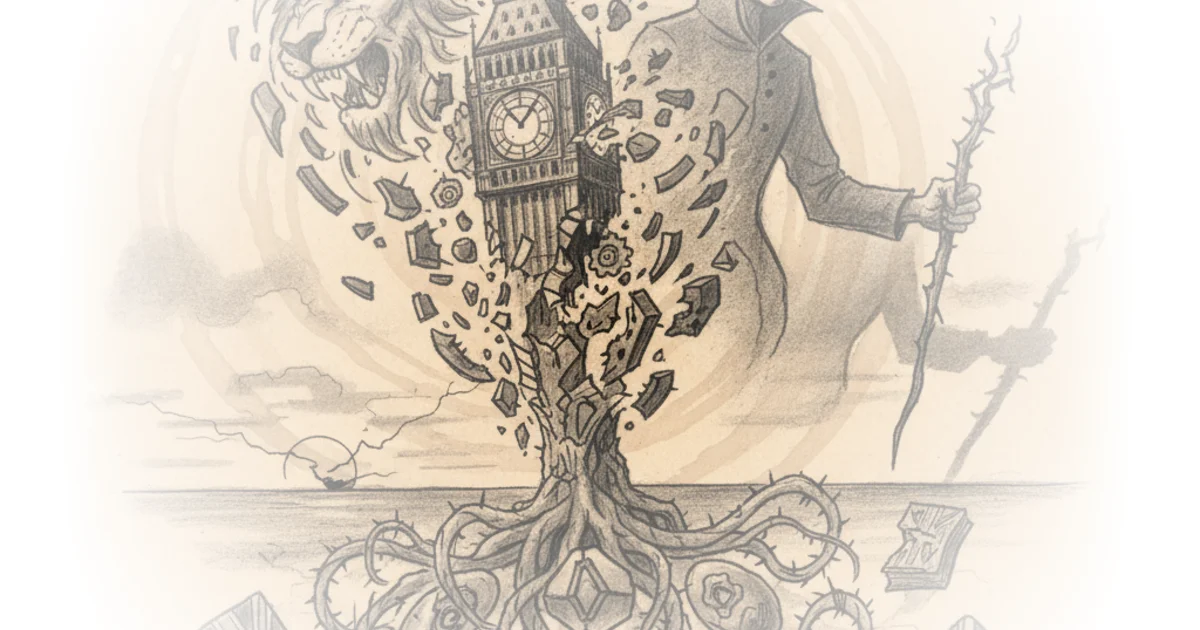
The narrative arc mirrors the trajectory of British history itself. Levin writes, "In Alan Hollinghurst's lush, symphonic Our Evenings, the arc of history bends toward Brexit." This is a bold claim, yet she supports it by showing how the personal is inextricably political. The bullying Dave endures from his schoolmate Giles Hadlow is not just childhood cruelty; it is the early manifestation of a political ideology that will eventually dominate the state. As Levin puts it, "Giles' reappearances in the novel summon back into the past the black horizon of the present." The author effectively uses the character of Giles to personify the transition from the liberal, arts-loving establishment of the mid-20th century to the ruthless, anti-immigrant conservatism of the late 20th and early 21st centuries.
"Hollinghurst gives us a gift we didn't realize we needed, so inured are we to half-baked prose and cranky narratives set in a perpetual 1992."
The Cost of Mimicry and the Bull in the Room
Levin draws a sharp parallel between Hollinghurst's work and L. P. Hartley's The Go-Between, a classic text about class and trauma. However, she notes a critical inversion: while Hartley's protagonist is an outsider due to class, Dave Win's otherness is compounded by his race and sexuality. "Non-white and explicitly homosexual, Win cannot blend in," Levin observes. His talent for mimicry becomes a survival mechanism, yet it is a fragile shield. The text highlights a chilling scene where Dave, having mastered the nuances of English culture, is violently reminded of his place by Giles, who calls him a "dirty mongrel" despite Dave's impeccable Englishness.
The symbolism Levin unpacks is particularly potent. She focuses on the character of Ernest, a bull at the Hadlow estate whose horns have been removed but whose danger remains. Levin describes the animal as "a chimera of fascism and power with an implicit aura of sexual violence." This metaphor serves as a microcosm for the Hadlow family's worldview: they believe they can tame the dangerous forces of their own heritage and the empire they represent, but the violence is inherent, not external. The removal of the horns offers a false sense of security, much like the "patronizing chumminess" the Hadlow parents offer Dave while ignoring their son's cruelty.
Critics might argue that focusing so heavily on the inevitability of political decay risks overshadowing the genuine resilience and joy Dave finds in his life outside the aristocratic sphere. Levin acknowledges this, noting that Dave "finds richness and fulfillment outside the Hadlows' circle of privilege" through his work in experimental theatre and his relationship with his mother. Yet, she insists that this personal victory is ultimately insufficient against the tide of history. The novel suggests that even the most vibrant subcultures cannot fully insulate individuals from the macro-political shifts that seek to erase them.
The Final Insult of the Helicopter
The climax of Levin's analysis centers on a specific, devastating scene in the novel where Giles, now a high-ranking government minister, disrupts a cultural event with a helicopter. Levin writes, "Giles takes a helicopter to the music festival so he can catch the performance before a meeting abroad." The noise of the machine ruins the performance, and Giles leaves without a second thought. Levin interprets this not as a calculated act of malice, but as something far more insidious: "It is just in his nature not to care." This distinction is vital. It suggests that the destruction of the arts and the marginalization of people like Dave are not the result of a grand conspiracy, but of a casual, systemic indifference that has become the norm.
The author connects this moment to the broader political landscape, noting that "Mark and Cara's callow liberal instincts don't pass onto the next generation — it is Giles' rapacious Thatcherite conservatism that wins the 20th century and is poised to sweep the 21st." This transition from the liberal patronage of the parents to the ruthless pragmatism of the son illustrates the fragility of the social contract. The "good kicking" Giles intends for the arts is the logical conclusion of a political philosophy that values power over beauty and exclusion over inclusion.
"Queerness, art, and love create a beautiful life for baby boomer Dave Win, but they cannot save him from political reality."
Bottom Line
Annie Levin's commentary succeeds by refusing to treat Our Evenings as a mere period piece; instead, she frames it as a prophetic warning about the limits of personal resilience in the face of structural hostility. The strongest part of her argument is the connection between the intimate violence of bullying and the macro-violence of political exclusion, showing how the former foreshadows the latter. However, the piece's vulnerability lies in its somewhat deterministic view of history, where the "black horizon" seems inevitable regardless of individual agency. Readers should watch for how this literary analysis intersects with current debates on the erosion of liberal institutions and the persistence of class and racial hierarchies in modern Britain.