Nate B Jones identifies a terrifying paradox in the current financial landscape: the market's panic over artificial intelligence is causing more immediate economic damage than the technology itself. He argues that Wall Street has developed an "autoimmune disorder," indiscriminately attacking healthy companies based on headlines from unproven startups, creating a self-fulfilling prophecy of corporate stagnation. This is not just a story about stock volatility; it is a warning that the reflex to "dump first, ask questions later" is forcing real companies to make catastrophic strategic errors today.
The Autoimmune Market
Jones opens with a jarring example of market irrationality: a company formerly known as "The Singing Machine Company," which sells karaoke equipment, briefly crashed the entire global logistics sector. He writes, "Within hours, CH Robinson Worldwide, one of the largest freight brokerages on the planet, plunged 24%." This event is particularly striking when viewed against the backdrop of the Russell 3000 Index, a broad measure of the entire US stock market that has historically shown resilience to single-company noise, yet here, a $6 million firm wiped out billions in value across a critical industry.
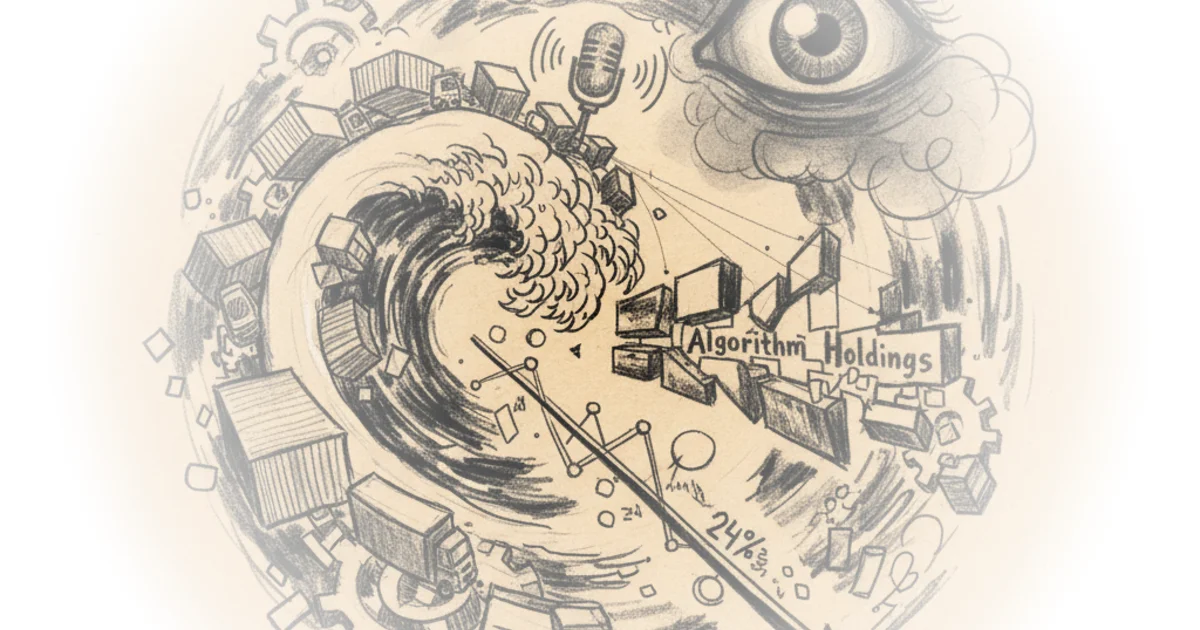
The author's central thesis is that this is not an isolated incident but a repeating pattern he calls the "AI scare trade." He notes, "The pattern is the story, and the pattern has consequences that go far beyond stock prices." Jones meticulously traces a ten-day contagion that swept through software, private credit, insurance, wealth management, and real estate services. Each sector fell not because of a fundamental shift in their business models, but because a competitor released a press release or a new tool.
"Fundamentally, Wall Street has developed an autoimmune disorder. The immune system risk repricing is attacking healthy tissue because it can no longer distinguish between what's real and what's not."
This metaphor is the piece's most powerful analytical tool. It reframes the sell-off not as efficient price discovery, but as a pathological reaction where the market's defense mechanism is more destructive than the threat. The author argues that when a stock like CH Robinson drops 24%, it forces a board meeting, a hiring freeze, and a rewritten roadmap, regardless of whether the AI threat is real. As Jones puts it, "Stock drop doesn't just reflect reality, it creates reality."
Critics might argue that markets are simply pricing in the highest probability of disruption, and that the "overreaction" is a necessary correction for companies that have been complacent. However, Jones counters that this panic forces companies into a "defensive crouch" that makes them more vulnerable to actual disruption later, as they gut product teams to satisfy investor optics rather than investing in genuine capability.
The Three Categories of Exposure
To make sense of the chaos, Jones proposes a framework that separates the market's panic into three distinct categories of AI exposure. He argues the market is currently treating all three as identical, which is a catastrophic error in judgment.
The first category includes sectors where AI is genuinely displacing labor today, such as software development. Jones points to tools like Cursor, an AI coding editor, which hit $300 million in annualized revenue faster than almost any software product in history. He writes, "The SaaS companies whose business models depend on selling seats to humans may well be in trouble." Here, the market's fear is grounded in reality, though perhaps exaggerated in its speed. The author suggests that while the "per seat" pricing model is under threat, the need for data and human oversight remains, meaning a total collapse is unlikely.
The second category covers sectors where AI matters on a three-to-five-year horizon, but the panic vastly overstates the near-term risk. Wealth management and insurance brokerage are prime examples. Jones notes, "An AI tool that does tax planning cannot replace a wealth advisor any more than TurboTax can replace accountants." The value in these industries lies in relationships, trust, and behavioral coaching—areas where current AI systems cannot compete.
"The market is pricing in a gradual transition over the next few years as if it's happening by earning season and it's going to be catastrophic no matter what. That's just wrong."
This distinction is crucial for investors and employees alike. The author highlights the irony that wealth management clients are panic-selling their own industry's stocks due to AI fears, a behavior that mirrors the very panic the industry is trying to manage for its clients.
The third category is where Jones believes the market has "lost the plot entirely." This includes commercial real estate and logistics, where a press release from a karaoke company cannot invalidate decades of proprietary data and complex regulatory relationships. He quotes Croup analyst Ariel Rosa, who was "very kind" to suggest skepticism about the karaoke company's ability to disrupt the industry. Jones argues that while disruption is inevitable, the timeline the market is pricing in is "delusional."
The Capital Reallocation Trap
The final section of the commentary focuses on the flow of capital. Jones observes a vicious feedback loop where public SaaS valuations are cratering while private AI startups, regardless of their actual product quality, are seeing valuations skyrocket. He writes, "You stick AI in the name, and magical things happen right now."
This misallocation of capital creates a generational buying opportunity for those who can distinguish between hype and reality. The author warns that the "SaaS tag," once a benefit, has become an "albatross around your neck," while companies with "AI" in their name attract capital even if they are overfunded and unproven.
"The companies that respond to a 15% stock drop by gutting out their product teams and signing a splashy AI partnership are the ones that are going to get actually disrupted in 3 years."
This is the core strategic insight of the piece. The market's short-term panic is forcing long-term strategic errors. Companies that pivot to "performative AI" to save their stock price will be the ones that fail when real disruption finally arrives. Conversely, those that ignore the noise and invest in genuine capability will survive.
Critics might note that in a fast-moving technological landscape, it is difficult to distinguish between "performative" and "genuine" AI investments, and that the market's aggression might be a necessary filter to weed out weak players. However, Jones maintains that the current reaction is "catastrophically imprecise," hitting every industry with the same hammer regardless of their actual exposure.
Bottom Line
Nate B Jones delivers a compelling critique of the financial market's reflexive panic, successfully arguing that the "AI scare trade" is creating a self-fulfilling prophecy of corporate weakness. His strongest contribution is the "autoimmune disorder" metaphor, which effectively explains why market reactions are causing more immediate harm than the technology itself. The piece's biggest vulnerability is its reliance on the assumption that corporate leadership will have the foresight to ignore market signals and invest strategically; history suggests many will succumb to the pressure to cut costs. Readers should watch for the next quarter's earnings calls to see if companies actually pivot to "performative AI" or if the "generational buying opportunity" Jones predicts begins to materialize.