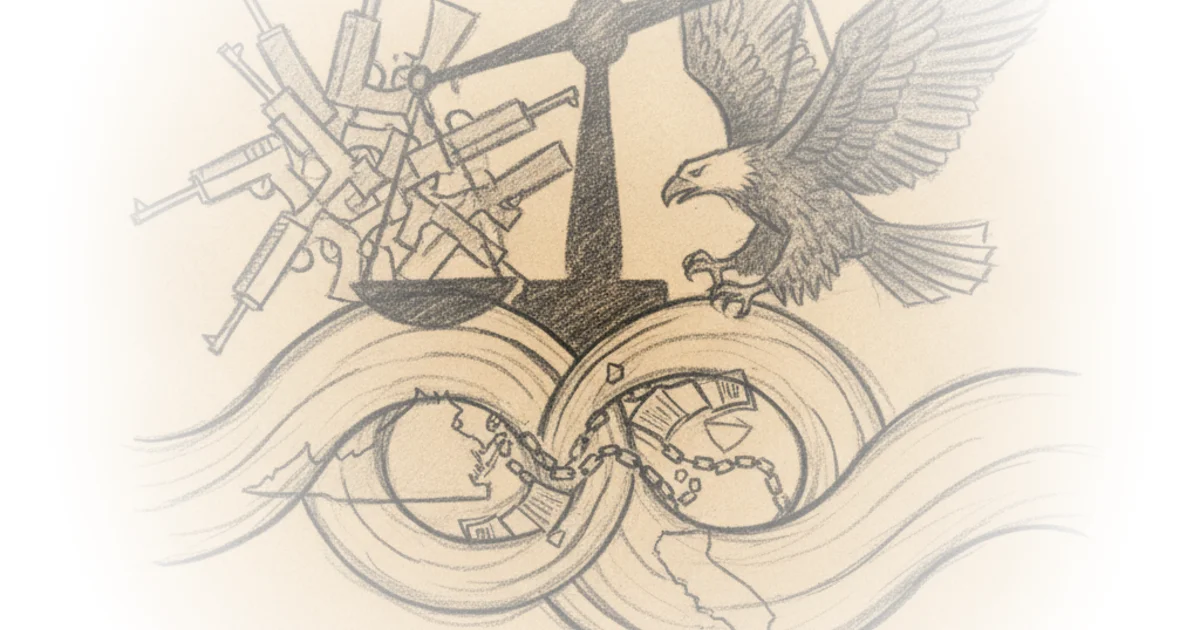
This isn't just another lawsuit filing; it represents a startling inversion of federal power where the executive branch is now the primary legal challenger to state-level gun bans. Reason reports that the Justice Department, under Assistant Attorney General Harmeet Dhillon, has filed suits against both Virginia and California, arguing that these states are violating the Second Amendment by banning weapons in "common use." The piece brings a crucial, often overlooked perspective: the federal government is no longer defending broad restrictions on firearms but is actively dismantling them using the very historical test established by recent Supreme Court rulings. For busy readers tracking the shifting legal landscape of gun rights, this signals a potential seismic shift in how the Constitution is enforced across state lines.
The Virginia Challenge and Historical Precedent
The core of the argument against Virginia's new "assault firearm" ban rests on a specific metric: popularity. Reason notes that the law targets semiautomatic rifles like the AR-15, which are owned by millions of Americans for lawful purposes like self-defense and hunting. The piece highlights Assistant Attorney General Dhillon's assertion in the complaint: "Americans own and use for lawful purposes tens of millions of AR-15-style rifles," making a ban on them presumptively unconstitutional.
This argument leans heavily on the 2022 Supreme Court decision in New York State Rifle & Pistol Association v. Bruen, which requires laws to be consistent with the nation's "historical tradition of firearm regulation." Reason points out that Virginia cannot meet this burden because, as Dhillon writes, "there is no historical tradition of banning arms in common use." This is a sharp pivot from previous legal battles where states argued these weapons were too dangerous. The article effectively uses the 2008 District of Columbia v. Heller ruling to reinforce that the Second Amendment protects "bearable arms" used for lawful purposes, regardless of their military lineage.
"It is hard to see how Virginia can overcome that presumption by meeting the Bruen test, which requires 'relevantly similar' historical analogs that resemble a challenged law in motivation and scope."
The piece contrasts this with the 4th Circuit's earlier ruling in Bianchi v. Brown, which upheld Maryland's ban by claiming these weapons are "ill-suited" for self-defense. Reason critiques this judicial overreach, noting that Judge Julius Richardson's dissent correctly identified that courts have no business "replac[ing] Americans' opinions of their utility with their own." Critics might note that the majority in Bianchi was deeply concerned with mass shooting statistics, a perspective the federal lawsuit attempts to sidestep by focusing strictly on ownership numbers rather than crime rates. However, as Reason observes, even if these rifles are used in crimes, the Supreme Court previously held in Heller that handguns remain protected despite their high homicide rates.
The California 'Glock Ban' and Regulatory Absurdity
The commentary shifts to California's restrictions on handguns, specifically targeting Glock pistols through a law banning "machinegun-convertible" models. Reason reports that the definition of this category is so broad it effectively bans nearly all Glock sales because their standard safety mechanism—a cruciform trigger bar—could theoretically be modified with household tools.
Dhillon's complaint, as cited by the publication, cuts through the regulatory complexity: "California's ban on the sale of the most popular handgun in America obviously violates the Second Amendment." The piece argues that the state is attempting to outlaw perfectly safe firearms based on a hypothetical conversion potential. Reason draws a powerful analogy here: just because a legal shotgun can be sawed down into an illegal weapon doesn't mean the state can ban all shotguns.
The article also exposes a bizarre regulatory failure in California's "Roster of Certified Handguns." Due to impossible requirements like microstamping, no new handguns have been added to the roster since 2013. Reason highlights Judge Cormac Carney's 2023 ruling that this situation forces citizens to rely on decade-old models, stating: "Californians have the constitutional right to acquire and use state-of-the-art handguns to protect themselves." This section of the piece is particularly strong because it moves beyond abstract legal theory to show how regulatory hurdles effectively disarm law-abiding citizens.
"These provisions of the Roster statute violate the Second Amendment... they prevent California residents from 'acquiring state-of-the-art handguns for self-defense.'"
The piece notes that while the Trump administration previously defended similar restrictions despite claiming to support gun rights, this new Justice Department section is explicitly tasked with opposing laws that "disarm broad categories of Americans for no good reason." A counterargument worth considering is whether federal intervention in state safety regulations undermines local autonomy, but Reason suggests that when state laws conflict directly with Supreme Court precedent on fundamental rights, such intervention may be necessary.
Bottom Line
The strongest part of this coverage is its clear demonstration that the Bruen test has fundamentally altered the legal battlefield, forcing states to prove historical justification for bans they previously enacted without scrutiny. The piece's biggest vulnerability lies in its reliance on federal litigation, which can be slow and subject to judicial pushback from courts still grappling with how to apply historical analogies to modern technology. Readers should watch closely as these cases proceed, particularly regarding whether the Supreme Court will hear similar challenges involving Connecticut and Illinois, which could finally settle the definition of "common use" once and for all.