This piece delivers a chilling diagnosis of a legal and cultural shift that is already reshaping the very definition of parenthood, arguing that the rapid integration of assisted reproductive technologies is not just changing how babies are made, but how the law views human beings. N.S. Lyons presents a stark warning: we are stumbling toward a future where children are legally redefined as assembled products and parents as merely provisional custodians, a transformation driven by a "blind rush" to marketize reproduction. The urgency here is not theoretical; it is rooted in real-world scenarios where embryos are selected for IQ and surrogacy contracts dictate the fate of unborn children based on commercial terms.
The Legal Inversion of Family
Lyons anchors the argument in a specific, dissident thesis: the law's primary role should be to defer to the "natural family" and the anthropological reality that children are inherently connected to their forebears. The author contends that current legal trends are actively dismantling this foundation. "Basic to the law's role in the relational security of children is the law's deference to the natural family and the anthropological depths that this family represents and anchors in society," Lyons writes. This framing is powerful because it shifts the debate from abstract "rights" to the concrete security of the child, suggesting that the law is failing its most vulnerable subjects by ignoring biological reality.
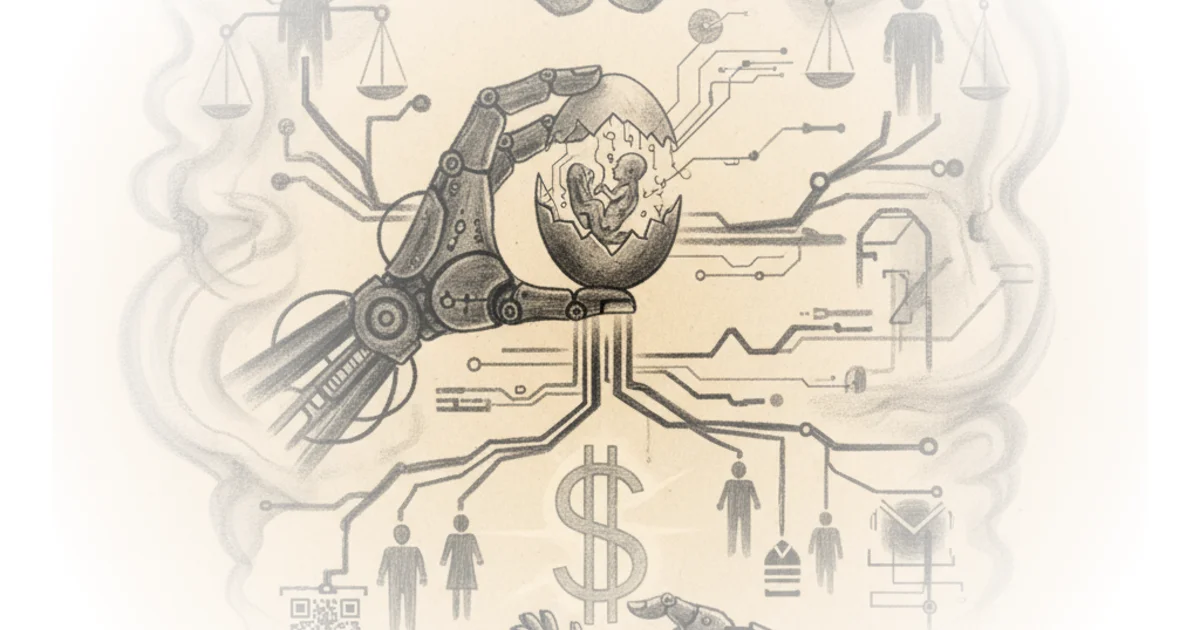
The commentary highlights how the assisted reproductive technology (ART) industry is driving this change by decoupling child-creation from conjugal relations. Lyons describes this as a "technocratic project of human reproduction that now confounds historic American family law." The argument suggests that by treating reproduction as a manufacturing process, the law is forced to adopt a consumer paradigm. "In the vision of the Technium, as well as in those precincts of the law that have absorbed the machine logic as its own, children are radically homeless… understood as conceived and entering existence without objective relation to anyone," the author explains. This is a disturbing claim, yet it is supported by the logic of the industry itself, where genetic material, gestation, and birth can be sourced from different continents and different people.
The organic and natural fact of the human person as familial is an orienting and ordering consideration of justice itself.
Critics might argue that this perspective ignores the reality of infertile couples or same-sex partners who rely on these technologies to build families, potentially framing their children as less "real" or their bonds as inferior. However, Lyons counters that the issue is not about who can become a parent, but how the law defines the child's status. The author warns that when the law refuses to recognize the "truth of the humanly defining relationality of the child to his forebears," it strips society of the ability to recognize the unique obligations of parenthood.
The Global Baby and the Totalitarian Drift
The piece moves from the philosophical to the geopolitical, introducing the concept of the "global baby." Lyons illustrates this with a scenario where a sperm donor lives in Israel, an egg donor in Mississippi, a gestator in New Delhi, and the commissioning parents in Denver. This fragmentation, the author argues, is not an anomaly but the "paradigm and the central case of the industry." By classifying all aspects of reproduction in "mere functional terms," the industry enables the commercialization and offshoring of human life. "The 'global baby' of the future is destined to have 'no default placement, no security of embeddedness, no people, no ancestors, no family history…' It will only have the state," Lyons writes.
This is where the argument takes its most ominous turn. Lyons posits that this redefinition of family is not a liberation from state power, but a pathway to a "truly totalitarian social and political dynamic." If the natural family is dismantled and children are viewed as isolated individuals with no inherent ties, then the state becomes the sole authority on who a child is and who gets to raise them. "When the individual is loosed from the natural family and its constraining certainty of relatedness, he (along with his now-contingent relationships) is instead comprehended exclusively within the uncertainties of political solicitude," the author notes. This suggests that the push for reproductive "rights" may inadvertently secure the "totalism of state jurisdiction."
The author points out that under this new legal model, parents are no longer naturally vested authorities but "provisionally accredited custodians." This shift means that the state, not the family, holds the ultimate power to assign custody and define identity. "The law's failure to forbid at the front end the industrializing of human reproduction ensures the law's submission thereafter to the mechanistic premises of that project," Lyons argues. The implication is that once the law permits the industrialization of reproduction, it loses the moral and logical ground to enforce traditional duties, leaving the state as the only remaining arbiter of human relationships.
Once the law permits the will-based biotechnical making of children from the parts and efforts of disbursed participants, the law already takes for granted and validates that the child (despite the visible realities of genealogy and filial origination), in fact belongs to no one in particular.
A counterargument worth considering is that the state already intervenes in family life to protect children from abuse and neglect, and that a more flexible legal framework might better serve children in complex modern families. Yet, Lyons insists that the current trend is not about protection, but about a fundamental redefinition of human nature that treats embodied connections as "merely empirical or mechanical—not meaningful and defining."
Bottom Line
N.S. Lyons presents a formidable, if unsettling, case that the commercialization of reproduction is driving a legal revolution that threatens to erase the natural bonds of family, replacing them with a state-centric, contractual model of human existence. The argument's greatest strength lies in its ability to connect specific technological practices to a broader, terrifying political trajectory, forcing readers to confront the long-term consequences of current legal permissiveness. However, the piece's vulnerability is its reliance on a specific, traditional anthropology that may struggle to resonate with a public increasingly accustomed to diverse family structures, potentially limiting its persuasive power among those who see these technologies as tools of liberation rather than instruments of control.