Mark Koyama challenges the popular narrative that World War II was won by a single, glorious battle, arguing instead that the Allied victory was a grinding economic attrition where the strategic bombing of Germany played a far more decisive role than history books admit. By weaving together the visceral horror depicted in the new Apple TV series Masters of the Air with rigorous quantitative analysis, Koyama reframes the high casualty rates of the 8th Air Force not as a tragic failure, but as a necessary, albeit brutal, component of dismantling the German war machine from the inside out.
The Myth of the Decisive Battle
Koyama begins by dismantling the romanticized notion of the "decisive battle." He argues that our collective memory clings to moments like Stalingrad because they condense the chaos of war into a single, understandable narrative of victory. However, the author writes, "Stalingrad did not destroy the offensive capabilities of the Wehrmacht." Instead, the war was a war of matériel, where the ability to replace losses mattered more than any single engagement. Koyama cites historian Cathal Nolan to support this, noting that "no one battle or named defeat was decisive in a war-winning sense: not Stalingrad, El Alamein or Bizerta, not even Kursk."
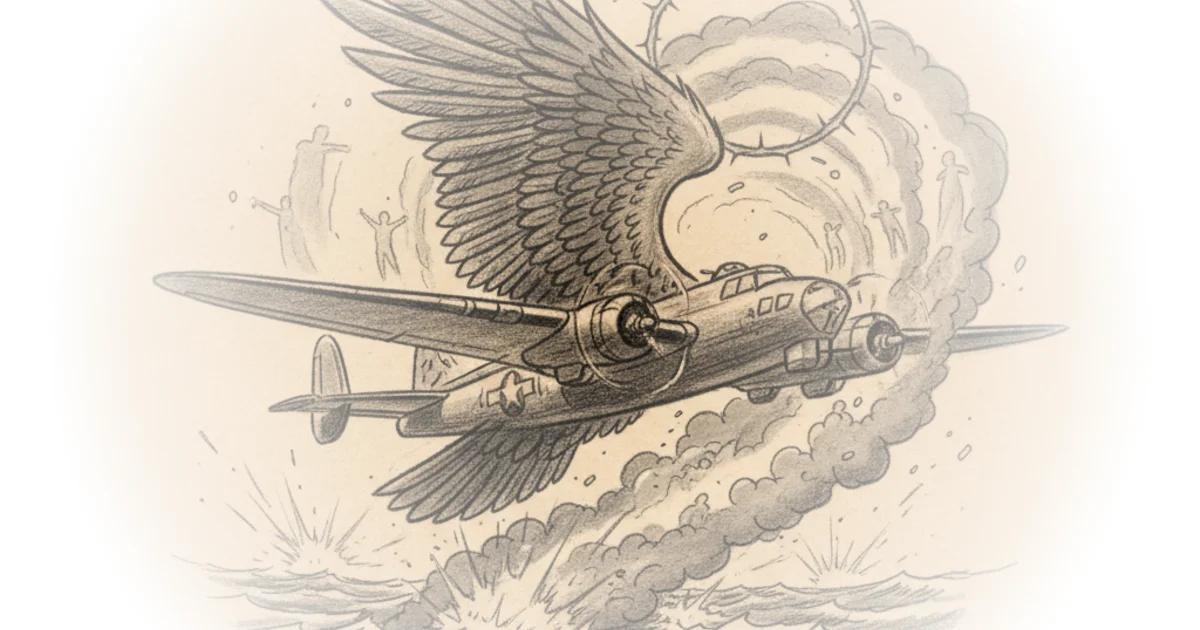
This framing is crucial because it shifts the focus from the heroism of the front lines to the industrial capacity of the nations involved. The argument holds up well against the historical record, which shows that the Soviet Union could absorb massive losses at Kiev and Stalingrad because their industrial base and manpower reserves were simply deeper than Germany's. The real turning point wasn't a specific tactical victory, but the cumulative wearing down of German resources.
The war will be won by whichever side produces the most motors.
The Economic Reality of Air Power
The core of Koyama's piece is the application of an economic lens to military history. He introduces the work of Philip O'Brien, who argues that the Allied air campaign was the primary driver of German defeat, long before the land invasion of Normandy. Koyama highlights a startling quote from German army chief Alfred Jodl, who admitted after the war: "Not taking into consideration the Russian air force, which was of no great importance, I would say in general that in the end the winning of the complete air superiority in the whole area of the war has altogether decided the war."
This evidence is compelling because it comes from the enemy's own high command, stripping away any potential Allied propaganda bias. Koyama explains that while German manpower losses seemed manageable until 1944, the air war forced a massive reallocation of resources. By late 1943, 70% of German fighters were pulled from the Eastern Front to defend the Reich, leaving the ground war with older, inferior models. This strategic shift was a direct result of the bombing campaign, forcing the Luftwaffe into a defensive posture that crippled their ability to support ground troops.
Critics might argue that the bombing campaign was morally ambiguous, given the high civilian casualty rates and the destruction of cities, a cost that economic models often struggle to quantify. However, Koyama's analysis focuses strictly on the military efficiency of the campaign, suggesting that the "necessary failure" of high bomber losses was the price paid for achieving this strategic dominance.
Destruction Before Production
Perhaps the most striking insight Koyama offers is the concept of "pre-production destruction." He argues that it is far more cost-effective to destroy a plane on the ground than to shoot it down in the air. The author notes that the Allied bombing campaign didn't just reduce output; it forced Germany to disperse its factories underground and into the east, destroying economies of scale. "The physical process of dispersing production to the east itself caused production declines just because of transportation," Koyama writes, explaining how the German industry became inefficient and fragmented under the threat of air attack.
The human cost of this industrial grinding is stark. The article mentions that 28,000 workers were diverted solely to building a bomb-proof bunker for Hitler, resources that could have been used for armaments. Furthermore, the collapse of the oil supply in 1944 meant that even when raw materials were available, they could not be transported to refineries. "Both Japanese and German armaments construction went into a terminal decline in the summer of 1944," Koyama observes, not because they ran out of steel, but because they lost the mobility to move it.
Allied attacks over German airspace made it increasingly difficult for German pilots to train. By late 1943, Allied pilots typically had twice the training of their German counterparts.
This disparity in training, driven by the constant threat of air raids, meant that the German air force was not just out-numbered, but out-skilled. The economic approach reveals that the bombing campaign didn't just break machines; it broke the logistical and human systems required to sustain a modern war.
Bottom Line
Mark Koyama's analysis successfully reframes the strategic bombing campaign from a controversial footnote into the central engine of Allied victory, proving that the immense sacrifices of the 8th Air Force were not in vain. While the piece effectively uses economic data to dismantle the myth of the decisive battle, it leaves the profound human tragedy of the bombing of German cities as a secondary concern to the strategic calculus. The strongest takeaway is that modern warfare is ultimately a contest of industrial resilience, where the ability to produce and move resources matters more than any single tactical triumph.