The Pacific War America Forgot
This episode of Hardcore History opens with something unexpected: Dan Carlin admitting he's got 27 hours of content on this subject, yet still diving back in. The guest is Ian W. Toll, whose three-book trilogy on the Pacific theater just wrapped up. What emerges isn't a recap — it's a corrective. A conversation about what Americans don't know about this war.
"You really need to just look at the map of the pacific and you see this is a sea war and an air war first."
This line from Dan Carlin captures the episode's core argument: Americans think of WWII as a land war, and they carry that assumption into the Pacific theater where it simply doesn't apply. The inversion here matters. In the Pacific, naval operations and air power came first. Island fights — Guam, Iwo Jima, Okinawa — were supporting roles in a larger sea war. Carlin frames this as a fundamental misunderstanding: most Americans absorbed the European theater's logic and carried it into their understanding of the Pacific, where it simply doesn't fit.
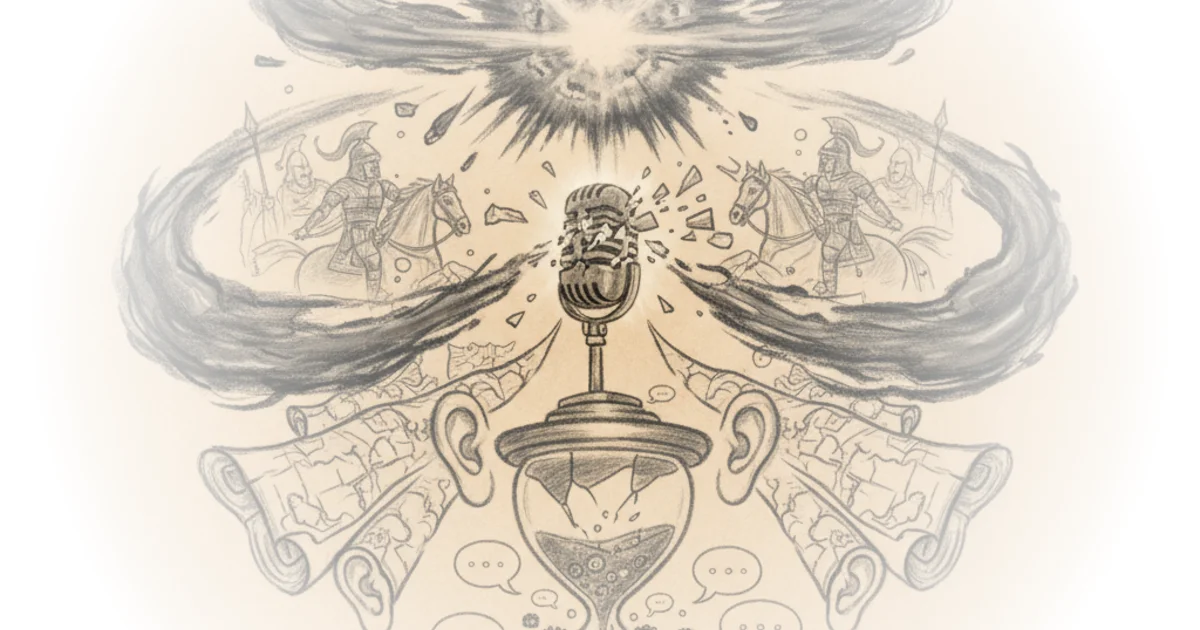
Ian W. Toll responds with something more layered. He points out that Americans know the battles they've been taught — the Marine exploits, MacArthur's campaigns — but the "whole Asia side of this conflict is enormous." Five years later, American troops would be in Korea with Chinese forces entering the war after a certain point. The fallout from the Pacific war ripples forward into conflicts America didn't anticipate.
Carlin presses harder: why don't Americans know more about this? Why do we ignore the giant land war in Asia?
"The simplest way to answer that is just that you know we weren't involved in that war in a big way."
This is the episode's most honest admission. American self-interest shapes historical memory — naturally, they gravitate toward narratives where their boys were directly involved. But Toll goes further: because Mao's China won the civil war after WWII, "the telling of the story was something that was controlled directly by mao's regime." Access to that history was limited. The gap isn't just about American indifference; it's about what information was available and who controlled it.
The conversation pivots to a counterfactual — what if Germany had won in Russia? What if Stalin had cut a deal with Hitler, allowing forces to redeploy against England?
"I find it very hard to imagine any scenario where the japanese could have escaped this conflict with in a better situation than they were on december 6 1941."
This is Toll's strongest claim: Japan was trapped from the start. The bet on Germany failing — that Hitler would dominate Europe and keep America worried about its own hemisphere — was "a very bad bet." But there's a moment of nuance here: if the decision had come two weeks later, after the German army was stopped outside Moscow, Japan might have reconsidered. The counterfactual isn't just hypothetical; it's the exact kind of strategic thinking that makes this episode valuable.
Then Carlin raises an interesting point about marketing and messaging — specifically, the Greater East Asia Co-Prosperity Sphere. The Japanese framed their war as "Asia for the Asians," a pan-asian liberation movement against Western colonial powers. Did they blow it by how they treated populations they'd "liberated"?
"The japanese would have done themselves a huge favor if they had just treated the asian peoples that they had conquered more in line with their ideology of this sort of pan-asian liberation movement."
Toll's answer is layered: yes, there was genuine imperialism — plundering Asia to raise living standards. But also, many Japanese genuinely believed in the pan-asian cause. That tension persists today among Japan's right-wing politicians and historians who view the Pacific war as "a kind of long-term sacrifice for the rest of Asia" that indirectly sped up decolonization.
The episode closes on something concrete: oil. Carlin notes he now sees oil as a first major global war — the embargo, the resource constraints, the fuel that drove military operations. This framing reframes what WWII meant in terms Americans can grasp today: supply chains, economic vulnerability, strategic dependency.
Bottom Line
This episode works because it takes a 27-hour series and asks one simple question: what's missing? The answer isn't obscure trivia — it's about how America framed the war itself. The Pacific wasn't just another theater; it was a sea war first, where Americans were never "involved in a big way." That framing shapes what we remember, what we forget, and why certain histories feel like foreign countries. The strongest thread here is Toll's observation that Japanese imperialism included genuine idealism — and that the failure to live up to the hype turned populations against them. That's not just history; it's a lesson on messaging and credibility that still resonates.