Who Was William Blake
William Blake emerged as one of the most inexplicable poets of the English tradition. Born in 1757 in London, he was a poet, painter, and printmaker largely unrecognized during his lifetime—though now celebrated as one of the greatest voices of the Romantic age.
During his childhood, young Blake witnessed visions of angels and prophets climbing ladders from trees, experiences that seemed to fuel a lifelong artistic quest against spiritually constricting trends. His enemies included Enlightenment rationalism in early years and later Enlightenment deism, yet his mythology maintained an underlying unity throughout.
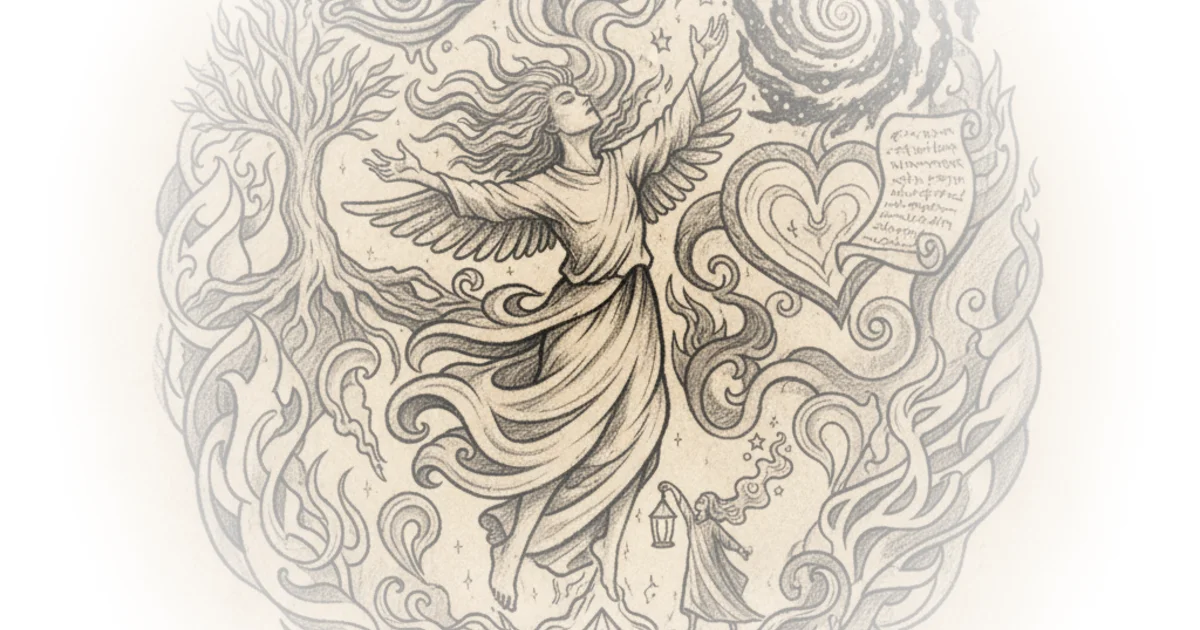
Blake's religious background shaped him profoundly. His parents were dissenters—nonconformists who belonged to groups of Christians separated from the Church of England. These Protestant communities held various beliefs ranging from Presbyterians and Congregationalists to Baptists, Quakers, and Unitarians. After 1689, these groups gained legal permission to worship, though they remained barred from public office and unable to obtain degrees at Oxford or Cambridge.
Some historical analysis suggests Blake's family belonged to a Moravian tradition imported from Germany. When young Blake reported his visions, both parents initially scolded him—his father even beat him at least once. Later, his mother intervened and protected him, perhaps believing her son or recognizing something genuine in his experiences.
This dissenting household primed Blake to be a nonconformist in every sense. His radical nature appears clearly in "Songs of Innocence and Experience," published together in 1794 though begun in 1789.
The Voice of the Ancient Bard
The poem "The Voice of the Ancient Bard" serves as an introduction to Blake's vision, particularly for readers seeking creative awakening. From "Songs of Experience," this piece functions as a bridge between the two collections.
Youth of delight, come hither And see the opening morn Image of truth newborn: Doubt is fled, and clouds of reason Dark disputes and artful teasing— Folly is an endless maze. Tangled roots perplex her ways. How many have fallen there? They stumble all night over bones Of the dead and feel they know not what But care and wish to lead others When they should be led.
The title itself—"voice of the ancient bard"—calls readers toward newborn truth, like morning sun, while warning against the endless maze of doubt, reason, and folly. The fourth line proved controversial for 18th-century readers: "Doubt is fled and clouds of reason" directly challenged an age that celebrated reason as its highest virtue—sometimes called the Age of Reason.
The symbols here appear throughout Blake's work: the morning sun representing new possibility, the endless maze suggesting spiritual confusion, tangled roots implying errors passed down through generations. The poem rejects external authority—whether priests, kings, or abstract moral codes—and instead locates divinity in human imagination, echoing an inner divinity proclaimed in "The Divine Image."
Blake's term for this unified imaginative perception is "futurity," existing beyond the fallen world of time, space, and reason. The bard figure calls readers to reject institutional "manacles" and mental rejection.
The Divine Image
"The Divine Image" from "Songs of Innocence" presents Blake's vision more directly:
To Mercy, Pity, Peace, and Love All pray in their distress, And in these virtues' delight return Their thankfulness. ... Thy mercy is a signet on all Justified kindled within: Mercy for mercy—Pity, peace, and love— Is God our Father dear, And Mercy, Pittle, Peace, and Love Is man his child.
The poem's simplicity proves deceptive—this is Blake at his most accessible. The divine image redirects readers from abstract personifications of love, mercy, peace, and pity toward actual incarnations in the material world.
Blake knew the Bible deeply, particularly as a dissenter better than most. In Genesis, he found the declaration: "So God created mankind in his own image." This passage typically reinforces human dignity—all are in God's image and deserving of respect. Blake builds upon this to reach more radical conclusions equally scriptural.
For Blake, the divine image becomes not merely copy but surrogate for God. The word "image" derives from Latin roots meaning not just picture but also idea or likeness—corresponding to the Greek "eikon," which Plato used describing reflections of higher reality. This connects directly to imagination.
The first two stanzas show movement: "going out and return." This concept of supplication—"All pray in their distress"—carries platonic significance about movement between states. The virtues then suggest energies operating like aspects of God's personality, drawing from Cabalistic traditions.
Blake's Mythology and Imagination
The Cabalist doctrine of the sephiro—ten divine emanations through which the infinite unknowable God interacts with creation—influenced Blake's complex system of imagery. Scholars including S. Foster Damon, Kathleen Rine, and Sheila A. Spectre have argued that Blake's mythology of the four zoas reworks these ten modes.
Blake likely encountered this through Moravian churches, which imported Jewish mystical traditions into their theology. The second stanza makes clear: God is love, peace, mercy, pity—and man is those things too. These virtues are embodied in human form, divine and material. For Blake, the spiritual never separates from the material.
In his engraving work, Blake invented unique illuminated printing allowing poetry alongside intricate symbolic illustrations. His goal remained consistent: to open immortal eyes toward worlds of inward thought.
Counterpoints
Critics might note that interpreting Blake through Cabalist traditions risks obscuring rather than illuminating his originality—particularly his radical rejection of external authority. Some scholars argue his vision stands more purely on prophetic biblical grounds than Jewish mysticism. Additionally, framing his religious background as primarily dissenting may underestimate his singular artistic vision that transcends any single tradition.
"It rejects external authority. So priests, kings, abstract moral codes—these are all enemies in Blake's art."
Bottom Line
This analysis succeeds by revealing Blake as a radical thinker who located divinity within human imagination rather than in external institutions—a position that still challenges readers today. The strongest evidence comes from close reading of his poems themselves, showing how "The Divine Image" embodies virtues materially rather than abstractly. However, the argument remains incomplete: why exactly should contemporary readers care? What does Blake's vision offer busy people seeking to enrich their lives? The piece answers what Blake believed but leaves unclear why that matters now.