In a world obsessed with human timelines, Nicolas Delon offers a startling reframing: the true measure of a life isn't its length, but the intensity of its agency. While most natural history pieces treat animal lifespans as mere biological trivia, Delon uses the rare convergence of two cicada broods to launch a profound inquiry into the relationship between time, consciousness, and the inevitability of death.
The Rhythm of Emergence
Delon begins by grounding the reader in the immediate, overwhelming reality of the current cicada emergence in the U.S. Midwest and Southeast. He notes that billions of insects are rising simultaneously, a phenomenon that hasn't occurred since 1803. "Because of their precise cycles, the last time these two broods co-emerged was in 1803," Delon writes, highlighting the mathematical rarity of the event. He argues that this synchronicity is not a glitch, but a survival strategy evolved to minimize predation risk through sheer volume. "Large-scale emergence compensates for whatever predation does happen simply by offering more than predators can chew," he explains. This framing is effective because it shifts the perspective from viewing the insects as a nuisance to seeing them as master strategists of evolutionary biology.
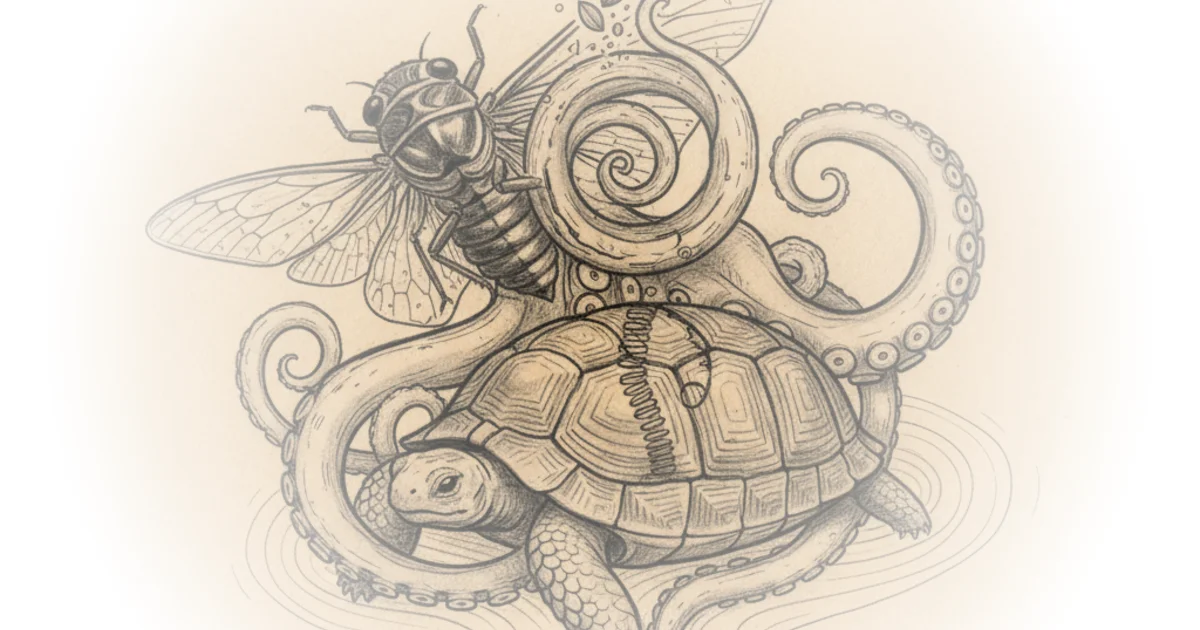
Yet, Delon pushes further, questioning why this high-stakes strategy is so rare. If it works so well, why do annual cicadas not go extinct? He suggests that for periodical cicadas, the threat of predation is concentrated entirely in the final weeks of their lives. "Most of their life is spent underground in a nymphal stage feeding on plant root xylem fluids," Delon notes, pointing out the paradox of a creature that spends 99.5% of its existence in relative safety only to risk everything in a brief, chaotic burst above ground. The author's observation that these creatures engage in complex courtship rituals—"alternating short flights with bouts of calling"—adds a layer of dignity to what might otherwise be dismissed as simple insect behavior.
"Periodical cicadas are your periodical reminder that there are so many unique ways to live—and die—in this world."
The Paradox of the Octopus
The commentary then pivots to a creature with a radically different relationship with time: the octopus. Delon draws heavily on the work of philosopher Peter Godfrey-Smith to explore the cognitive dissonance of an animal that possesses immense intelligence but lives a shockingly short life. "I had assumed that the cuttlefish I'd been interacting with were old... I realized that year, though, that I'd come across these cuttlefish in the early part of the breeding season, and all the animals I'd been visiting would soon be dead," Delon quotes Godfrey-Smith, illustrating the jarring realization that these "worldly" creatures are essentially newborns in human terms.
Delon identifies the biological mechanism as semelparity—reproducing once and then dying—a strategy common in invertebrates but rare in vertebrates. He argues that this is a reflection of the "inextricable link, and associated tradeoffs, between sex and death." The author suggests that in high-risk environments, the evolutionary logic dictates a "bet big" approach: "If you spend less now to save something for later, that will do you no good if animals of your kind have little chance of making it to the next breeding season," he paraphrases the evolutionary theory. This is a compelling argument that reframes the octopus's short life not as a tragedy, but as a calculated, high-yield investment.
Critics might note that projecting human concepts of "waste" or "tragedy" onto evolutionary strategies risks anthropomorphizing the biological imperative. However, Delon carefully avoids this trap by focusing on the experience of the animal rather than the utility of its lifespan. He highlights the absurdity of the octopus's existence, quoting the philosopher Schopenhauer: "Directly after copulation, the devil's laughter is heard." Yet, he immediately counters this nihilism by asserting that octopuses are not passive victims of their biology. "Either way, octopuses are not letting this life happen; they are making it happen, eight arms and myriad colors at a time," Delon writes. This assertion of agency is the piece's emotional core.
The Slow Time of the Tortoise
In stark contrast, Delon examines the tortoise, a creature that represents the other extreme of the temporal spectrum. "Many species take decades to reach reproductive maturity, and then continue reproducing for the rest of their lives—many more decades," he observes. The author raises a fascinating hypothesis about the tortoise's perception of time, suggesting that their slow neural processing might result in a "sped-up perception of time," where clouds race and grasses wave frenetically. "In the case of chelonians like turtles... we may know even less about how they experience the world than we do about bats," Delon writes, underscoring the profound alien nature of these creatures.
Delon critiques the cultural neglect of these long-lived animals, noting the scarcity of literature dedicated to individual tortoises or octopuses compared to mammals. "We don't expect the lives of the individual animals to be worth telling, because they're too alien, short, or boring," he argues. This is a sharp cultural critique that challenges the reader's own biases about what constitutes a "meaningful" life. He posits that if rats can find meaning, so can these creatures, regardless of their lifespan. "Cosmically, any life is insignificant. However, these animals hardly leave their mark on the world... But again, most of us don't," Delon concludes, leveling the playing field between human and non-human existence.
Bottom Line
Delon's strongest move is his refusal to rank these life histories by duration, instead treating them as equally valid expressions of agency and adaptation. The piece's vulnerability lies in its heavy reliance on philosophical interpretation of animal consciousness, which, while evocative, remains scientifically unproven. Ultimately, this is a vital reminder that the human experience of time is not the universal standard, and that meaning can be found in the briefest burst of life just as easily as in the longest stretch."