Judd Legum delivers a stark financial audit of the coming military budget, arguing that a trillion-dollar appropriation is less about national defense and more about a massive, state-subsidized wealth transfer to a handful of corporate shareholders. While headlines often focus on geopolitical threats, Legum forces a reckoning with the domestic economics of war, revealing how taxpayer money is effectively funneled into stock buybacks for the top 1%. This is not just a budget analysis; it is an indictment of a system where public funds subsidize private enrichment while social safety nets erode.
The Architecture of Privatization
Legum begins by dismantling the scale of the proposed spending. With the House and Senate debating figures between $893 billion and $926 billion, and the executive branch planning to add another $119 billion, the total is set to exceed one trillion dollars. The author's central thesis is immediate and provocative: "Money is policy." He argues that approving this sum would not only enable dangerous foreign interventions but also "trigger a historic redistribution of wealth from the public to private arms companies and their shareholders."
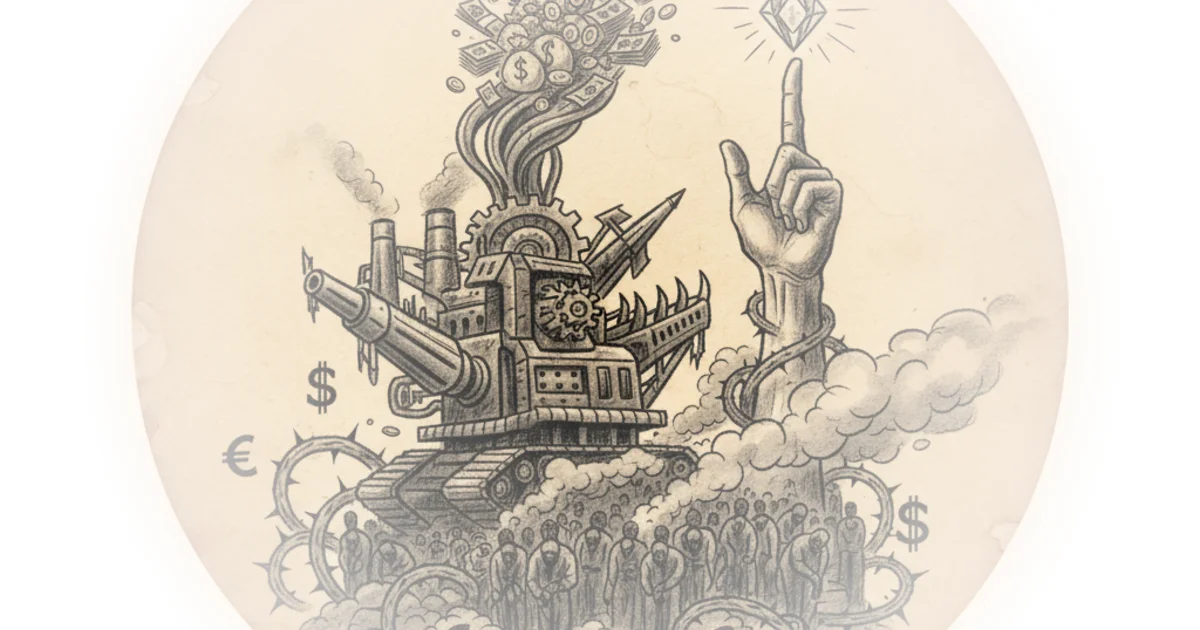
The piece relies heavily on data Legum himself expanded upon, extending a Brown University study by two decades to show a consistent pattern. He notes that "Since 2000, 53% of Pentagon spending has gone to contracts." This statistic is the bedrock of his argument: more than half of the proposed trillion-dollar budget will likely be privatized. The framing is effective because it moves the conversation away from abstract geopolitical strategy to concrete financial flows. By highlighting that over a quarter of these contract dollars go to just four firms—Lockheed Martin, Raytheon, General Dynamics, and Northrop Grumman—Legum illustrates a market that is not competitive but concentrated.
Critics might argue that these companies provide essential national security capabilities that justify their revenue, or that the market for such specialized defense technology is naturally limited. However, Legum counters this by focusing on the financial mechanics of these firms, showing that their reliance on the government is absolute. For Northrop Grumman, 85% of revenue comes from US contracts; for Lockheed Martin, it is 72%. This dependency creates a unique dynamic where the government is not just a customer but a lifeline.
"Taxpayers are subsidizing arms company shareholders."
The Mechanics of Subsidy
The most damning section of the commentary details how these corporations utilize public funds to enrich their owners. Legum reviews ten years of financial filings to reveal a staggering figure: the four major contractors used public funds to cover $103 billion in stock buybacks and dividends. He calculates that "US taxpayers covered two out of every three dollars these companies spent enriching their shareholders."
This is a conservative estimate, as Legum notes, because it excludes foreign sales brokered by the US government. The logic is straightforward: when a company derives the majority of its revenue from the government, and that company spends billions on buybacks, the source of that capital is, in effect, the taxpayer. Legum writes, "In 2024, each spent an average of $4.3 billion on stock buybacks and dividends — well above the S&P 500 average of $3.1 billion." This comparison is crucial; it shows that defense contractors are not merely surviving on government money but are outperforming the broader market in returning value to shareholders, funded entirely by public appropriation.
The human cost of this financial engineering is often overlooked in budget debates. Legum points out that while executive pay soars, "arms industry salaries are declining." The argument here is that the wealth redistribution is not just a transfer from the public to the wealthy, but also a transfer from workers to owners. The working and middle classes bear the brunt of the trade-offs, as social programs are cut to offset the historic levels of military spending. Legum concludes this section with a grim assessment: "This is not a sign of a country on the ascent. Rather, it suggests a state in decline and addicted to war, two traits that often go together."
Class Warfare and Strategic Risk
The final thrust of the piece connects the financial data to a broader social critique. Legum identifies the winners and losers with surgical precision. The winners are the top 1%, who own half of all stocks and mutual funds. The losers are the bottom 50%, who own just 1%. He frames the budget not as a security necessity but as "class warfare," where the state apparatus is used to concentrate wealth.
He also touches on the potential policy outcomes enabled by this spending, including "military occupations of US cities, the resumption of nuclear weapons testing, and rushing toward wars in Mexico, Nigeria, and Venezuela." While these specific policy predictions are speculative, they serve to illustrate the stakes of the budget. The argument is that a budget of this magnitude creates a momentum for conflict, driven by the financial incentives of the contractors who demand it. The underlying message is that the budget itself is a policy choice that prioritizes corporate profit over human security and domestic stability.
Critics might note that the link between stock buybacks and the decision to go to war is indirect, and that geopolitical strategy is driven by complex diplomatic and security factors beyond corporate balance sheets. Legum does not claim a direct causal line for every conflict, but rather argues that the financial structure of the military-industrial complex creates a systemic bias toward conflict and spending that is difficult to reverse.
"Military spending's redistribution of wealth produces few winners and many losers."
Bottom Line
Legum's strongest contribution is the forensic accounting that exposes the trillion-dollar budget as a mechanism for wealth transfer rather than pure defense. His argument is vulnerable only in its reliance on the assumption that the political will exists to redirect these funds, a hurdle that remains immense. The reader should watch for the upcoming congressional vote not just as a budgetary decision, but as a referendum on whether the US will continue to subsidize the enrichment of the top 1% at the expense of its own social fabric.