Art as Life Form: Marguerite Humeau's Ambitious Mythology-Making
French artist Marguerite Humeau does not make art in any conventional sense. At least, that is how she tells it. In a wide-ranging conversation with Louisiana Channel, Humeau describes a practice that reaches far beyond studio walls, pulling together scientists, clairvoyants, Reiki masters, geomancers, and foragers into a sprawling project of world-building. The ambition is staggering. Whether it holds together under scrutiny is another question entirely.
At the core of Humeau's practice is a refusal to treat her sculptures and installations as static objects. She insists they are something closer to living beings:
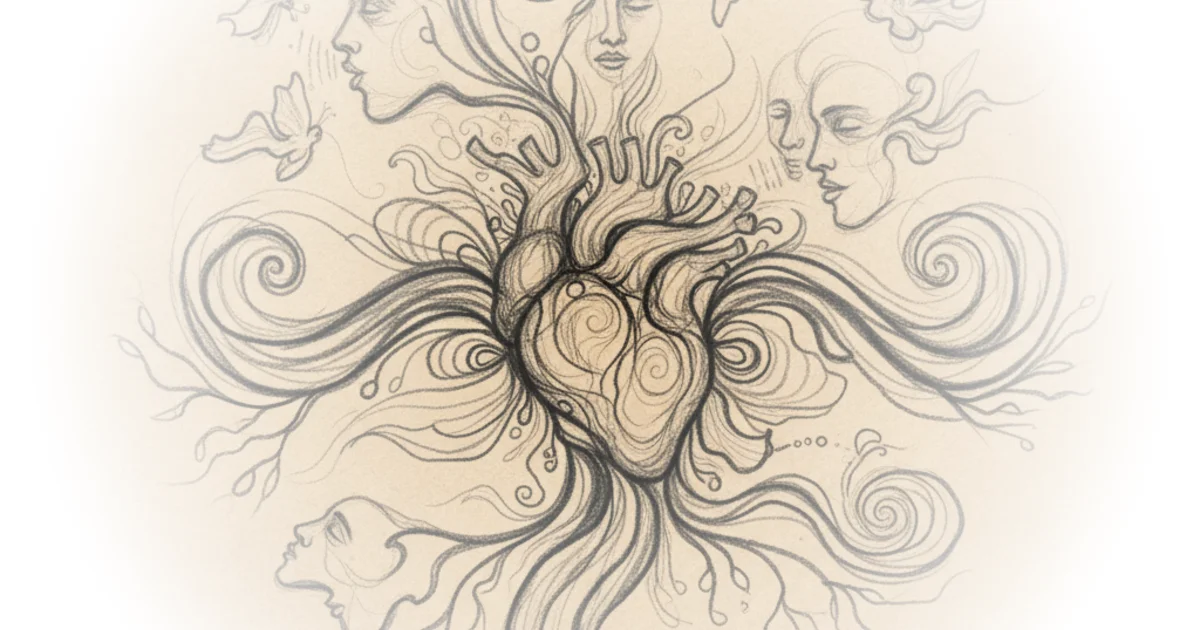
The way I see my artworks is very much from the point of view that I don't see them as artworks. I see them as real life forms that have a voice, they have a pulse, they have maybe a heartbeat, they have a rhythm. So they are very much alive.
This is a bold claim, and one that places Humeau in a lineage of artists who have sought to collapse the boundary between art and life, from Joseph Beuys's social sculpture to Donna Haraway's multispecies worlding. But where those predecessors grounded their work in specific political or philosophical frameworks, Humeau's ambitions are more diffuse. She wants nothing less than to build new mythologies for the contemporary era, complete with mythological creatures, guides, and encounters with spirits.
The Near-Death Catalyst
Humeau traces the origins of her practice to a near-death experience at age twenty-five, which she describes as "the beginning of everything." The experience prompted a cascade of existential questions:
When you come close to death, it makes you reflect on what it means to live, right? What does it mean to exist? What does it mean to exist physically? What does it mean to exist spiritually? Can you exist without a physical body? What happens after you die? What will survive you?
These are not new questions, of course. They have animated philosophy, theology, and art for millennia. What makes Humeau's approach distinctive is her insistence on pursuing them through direct collaboration with holders of non-scientific knowledge, people she describes as possessing expertise "about to go extinct." There is something genuinely compelling about an artist who takes palm readers, herbalists, and crane specialists equally seriously as research partners. It reflects a real intellectual generosity.
But it also raises uncomfortable questions about appropriation and dilution. When a Royal College of Art graduate from the Loire Valley consults with indigenous mythologists in Colorado, who benefits? And does flattening the distinction between peer-reviewed science and clairvoyance serve anyone well, or does it merely aestheticize epistemological pluralism without doing the hard work of understanding why these knowledge systems differ?
Leaving Catholicism, Building Something New
Humeau describes growing up Catholic and gradually finding that the creation stories of the Bible no longer resonated. By fifteen or sixteen, she had stopped practicing. What she wanted was something "more holistic," a narrative framework that could accommodate technological development and scientific understanding while still providing the mythic depth that religion once offered:
I needed to have great narratives that I can connect to. It's just that specific one maybe wasn't enough for me because I was thinking, okay, so how do we explain all the technological development? And so I just really felt I need something more holistic, and I never really found it. So I think naturally I ended up building it for myself.
This is a familiar trajectory for artists of Humeau's generation: the departure from inherited religion, the search for substitute mythologies, the eventual decision to construct them from scratch. It is also a project fraught with risk. Self-made mythologies tend to lack the communal weight and historical testing that give traditional mythologies their power. They can become personal cosmologies dressed up as universal ones.
Termites, Weeds, and the Web of Life
Where Humeau's thinking becomes most interesting is in her attention to overlooked life forms. She has studied termites and so-called weeds, organisms that humans have dismissed as pests or nuisances but that have thrived on Earth for millions of years. Her argument is ecological and ethical: these creatures have something to teach about resilience and sustainability.
We are interconnected with a great web of life and whatever we do it's like being a spider in the spider web. Whenever we move there are many other things that move around us as a result of our own movement. So there is a great responsibility that comes with just existing in the world.
This is not a novel insight within ecological thought, but Humeau articulates it with genuine feeling, and her installations attempt to make it visceral rather than merely intellectual. Her Colorado project, "Horizons," placed wind-activated divination instruments and large bird sculptures in the San Luis Valley, a region experiencing megadrought. Visitors were invited to lie on the wings of the sculpted birds, an act of physical surrender meant to prompt reflection on humanity's place within the broader fabric of life.
The installation sounds poetic in description. Whether it achieves its ambitious goals of "healing" or "setting free spirits" in practice is harder to assess without experiencing it directly. There is always a tension in environmental art between the sincerity of the ecological message and the carbon footprint of fabricating and shipping large-scale sculptures to remote locations.
Cities as Fungus
One of Humeau's most striking observations concerns urban environments. Living by the Thames and attuned to its tidal rhythms, she rejects the conventional division between city and wilderness. Viewed from satellite imagery, she argues, cities resemble mold or fungal growth, organic formations generated by living beings:
When you look at Google in certain parts of the world you can see that cities, they look like mold a bit. And then if you zoom out even more you start to see all the connections between the different cities and it really does look like a fungus that's been growing on Earth.
This is a genuinely provocative reframing. Rather than treating urbanization as something opposed to nature, Humeau sees it as a specific form of growth, one generated by humans but continuous with other biological processes. The problem, she argues, is not that cities exist but that they grow unsustainably. The challenge is to transform them from within, thinking of buildings as crystal formations that could be reorganized along more sustainable lines.
It is a seductive metaphor, though it risks obscuring the political and economic forces that actually shape urban development. Cities do not grow like fungus; they grow according to zoning laws, capital flows, colonial legacies, and infrastructure investments. Treating urbanization as a purely biological phenomenon can inadvertently naturalize deeply political processes.
The Interdisciplinary Question
Humeau's training at the Royal College of Art's Design Interactions program, where she graduated in 2011, clearly shaped her boundary-crossing approach. The program emphasized content over medium and exposed students to researchers in nanotechnology, biotechnology, and artificial intelligence. Humeau describes it as liberating, a space where the form of the work, whether film, sculpture, performance, or design object, was subordinate to the ideas driving it.
This interdisciplinary freedom is both Humeau's greatest strength and her most significant vulnerability. At its best, it produces work that genuinely bridges art and science, offering audiences encounters with deep time, ecological interconnection, and non-human intelligence that they would not find in a gallery of conventional paintings. At its worst, it produces a kind of conceptual tourism, where complex knowledge systems are sampled and aestheticized without the depth that specialists would bring.
Humeau herself seems aware of this tension. She speaks of wanting to be "in the center of the crisis," not observing from a distance. Whether her installations achieve that proximity or merely represent it is a question each viewer will answer differently.
Bottom Line
Marguerite Humeau is attempting something genuinely difficult: to create a new mythological framework adequate to the ecological and existential crises of the present moment. Her willingness to draw on diverse knowledge traditions, her attention to overlooked life forms, and her insistence on physical, embodied encounters with art all point to a serious and searching practice. The risks are real, that the mythologies remain personal rather than communal, that interdisciplinary breadth substitutes for depth, that ecological sincerity sits uneasily alongside the material realities of large-scale art production. But the ambition itself is worth taking seriously. In a moment when inherited narratives are failing and new ones are desperately needed, Humeau is at least asking the right questions, even if the answers remain, by her own admission, a life's work in progress.