John Campbell, a physician and author with decades of experience in public health, delivers a scathing indictment of modern British institutions, arguing that the nation has abandoned the very principles of science and democracy that once defined it. He does not merely critique policy failures; he presents a disturbing statistical anomaly regarding civil liberties and a radical hypothesis about the collapse of professional expertise in favor of bureaucratic management. For the busy professional seeking to understand the disconnect between official narratives and ground-level reality, Campbell's synthesis of medical history, legal analysis, and intelligence reports offers a provocative, if polarizing, roadmap of a society in freefall.
The Myth of Management and the Death of Dissent
Campbell anchors his argument in the transformation of the National Health Service (NHS), tracing a shift from clinical leadership to what he terms a "managerial process." He contends that this shift is not an improvement but a fundamental error in logic. "The managerial process, of course, is a myth," Campbell asserts, noting that in a field requiring deep expertise, delegation often leads to incompetence rather than efficiency. He argues that the system now prioritizes administrative rituals over the practical knowledge of doctors, a move that has eroded the quality of care and the integrity of the institution.
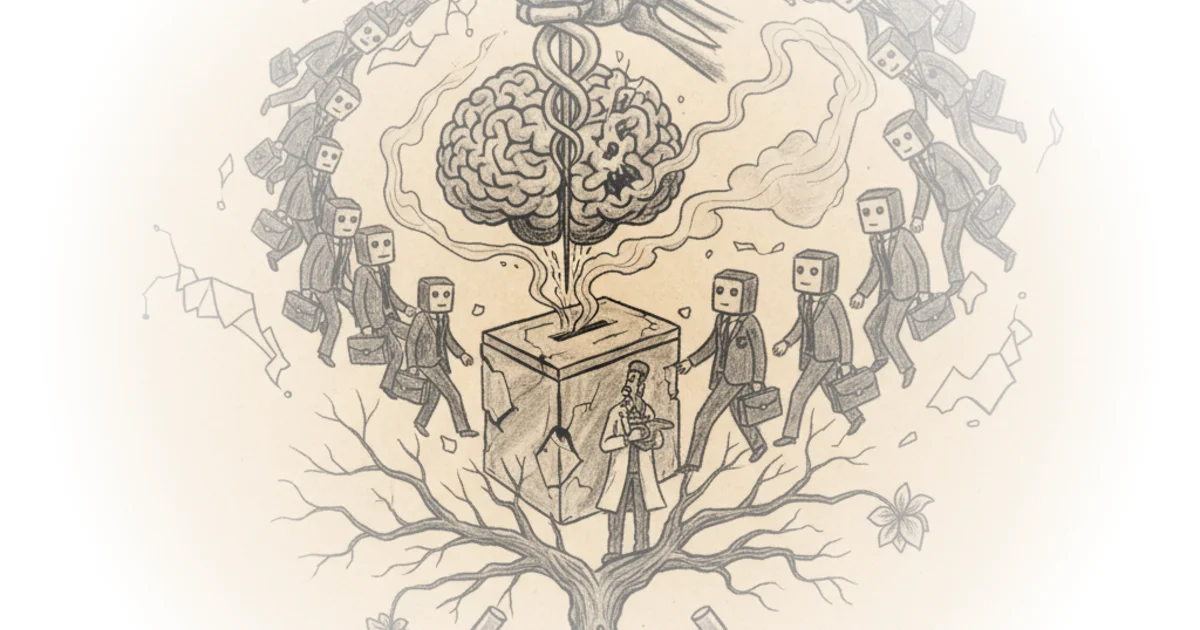
This critique extends beyond healthcare into the broader suppression of scientific discourse. Campbell observes that society is no longer evaluating evidence but is instead being told what science must be. "We're not allowed to have the dissent and discussion," he laments, suggesting that the scientific method has been replaced by a rigid orthodoxy. The stakes, he implies, are existential: when experts are silenced, the feedback loops necessary for correcting course are severed. Critics might note that Campbell's definition of "dissent" sometimes blurs the line between legitimate scientific debate and the spread of misinformation, a distinction that is crucial in public health crises. However, his core point remains potent: a system that punishes questioning cannot claim to be scientific.
"We're no longer looking at science in the way we used to. We're being told what science should be rather than being allowed to express our opinions."
A Lawfare State and the Erosion of Rights
The most startling data Campbell presents concerns the scale of arrests for social media activity. He contrasts the United Kingdom with Russia, highlighting a bizarre inversion of authoritarian metrics. "In Russia there's about 400 arrests a year for social media posts," Campbell notes, "In the UK I think it's around about 12,000 a year." He uses this comparison to illustrate a creeping authoritarianism where the state criminalizes speech that is merely "annoying" rather than genuinely harmful. This surge in arrests, he argues, has created a backlog that threatens the judicial system itself, leading to proposals to abolish jury service—a right he traces back to Magna Carta.
Campbell connects this legal overreach to a broader cultural shift where human rights are discussed but not practiced. He points to the abandonment of "stop and search" policies as a prime example of prioritizing perceived fairness over public safety. "It strikes me that what you're saying is that we don't really care about human rights," he suggests, arguing that the outcry against police powers allowed dangerous behavior to flourish. The result, he claims, is a "lawfare type society" where the law is used as a weapon against the populace rather than a shield. This framing is effective in highlighting the unintended consequences of policy, though it risks oversimplifying the complex trade-offs between civil liberties and security that democracies constantly navigate.
The Failure of Expertise and the Inquiry Industrial Complex
Turning to the pandemic, Campbell delivers a harsh verdict on the UK's response, distinguishing between effective quarantine and ineffective lockdowns. "Lockdowns don't work," he states bluntly, arguing that the strategy was never proven and that China's success came from quarantining specific areas, not locking down entire populations. He contrasts the UK's chaotic inquiry process with the efficiency of US congressional hearings. "If I as a doctor... were asked to do an inquiry into the law, I'm afraid we would be SH1T," he jokes, before turning serious: "And yet we have lawyers doing an inquiry into medicine."
He reveals that despite having access to intelligence suggesting the virus was engineered, the UK inquiry ignored this evidence. "Sir Richard Dearlove... said it is now beyond reasonable doubt that COVID was engineered in Wuhan," Campbell reports, noting that this intelligence was completely disregarded. The inquiry, he argues, was a costly farce that excluded practicing doctors and scientists while spending nearly £300 million. "They weren't allowing questions," he adds, painting a picture of a process designed to confirm a narrative rather than discover the truth. This section is the most damning, as it combines specific financial figures with the testimony of former intelligence heads to question the very legitimacy of the state's response.
"We've spent nearly £300 million on that already... And yet we have lawyers doing an inquiry into medicine without any doctors on the panel."
Bottom Line
John Campbell's argument is strongest in its relentless focus on the disconnect between professional expertise and bureaucratic power, using the UK's pandemic response and legal system as case studies for a broader democratic decay. His evidence regarding the scale of arrests and the exclusion of medical experts from inquiries is compelling, even if his dismissal of all lockdown measures and his interpretation of civil liberty trends are contested by mainstream authorities. The reader is left with a stark warning: when a society stops listening to its experts and starts punishing its dissenters, the foundations of both science and democracy begin to crumble.