Then & Now delivers a startling diagnosis: the modern crisis isn't just about substances, but about an entire economic system engineered to hijack our evolutionary wiring. The piece argues that we have shifted from a world defined by scarcity to one of overwhelming abundance, creating a post-modern epidemic where the very technologies designed to connect us are chemically rewiring our brains for compulsion. This is not a moral panic about screen time; it is a structural analysis of how profit models now depend on the systematic exploitation of human dopamine pathways.
The Shift from Scarcity to Excess
The core of the argument rests on a historical pivot. Then & Now writes, "The modern world... was an attempt in many ways to fix a pre-modern problem scarcity... what happens when for some of us the problem of scarcity is overcome the modern problem of overcoming scarcity turns on its head and becomes a post-modern problem that of abundance and excess." This reframing is crucial. It suggests that our ancient brains, evolved for the savannah where food and safety were rare, are now drowning in a sea of hyper-stimuli. The author effectively connects the dots between our biological history and our current psychological distress, noting that "post-modern life is a constant fight against the ghosts of that wiring."
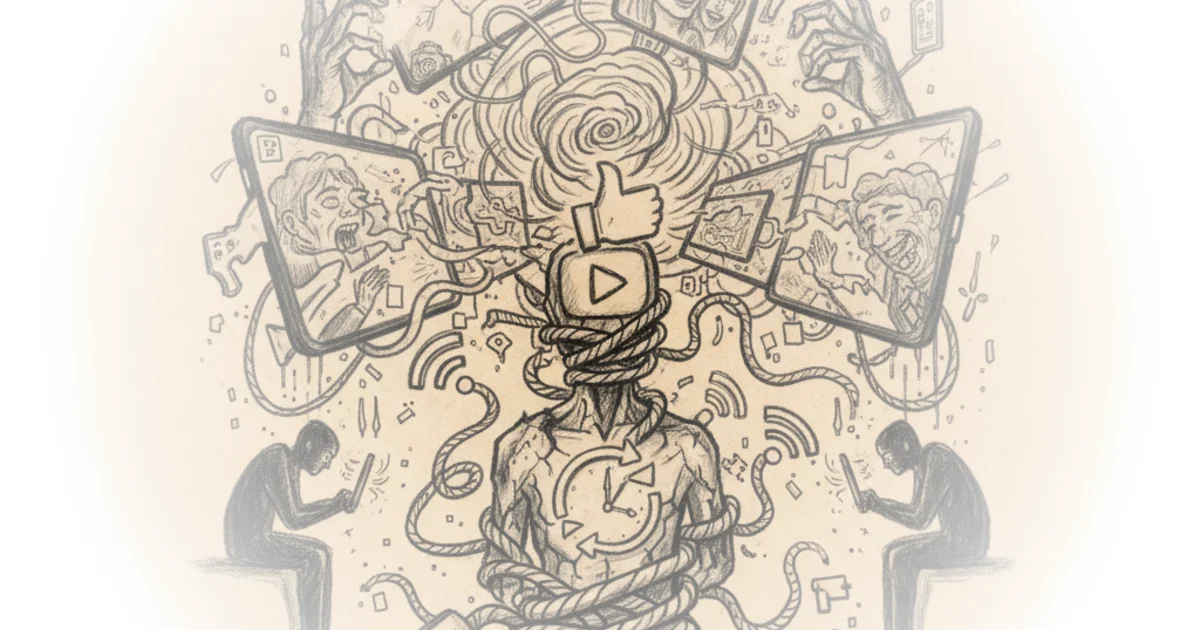
The piece marshals staggering statistics to prove this isn't just a feeling but a measurable crisis. Drug overdoses have tripled since 1990, and one in ten Americans may qualify for social media addiction. But the most compelling data point comes from neuroscience. Then & Now observes that "Studies have shown that substance addictions to nicotine say and behavioral addictions to phones say indistinguishable in brain scans." This biological equivalence dismantles the common defense that "it's just a game" or "it's just scrolling." If the brain reacts to a slot machine and a World of Warcraft quest with identical dopamine spikes, the distinction between chemical and behavioral addiction collapses.
We've built civilizations on the pursuit of dopamine, the most important neurotransmitter in our brain, the feel-good chemical, the reward molecule.
Limbic Capitalism and the Mathematization of Desire
The article introduces a powerful concept to explain why this is happening: "limbic capitalism." Then & Now defines this as "a technologically advanced way of doing business that encourages excessive compulsion and addiction targeting of the limbic system." This is the piece's strongest analytical contribution. It moves beyond blaming individual willpower to indict the business models of major corporations. The author argues that just as casinos used mathematics to professionalize gambling in the 17th century, today's tech giants use algorithms to predict and manipulate user behavior with scientific precision.
The commentary highlights that these systems are not accidental; they are designed. "Big Tech Giants work on the probabilities of you opening an app at a certain time of day," the author notes, drawing a direct line from Gilamo Cadano's probability lists to modern engagement metrics. The system is optimized for the most vulnerable. Then & Now points out a brutal economic reality: "eighty percent of alcohol sales go to 20 of the heaviest users... in social media use the top one percent of users create the majority of content." The business model relies on a small minority of users who have lost control, turning their vulnerability into predictable profit.
Critics might argue that this framing strips individuals of agency, suggesting we are helpless victims of algorithms rather than active participants in our own attention economy. However, the author counters this by emphasizing the sheer ubiquity of the hooks: "cues the expectation of reward or hooks are Central to a post-modern addictions." The environment itself has been weaponized against our ability to resist.
The Siren Song of the Notification
The piece uses the myth of Odysseus to illustrate the modern condition. Just as the sailors had to tie Odysseus to the mast to resist the Sirens, we are constantly bombarded by "digital drugs that are likable clickable repeatable." Then & Now writes, "The key to the attention economy... is to dangle digital drugs that are likable clickable repeatable that entice persuade and cajole us." This metaphor lands hard because it explains the feeling of losing control. We check our email 36 times an hour not because we need to, but because the red notification badge triggers a primal "fight or flight" response.
The author notes that this competition for attention forces a race to the bottom. "Under competition the race will naturally run to the bottom attention will almost invariably gravitate towards the more garish lurid outrageous alternative." This explains why our feeds are increasingly filled with outrage and sensationalism; calm, reasoned discourse simply cannot compete with the dopamine hit of a shocking headline. As the author puts it, "Aldous Huxley... wrote that the development of a vast mass communications industry... failed to take into account man's almost infinite appetite for distractions."
We've become addicted to inbox zero to running streaks on our sports watches to a Duolingo streaks to posting once a day to beating a high score.
Bottom Line
Then & Now's most vital contribution is identifying "limbic capitalism" as the engine driving the addiction epidemic, shifting the blame from individual weakness to systemic design. The argument is strongest in its biological evidence showing that behavioral and substance addictions are neurologically identical. Its biggest vulnerability lies in the difficulty of regulating these systems without stifling innovation, a tension the piece acknowledges but does not fully resolve. Readers should watch for how policymakers begin to address the "mathematization of desire" in the coming years, as the current trajectory suggests a future where human attention is the only resource left to extract.