Razib Khan opens a window into deep time, arguing that while human languages and empires are fleeting, the genetic code offers an unbroken thread connecting us to the very dawn of civilization. This piece is notable not just for its historical sweep, but for its specific focus on a newly sequenced genome from the dawn of the Old Kingdom, a discovery that challenges long-held assumptions about the origins of the modern Egyptian people.
The Universal Code vs. The Fractured Past
Khan begins by contrasting the stability of biology with the volatility of human culture. He writes, "For billions of years, life's replenishment has proceeded with a certain leaden regularity... the mechanisms fine-tuned to roll out generation upon generation of progeny trundle on, unmoved by fad or fashion." This framing is effective because it establishes DNA as the ultimate historical record, one that does not suffer from the translation errors or lost manuscripts that plague our understanding of ancient history. He notes that while languages "blink out of existence incessantly," the genetic code remains a "wonder of clockwork reliability."
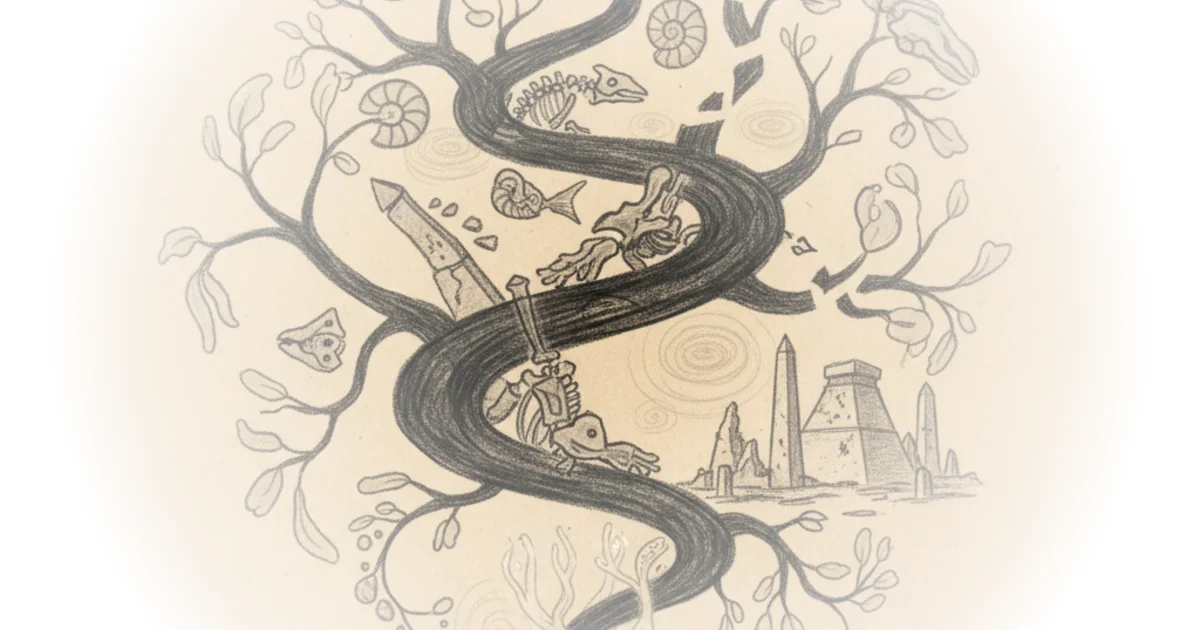
The author uses this biological permanence to set up the central mystery: if the code is unchanging, why does the cultural record of Egypt seem so discontinuous? He points out that while the West views Egypt as the "root of the tree that eventually became civilization," the people themselves underwent a radical cultural transformation. "Memes are not as stubborn as genes," Khan observes, highlighting how a population can adopt a new religion and language while retaining their ancestral biology. This distinction is crucial; it separates the idea of a 'people' from the idea of a 'culture,' suggesting that the modern Egyptian identity is a cultural overlay on a deeply ancient genetic substrate.
Memes are not as stubborn as genes. Just as a people can accept Islam, so can they abandon their old languages for the new.
Critics might argue that this biological determinism risks oversimplifying the complex social realities of identity, where language and religion often define belonging more than genetics. However, Khan's point is strictly about demographic continuity, not cultural erasure. He acknowledges that the "indigenous Egyptian language persisted even longer" than the religion, surviving into the 20th century as Coptic, yet the genetic story remains distinct from the linguistic one.
The Nuwayrat Man and the Dawn of History
The core of the article hinges on a specific scientific breakthrough: the sequencing of a genome from a man who lived approximately 4,500 years ago. Khan describes this individual, dubbed NUE001, as a "clear window onto Egypt's genetic and demographic landscape at the very beginning of history." The sample comes from a man buried at Nuwayrat, likely a potter who achieved high social status, whose remains date to the transition between the early-dynastic period and the Old Kingdom.
Khan explains that previous studies were limited to samples from the twilight of the dynastic era, a time when Egypt was already heavily influenced by foreign powers. "A major lacuna in this work is that the oldest whole genomes... date to the 8th century BC," he writes, noting that these later samples reflected a civilization already under pressure from Libya, Nubia, and the Levant. The new sample, however, predates these influxes, allowing researchers to see the "foundation of the polity" before it was altered by centuries of conquest.
The analysis reveals that this ancient man had parents with predominantly North African ancestry, with only minor ties to West Asia. This finding directly addresses a persistent historical debate. Khan writes, "It is notable here that Arabians and modern Levantines remain distinct from modern Egyptians, refuting the notion that Arabic-speaking Egyptian Muslims descended from newcomers from the east." This is a powerful corrective to the idea that the Arab conquest of the 7th century involved a massive replacement of the local population. Instead, the data suggests the conquest was primarily a cultural and political shift.
The genome of a single anonymous Egyptian man who lived and died some 5,000 years ago plainly shows us how genetically like their storied Old Kingdom ancestors Egyptian citizens remain today.
The Shift in the Modern Landscape
While the ancient genome shows strong continuity with the Old Kingdom, Khan does not ignore the changes that have occurred over the last four millennia. He details how modern Egyptians show a "shift" toward Sub-Saharan African ancestry, likely due to the Islamic slave trade, as well as genetic influxes from the Pontic Steppe, possibly from Mameluke slaves. The author notes that "modern Egyptians have Sub-Saharan African ancestry, both Nilotic ancestry, with a presumably Nubian provenance, and Bantu-like heritage reflecting the wide reach of the Islamic slave trade."
This section is vital because it prevents the argument from becoming a simplistic tale of pure continuity. The genetic makeup of Egypt has evolved, but the core North African component remains dominant. Khan argues that the "predominance of the khaki-toned North African cluster" in modern samples, even if reduced, proves that the Arabization of Egypt was not a demographic replacement. The "magnetic attraction" of Egyptian monuments and symbols, he suggests, is rooted in this deep, unbroken biological lineage that spans from the builders of the pyramids to the citizens of today.
Bottom Line
Razib Khan's strongest argument is the demonstration that cultural transformation—specifically the shift to Arabic and Islam—did not require a wholesale replacement of the Egyptian people. The evidence from the Nuwayrat genome effectively dismantles the myth that modern Egyptians are merely descendants of Arab conquerors. However, the piece's greatest vulnerability lies in its reliance on a single ancient sample; while statistically robust, a larger dataset from the same era would provide even greater certainty. Readers should watch for future studies that expand this genetic timeline, which will likely continue to refine our understanding of how the Nile Valley's population has shifted and persisted over the last five millennia.